

New flagship for Greenpeace, design: Dykstra Naval Architects
Dykstra proudly reports that the design firm has designed Greenpeace’s new flagship.
It will be a next-generation ship designed to significantly reduce emissions and eventually move to completely fossil-free sailing. The ship, currently under construction at Freire Shipyards in Vigo, Spain, is scheduled to enter service in 2027. It combines state-of-the-art sail propulsion with advanced on-board energy systems.
The sail drive is provided by the Dynarig system supplied by Southern Spars, a proven technology previously installed on 𝙈𝙖𝙡𝙩𝙚𝙨𝙚 𝙁𝙖𝙡𝙘𝙤𝙣 and 𝘽𝙡𝙖𝙘𝙠 𝙋𝙚𝙖𝙧𝙡. The rig incorporates advanced composite structures and automation tailored to continuous commercial marine operations. The sail area is 1746 m2.
Power generation
The vessel will also generate electricity while sailing via two variable pitch propellers coupled to two generators. For electricity generation, the ship will have four dual-fuel generators and four proton exchange membrane (PEM) fuel cells. The generators are designed to run on methanol, while the fuel cells will use hydrogen. Hydrogen that will be stored below deck in 72 tanks at a pressure of 250 bar. Solar panels on the bridge will provide an additional energy source.
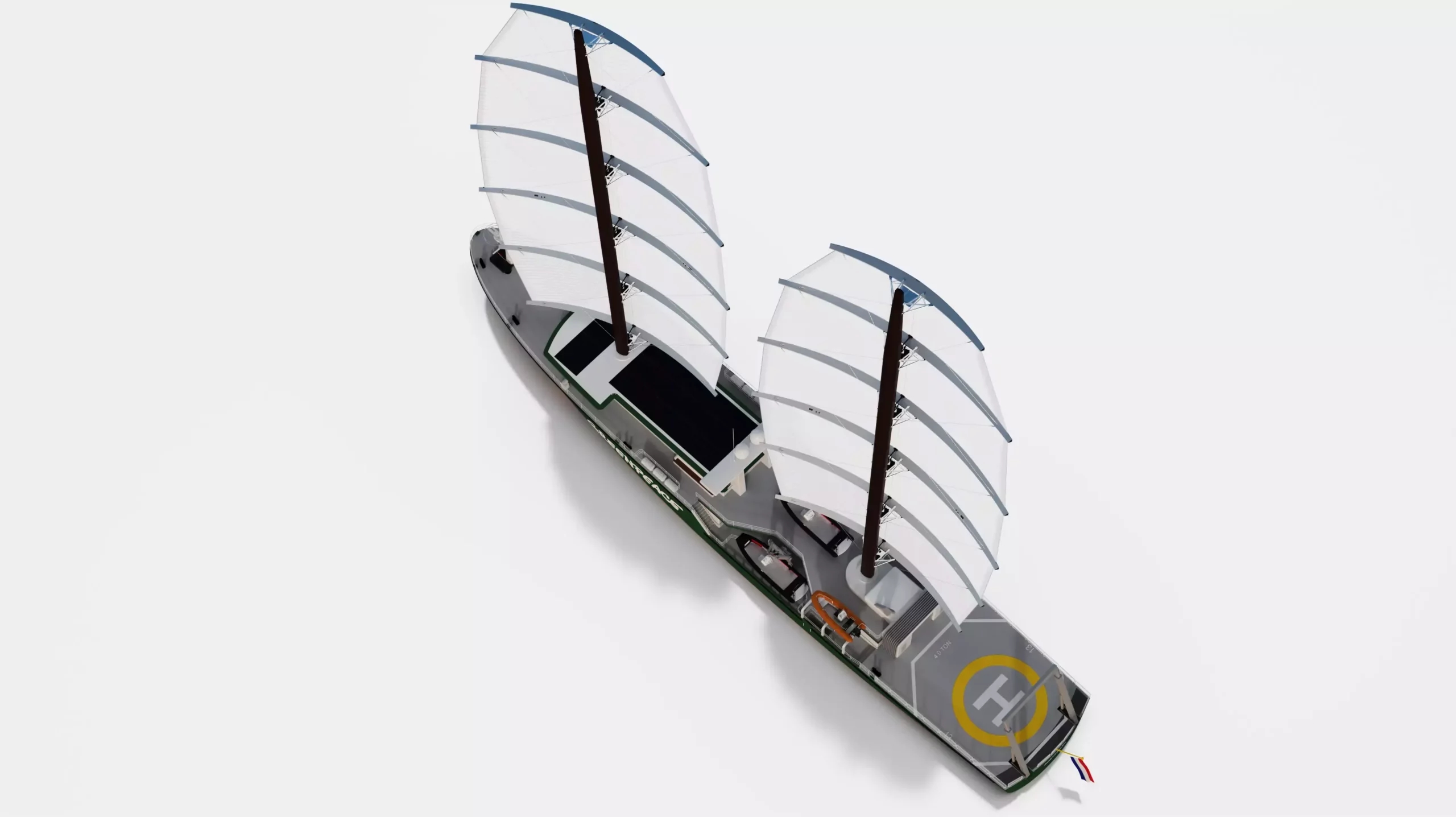 By using wind as the primary source of propulsion, combined with battery systems, alternative fuels and on-board renewable energy generation, the vessel is designed to operate with a significantly reduced carbon footprint, while being able to maintain a constant cruising speed. On board are diesel, methanol and hydrogen. Two electric motors are provided, both of 900 kW. The vessel is designed for arctic seas and is designed to support global scientific research, studies and environmental campaigns, and will also be suitable for polar operations and advanced scientific missions.
Pioneering example
The design office says: “The project demonstrates what can be achieved when wind propulsion, advanced engineering and complementary alternative energy systems are integrated from the outset, providing a pioneering example of low-emission commercial shipping using technology available today.”
The details:
LOA: 74.95 m
Beam 13.35 m
Draught 5,50 m
Crew: 38 heads
Source and image: Source : Dykstra Naval Architects and Freire Shipyard

Windassist sponsor