

The magnetic North Pole on the move
Several -not nautical- media reported that the magnetic north pole is shifting.
And in addition, worrying reports appeared that the magnetic pole could suddenly be at the South Pole. What does this mean for the navigators among us?
Anyone with a little education in navigation knows that in order to make a course to steer, calculations have to be made; drift, tide, deviation and also magnetic variation. The latter depends on where you are on the earth.
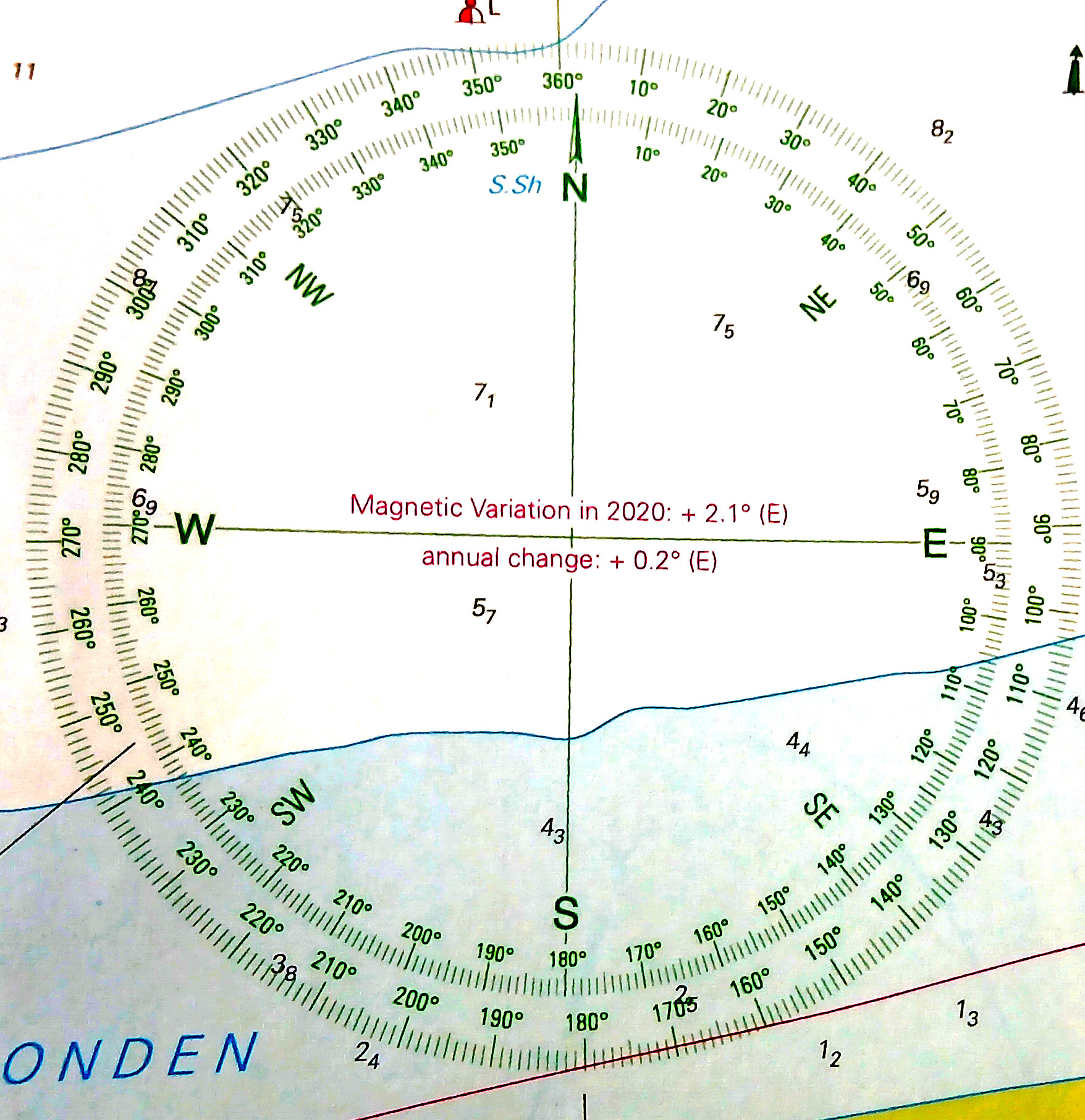 And in recent decades, we in Western Europe were a bit lazy: the magnetic variation was very small. In 2020, it was +2.1 degree east. Every sea chart gives, often by the compass rose, the variation for the area of that chart.
The magnetic pole is shifting
It is a fact: the magnetic north pole has shifted from Canada to Siberia. This pole is constantly moving, but in recent years it has been moving a bit faster than normal and this does indeed affect navigation. Just the theory; Magnetic north is the point in the north of the earth where the magnetic field points vertically downwards. This is the point to which the compass points and therefore not to the true geographic north pole. Because the magnetic and true north poles in Western Europe have been almost aligned in recent years, the variation was very small in our case, but as much as 14 degrees on the US west coast, for example.
Recent years are different
Historical data show that around the 20th century the North Pole moved at ±10-15 km per year, but around 2000-2020 distances of ±50-60 km per year have been measured.
That the magnetic North Pole is moving is nothing new. However, the fact that it is moving faster in recent years is unusual. It is moving so fast that researchers had to revise the “World Magnetic Model” (WMM) one year early. This is normally done every five years, but because of the rapid change, they published the new WMM already this year. Why it is so fast now, the researchers do not know exactly. The magnetic north pole has, for the first time since measurements began in 1590, passed the Greenwich meridian. So we are now looking at a western variation.
Pole switch
Over long periods of time (tens of thousands to millions of years), the Earth’s magnetic poles switch places during so-called geomagnetic reversals. This is something that has occurred frequently in geological history (at least hundreds of times over the past tens of millions of years). These reversals take a long time; thousands of years. The current field has also weakened and strengthened in the past without reversing. There is no evidence that we are indeed currently entering a reversal, despite some models showing that the field is weakening in certain areas. So it is a phenomenon that scientists study, but misleading claims (such as “flipping within a few years”) are not supported by reliable evidence. Polarisation, climate or catastrophe theories linking this to immediate disasters have no scientific basis.
The navigator
Those who go from a chart course to a magnetic course ‘by the book’ have nothing to fear. The hydrographic service provides all the information on the recent sea chart. But, those who only blindly rely on digital navigational aids have to wait and see if the creator of all that beauty has kept up with the changes. In that case, it helps if you have a paper chart on board to compare the variations between ‘analogue’ and ‘digital’.
Source: own news gathering.

Windassist sponsor