

Grain de Sail II launched
French shipping company Grain de Sail has expanded its fleet of sailing cargo ships with the recent acquisition of a new vessel, delivered by Piriou shipyard in Vietnam. It was recently commissioned.
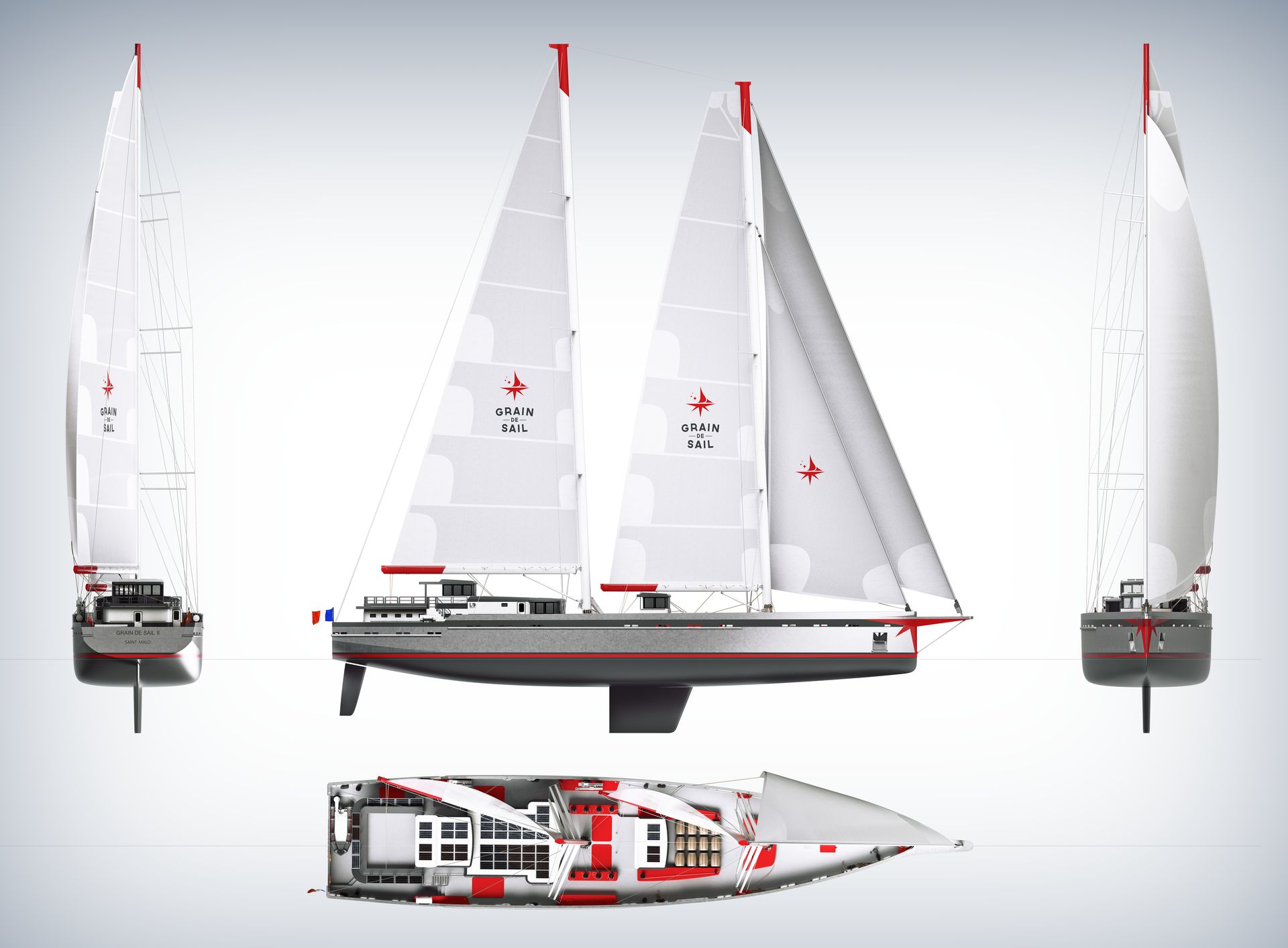
“It is a pure schooner-type sailing vessel that can carry up to 350 tonnes of palletised cargo, with a gross tonnage of about 500 and a crew of six to nine people,” Grain de Sail told Baird Maritime. “We also wanted a vessel with its own cranes and a dual steering station, with one aft behind the main mast for general navigation and one directly behind the foremast for manoeuvring, as this would provide a better view of operations and an optimal position for communication with sailors.”
2.5 m² of sail per tonne
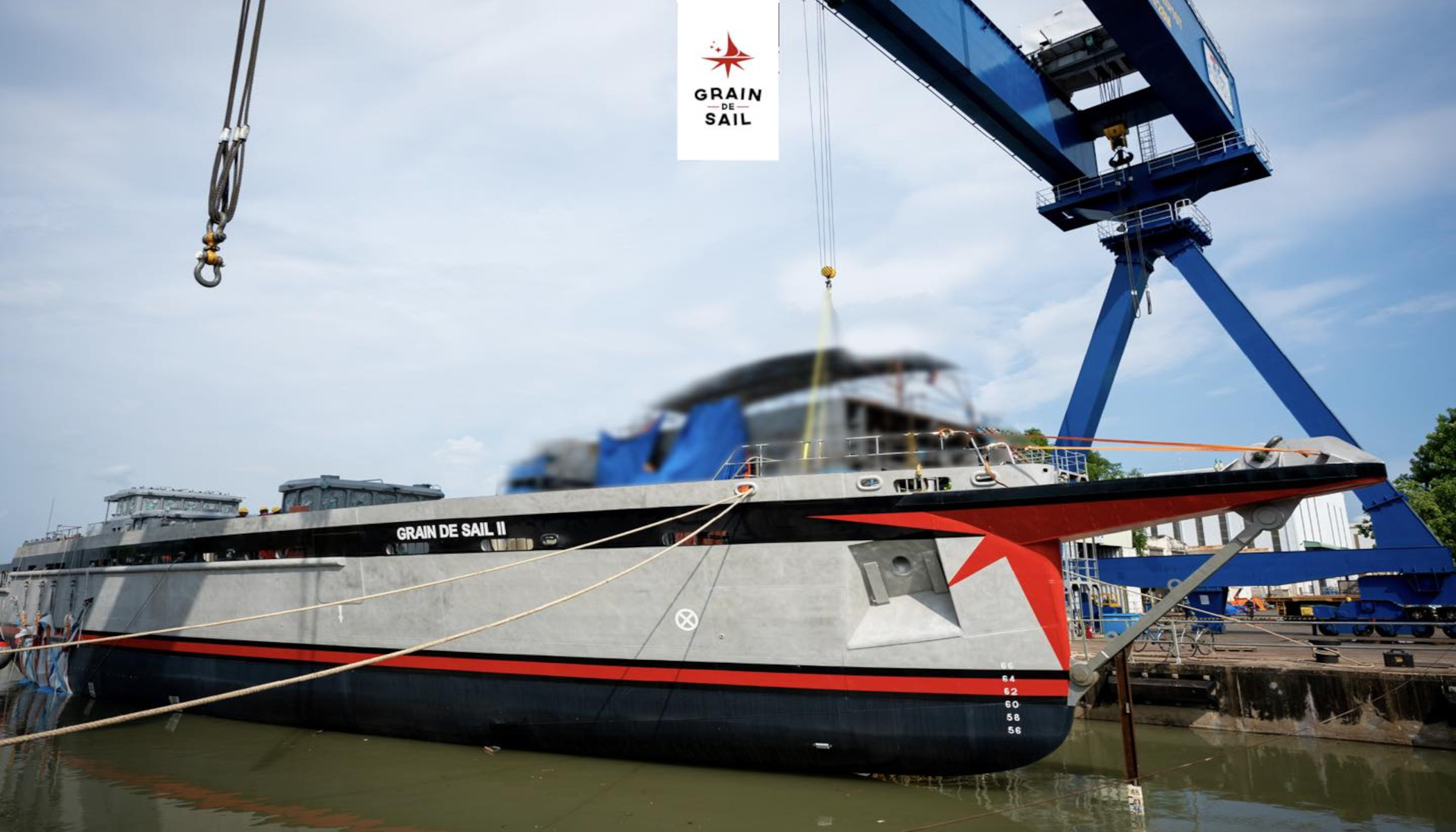 The new building has a length of 52 metres (170 feet), a width of 10.7 metres (32 feet), a maximum draft of six metres (17 feet) and two carbon fibre masts supporting sails with a total area of 1,500 square metres. Cargo is kept in separate holds spread over two decks. The upper deck has space for 24 barrels to store liquid cargo as an alternative to liquid bulk tanks. Aluminium was chosen for the ship’s construction because it is lightweight, durable and recyclable. The hull length of 52 metres allows the vessel to reach secondary ports and marinas, avoiding overloaded water. The large total sail area means Grain de Sail II will be efficient even in low winds. The cabins can accommodate up to nine crew members.
The rig has been developed to result in a sail-to-water displacement ratio of 2.5 square metres of sail per tonne. This ratio means the ship can reach speeds of up to 12 knots while reducing CO2 emissions by more than 90 per cent compared to a conventional ship on an equivalent voyage. The main aim of navigating without engine assistance is to reduce the impact on the environment. A series of tests conducted under different weather conditions and with different sail plan configurations confirmed that the hull, combined with the schooner rig, is more efficient than expected in speed with optimal balance under sail.
Cyclone-proof
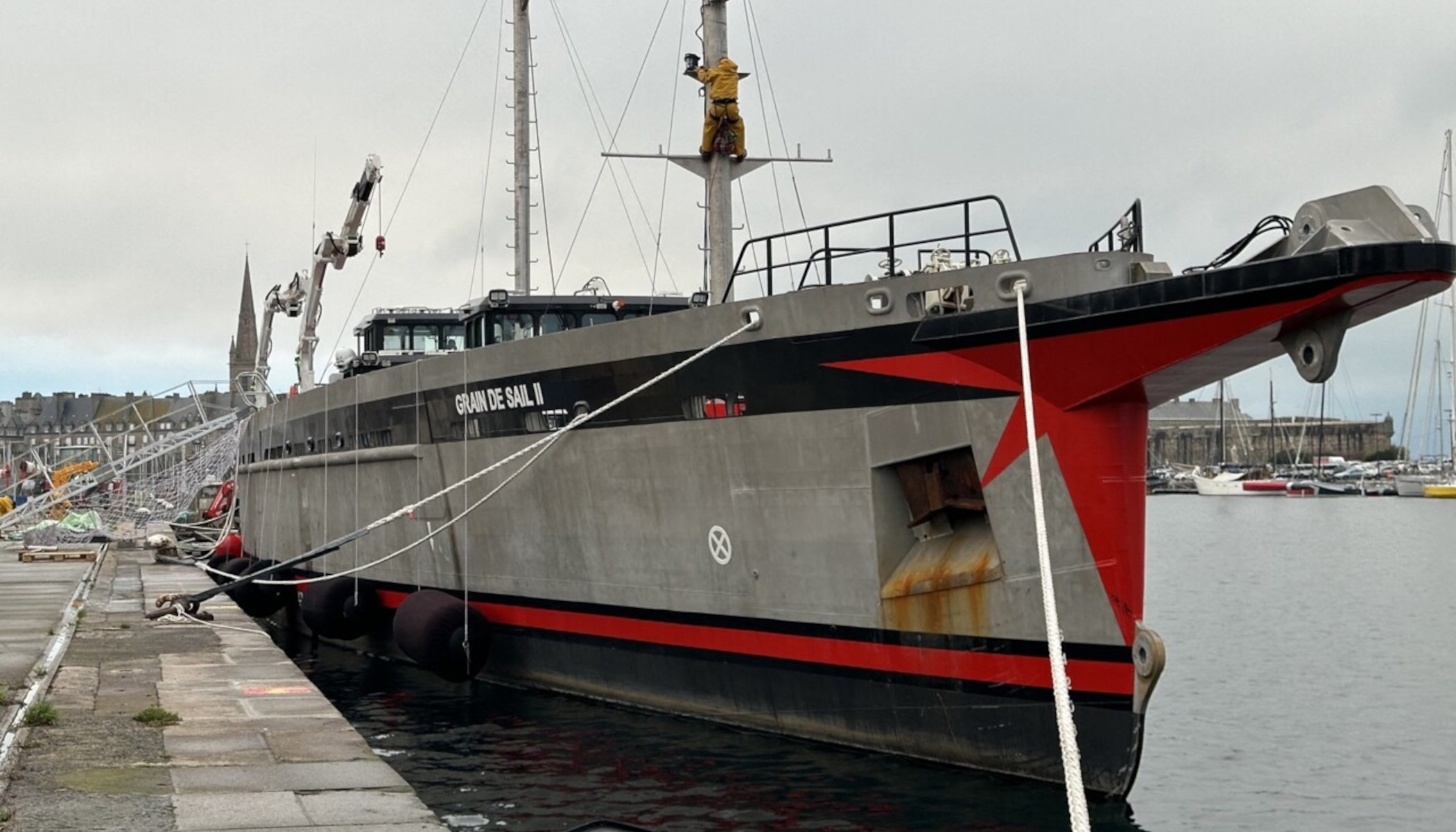 The vessel is designed to withstand cyclones, ensuring safe use in the Atlantic in all seasons. The vessel meets the owner’s need for a larger carrying capacity. Grain de Sail wanted a larger version of its first ship, Grain de Sail I, the first modern cargo sailing vessel that met international maritime shipping standards. The experience gained from navigating that 24-metre-long ship with a cargo capacity of 50 tonnes was used to improve the design of the new vessel and increase its size.
“We are interested in reducing the carbon footprint of maritime cargo shipping, which is why we designed purely sailing cargo ships. However, we also take into account the ship’s hotel load and find ways to reduce energy consumption on board and integrate renewable energy sources and low-carbon solutions.”
Grain de Sail noted that one of the first steps is to ‘over-insulate’ the ship to reduce temperature fluctuations and the need for heating or cooling. There are also enclosed power generation/regeneration systems including thermodynamic dual-flow ventilation.
“We estimate cruising speeds of about 11 to 12 knots, so we will probably produce between 30 and 40 kW (40 and 53 hp). We also have electric battery packs to store and possibly use energy. For air and water heating, we have also installed the first biomass boiler installed on a commercial merchant ship, providing a low-carbon solution.”
Engine only for manoeuvring
“She is capable of crossing the Atlantic from France to the east coast of the US in about two weeks, using only wind,” says Loys LeClerq, naval architect at L20Naval. The ship’s power consumption is further supported by solar panels and hydrogenerators specially designed for the ship. Output power is 10 kW at nine knots and 20 kW at 12 knots. A 480 kW (650 hp) diesel engine will be used for manoeuvring in port, along with a bow thruster at the front for better handling. However, when fully loaded, the vessel’s displacement can reach 600 tonnes, making the diesel engine less suitable for propulsion on the high seas.
“For safety reasons, we only carry fuel good for up to two or three days of sailing,” says Grain de Sail. “Over long distances, we navigate with or without wind.”
Viable modern solution for long distances
“To meet the pure need for sail cargo,” added LeClerq, “we had to optimise everything without using expensive solutions. Everything has to be optimised and simplified.”
LeClerq noted that Grain de Sail II was L20Naval’s first sailing ship project, and the resulting design work provided a learning experience for the company.
“From the moment we founded the company, our goal has always been to reduce the environmental impact of maritime activities. We learned that sails are the most effective solution in this respect and since then we have been working almost exclusively on passenger and cargo sailing vessels.”
Four voyages a year
 Grain de Sail II will travel the transatlantic route from its home port of St Malo to the United States to carry wines and other products. For each return trip, the ship will sail from Latin America to France with a cargo consisting of raw materials that will be processed at Grain de Sail’s facilities in Morlaix. The Atlantic crossing is estimated to take around two weeks, depending on route choices and wind conditions, and the company expects to make up to four return trips per year.
“We are unique in that we are fully integrated,” Grain de Sail told Baird Maritime. “We are a shipping company with a maritime business, but we are also a land company with our own factories to produce chocolate and coffee, which is then sold and distributed by us under the Grain de Sail brand.”
Coastal transport
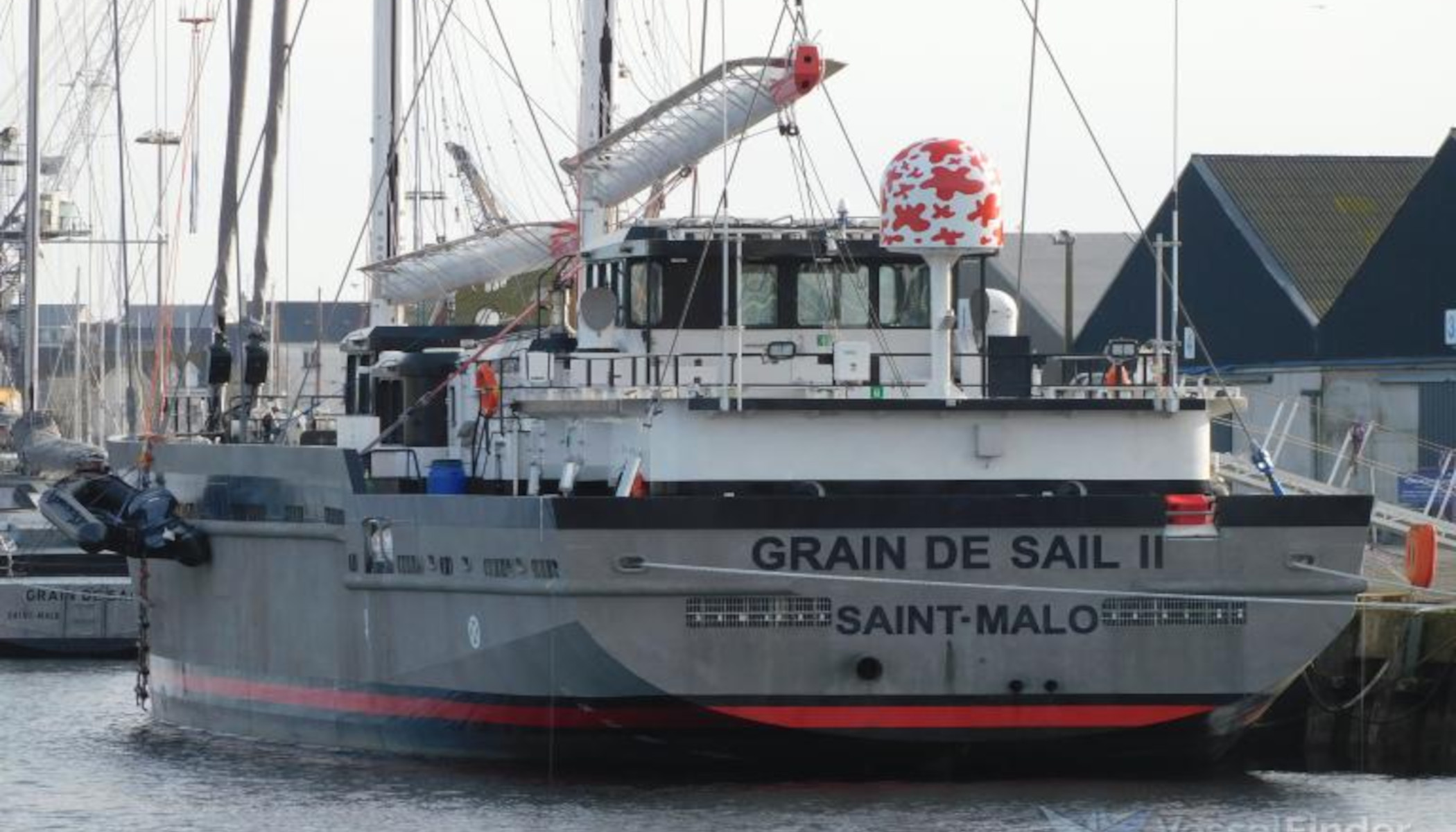 Grain de Sail’s fleet of cargo ships is designed to transport and deliver its own raw materials such as cocoa and raw coffee from Latin America. The owner’s first ship, a demonstration ship Grain de Sail I, and prototype designed intentionally small, was not considered fully capable of meeting transport needs. The newer sailing vessel was therefore designed and built to enable the company to transport 100 per cent of its raw materials.
Now that the Grain de Sail II is in service, its predecessor will be repurposed for coastal transport within Europe.
Source: Baird Maritime (courtesy of Ger de Jager)
This is a translation of an article in Dwarstuig, the Dutch alumni magazine of the Enkhuizen Nautical College.
Image: Grain de Sail

Windassist sponsor