
Saving energy in two ways
As low and zero-carbon fuels are not yet widely available, shipowners have to look for alternatives. Wind-assisted propulsion systems and silicone-based antifoulings are prime opportunities for fuel and emission savings.
Maritime shipping is by far the most efficient form of transporting cargo; much more efficient than. railways, trucks and aircraft, if we consider the amount of cargo per kilometre travelled and the amount of fuel used.
But the maritime sector is being forced to boost that efficiency even further by international and regional emissions regulations to meet the climate ambitions set out in the Paris Agreement to achieve net zero emissions by 2050.
Pricing
To move shipping forward, the EU has taken the step of including the maritime sector in the EU Emissions Trading Scheme (EU ETS) in 2024 and requiring the sector to comply with FuelEU Maritime from 1 January 2025. Through these two schemes, the EU regulates both polluting emissions and the fuels themselves. As a result, ship operators will pay for pollution.
How much they pay depends on the investments ship owners make now to reduce fuel consumption and greenhouse gas emissions. By choosing the right investments, an operator remains commercially competitive while creating a pathway to meet IMO’s ambitious targets for 2030 (20-30% reduction), 2040 (70-80% reduction) and net zero emissions around 2050. IMO’s GHG reduction targets use 2008 emissions as a baseline.
Investing in ESDs
Although low-carbon and carbon-free alternative maritime fuels will not be widely available for years to come, operators can take energy-saving operational and technical measures to reduce fuel consumption and greenhouse gas emissions. Classification society and insurer DNV says such measures could reduce fuel consumption by 4% to 16% by 2030. Initial gains can be made through operational efficiency improvements, but larger reductions will require investment in energy-saving devices (ESDs).
As of 1 January, about 10,360 ships were equipped with ESDs, accounting for 37% of fleet tonnage, according to Clarksons Research. Quoting data from its Green Technology Tracker report, the broker notes that ships are equipped with propeller cases, rudder balls, Flettner rotors, wind kites, air lubrication systems and other technologies. The report reports that air-lubrication systems have been applied to 580 ships and wind-assisted propulsion systems (WAPS) to 145 ships in operation or on order.
“Our tracker also includes 37 ships in the fleet (plus 12 newbuilding orders) testing carbon capture technology on board. And the proportion of the fleet equipped with an ‘Eco’ engine has risen to more than 34%,” Clarksons said.
More efficient sailing
Slow cruising, route optimisation and reducing engine speeds are among the most common ways to reduce fuel consumption and emissions. These strategies are used by chemical tanker owner Odfjell, which has a deep-sea fleet of about 70 vessels, among others. Odfjell has invested more than $35 million in ESDs, with 135 installations since 2014 and another 50 planned until 2030. As a result, the fleet’s carbon intensity, or annual efficiency ratio, is down 53% from the 2008 baseline as of the first quarter of 2024 – well ahead of IMO’s emission reduction targets.
Wind support
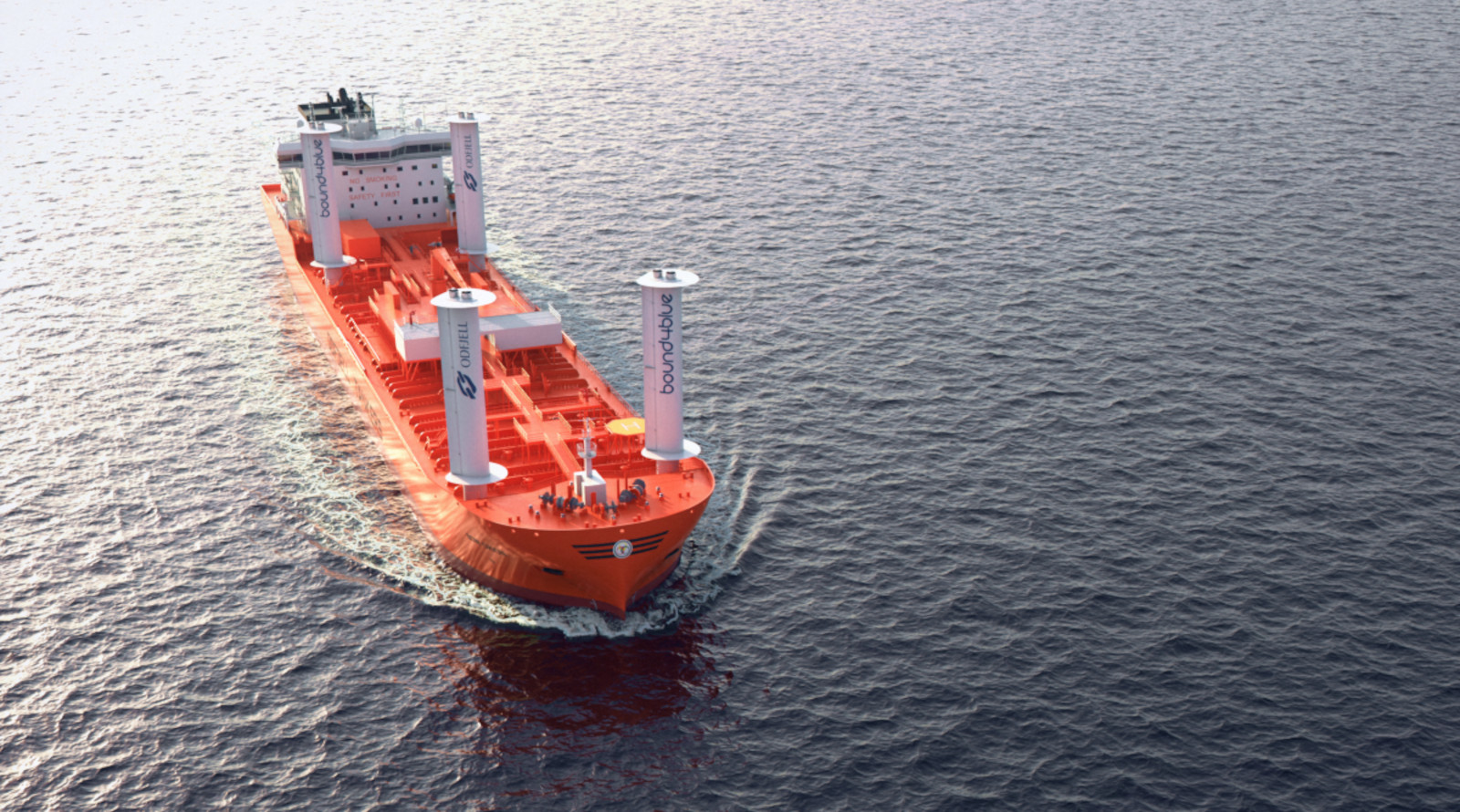
The Norwegian shipping company is also taking more novel approaches by testing WAPS and air lubrication. Odfjell will install four bound4blue’s eSails on the 49,000-dwt Bow Olympus during the vessel’s five-year dry-docking in Chengxi in January. Data will be collected during the pilot to determine further investments in WAPS for the existing fleet and new-build vessels.
A DNV white paper on WAPS reports the following: “Wind-assisted propulsion has already yielded annual fuel savings of 5% to 20% for some vessels according to ship owners, operators and technology manufacturers, resulting in a reduction in greenhouse gas emissions in the same proportion.”
Routing
DNV senior principal engineer, Hasso Hoffmeister, notes, “Current WAPS technologies use advanced control and automation systems and combine aerodynamics, automation, computer modelling and modern materials. Currently, these technologies are not yet widely used, but they are promising as part of hybrid propulsion systems.”
In addition to WAPS, Odfjell is installing a weather routing platform on Bow Olympus and another MR tanker Bow Optima. This weather routing system, provided by a French start-up, Syroco, uses sea and weather data and a digital twin of the vessel, based on data, machine learning and ship architecture principles to calculate an optimised route.
Anti-fouling silicone-based paints
Investing in the right antifouling can also yield fuel savings. An analysis by an Athens-based non-profit organisation formed by five leading Greek ship owners and Lloyd’s Register’s Maritime Decarbonisation Hub found that silicone-based hull paints can deliver 3-5% fuel savings.
Research by the Maritime Emissions Reduction Centre (MERC) suggests that Very Large Crude Carriers (VLCCs) could achieve significant efficiency gains when using a ‘hybrid coating scheme’ – combining traditional antifouling systems with silicone coatings at specific locations on the hull. According to MERC, partial application of silicone paint on VLCCs resulted in ‘out-of-dock’ improvements of about 5%, with average fuel savings of about 3% during the docking cycle compared to traditional antifouling.
MERC director Stelios Korkodilos says advanced coatings “can be a valuable tool for decarbonising the fleet”. Silicone-based antifoulings are expensive and have strict requirements for application. The report says: “Although costs depend on the vessel and coating specifications, they are expected to be about three times as expensive as a traditional self-shining coating system.”
Source: riveramm.
Image: bound4blue

Windassist sponsor