
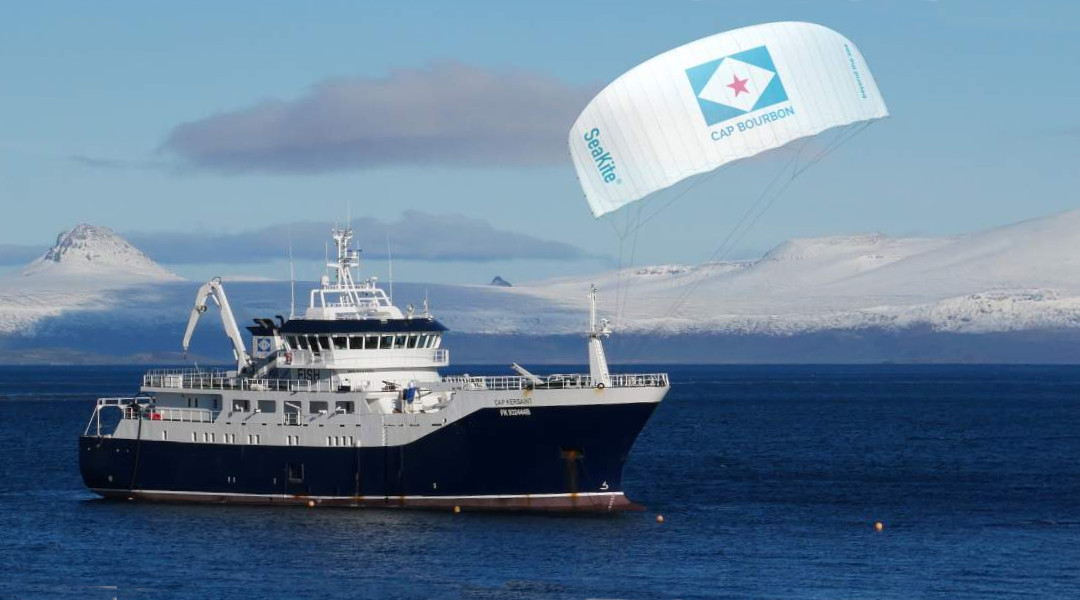
First commercial test Seakite
So far, the French Seakite system has mainly been demonstrated on a small catamaran. Now, however, it is also being installed on board the fishing vessel Cap Kersaint of French shipping company Cap Bourbon.
The company’s founders include the well-known French ocean sailor Yves Parlier, known among other things for his participation in the Vendée Globe with the Aquitaine. A smaller version of this kite system is already being used with some success and in limited numbers on smaller yachts.
Earlier, the Seakite system was installed on board the tanker Forbin, although no further information on this has been made public. Recently, however, the Seakite system was also demonstrated on board the tug Jason of French shipowner Les Abeilles. Further applications are planned on an UltraNav chemical tanker and on the French fishing vessel Cap Kersaint – similar to an earlier application of the German Skysail system aboard the Dutch fishing vessel Maartje Theadora in 2010.
Although Skysails managed to equip several ships at the time, the company ultimately proved unsuccessful and one of the then cargo ships was actually recently equipped with suction sails. The hope is that Beyond the Sea, partly through its experience with the smaller systems, will succeed in developing kite technology into a fully commercially deployable wind propulsion solution.
Beyond the Sea will now install a 100m² kite on Cap Bourbon’s longliner Cap Kersaint. This 60-metre vessel, which is stationed on Réunion Island and fishes for toothfish off the coast of the Kerguelen and Crozet islands, allowing it to make significant fuel savings.
Although the number of wind-powered vessels is rapidly increasing, the fishing industry remains difficult to equip with these technologies due to operational constraints, lack of space, configuration and stability.
The installation should be completed by the end of the year. Cap Bourbon will benefit from this when its longliner is in dry dock at CNOI (Chantier Naval de l’Océan Indien) in Port-Louis in Mauritius for a 10-year maintenance service.
No place for sails
“We have been working with Cap Bourbon for more than a year,” said Marc Thienpont, CEO of Beyond the Sea, welcoming this “first sale of our system at scale 1”, which could deliver “20% decarbonisation”, and praising “the real will to strive for a more sustainable fishery” of the shipowner.
“Our impact on the environment and thus the topic of decarbonisation align with my main concerns,” Tugdual Poirier, managing director of Cap Bourbon, explained to Mer et Marine. Being hesitant about the possibility of using an alternative fuel in Réunion in the short term and with the required technical level, he opted for propulsion by wind. Since installing a mast or a Flettner rotor on his vessel as part of a refit seemed complicated, he was immediately sold when he saw Beyond the Sea’s Seakite system.
“We have a system that is perfectly suited to their vessel because it does not cause any loss of stability,” says Marc Thienpont.
“Moreover, the crews are very familiar with handling lines and winches: these are things that fishermen know and they don’t have the reluctance that more traditional shipowners might have.”
Initially, the shipping company will gain experience with a 50m² wing, while a 100m² wing and associated systems are also available. In addition, sailors will carry out tests and undergo training at Beyond the Sea. “We will have to be creative and learn together,” adds Tugdual Poirier. “The relationships are good, which is an advantage; I think we will be able to work together easily, but it will inevitably be empirical. We are the first to opt for this innovative system for fishing, so we will have to assimilate it and familiarise ourselves with it. But it is clear that the learning process will be essential, i.e. using the kite, launching and retrieving. On paper, the automaton controls everything, but we have to anticipate what we have to do ourselves. That will be very interesting.”
Especially for longer journeys
The system, which will generate about 10 tonnes of traction power, will initially be used during the ship’s crossings, mainly between Reunion and the fishing grounds (predominant crosswind), but also to sail from Crozet to Kerguelen (mainly tailwind). That amounts to 15-20 days per tidal cycle of about 80-90 days, with the longline fisherman making three to four cycles a year. “I wanted to be cautious,” explains Tugdual Poirier, using the kite during long boating cycles with favourable winds and “without pressure because there are no lines or operations going on”. “In the future, if captains are familiar with it, they may be able to use the kite to switch sectors for a day or two to save fuel, but we have not included that in our calculations for now.” According to Tugdual Poirier, who explains that the shipping company has received subsidies from the BPI, the vessel should save more than 10% in fuel over an entire fishing trip.
The Cap Kersaint is a freezer trawler converted in 2015 for toothfish hunting. “Environment, safety and crew comfort were paramount in the design,” said Cap Bourbon. “It is the first fishing vessel for toothfish hunting equipped with a moonpool: a central shaft that provides a safer working environment for the crew and minimises the impact of lines on birds.” The Cap Kersaint has a crew of 28 to hunt toothfish in the waters of the French Southern and Antarctic Territories.
Cap Bourbon, founded in 1998, is one of France’s pioneers in hake hunting.
Source: MeretMarine.
Image: Beyond the Sea.

Windassist sponsor