
IMO puts wind propulsion on the agenda
The increasing use of wind propulsion has led to the issue now being explicitly on the agenda of the IMO’s Ship Design & Construction (SDC) subcommittee.
This includes considering whether revisions to the IMO stability criteria are needed to take into account the heeling moments generated by wind propulsion. After all, it is no surprise to sailors that sails can have a negative effect on vessel stability.
From 19 to 23 January, the 12th session of the IMO Ship Design & Construction (SDC) subcommittee took place. This committee deals with regulations around ship design and construction. There, they are now also concerned with wind propulsion.
Stability
Among other things, it is considering whether revisions to the IMO stability criteria are needed to take into account the tilting moments generated by wind propulsion. After all, it is no surprise to sailors that sails can have a negative effect on vessel stability.
Currently, the IMO stability criteria, which form the minimum framework that ships must meet, do not take into account the impact of wind propulsion on stability. However, class societies are allowed to apply additional, more stringent rules, and some do so by imposing additional requirements on the stability of ships with wind propulsion. However, these requirements vary considerably from class to class and are often incomplete. Moreover, the distinction between different types of systems is often not made, even though the difference can be significant. For example, the heeling moment generated by a rotor sail remains almost constant during wind gusts, despite an increase in wind speed, whereas with a suction sail this can be greatly reduced within seconds at the push of a button.
Manoeuvrability
There is also a review of whether adaptation of IMO regulations on manoeuvrability is needed, such as MSC.137(76), as well as the COLREGs (International Marine Propulsion Regulations). Again, there are indications that revision may be desirable. For example, the use of wind propulsion is not included in MSC.137(76), and it is not inconceivable that a wind-assisted cargo vessel may be more restricted than a conventional motor vessel in certain situations. It is common knowledge that the current COLREG rules require a motor vessel to give way to a sailing vessel, but motor sails (or wind assistance) and the actual manoeuvring characteristics of modern vessels are not explicitly considered therein.
It is a positive development that regulators are now addressing these issues. This can enhance safety and does not necessarily inhibit further development. On the contrary, depending on the final interpretation, new or adapted rules may also have a positive impact on the further application of wind propulsion.
However, it will take some time before this leads to concrete regulations. A preliminary target date for draft versions of any new or adapted rules is around 2029.
Source: IMO
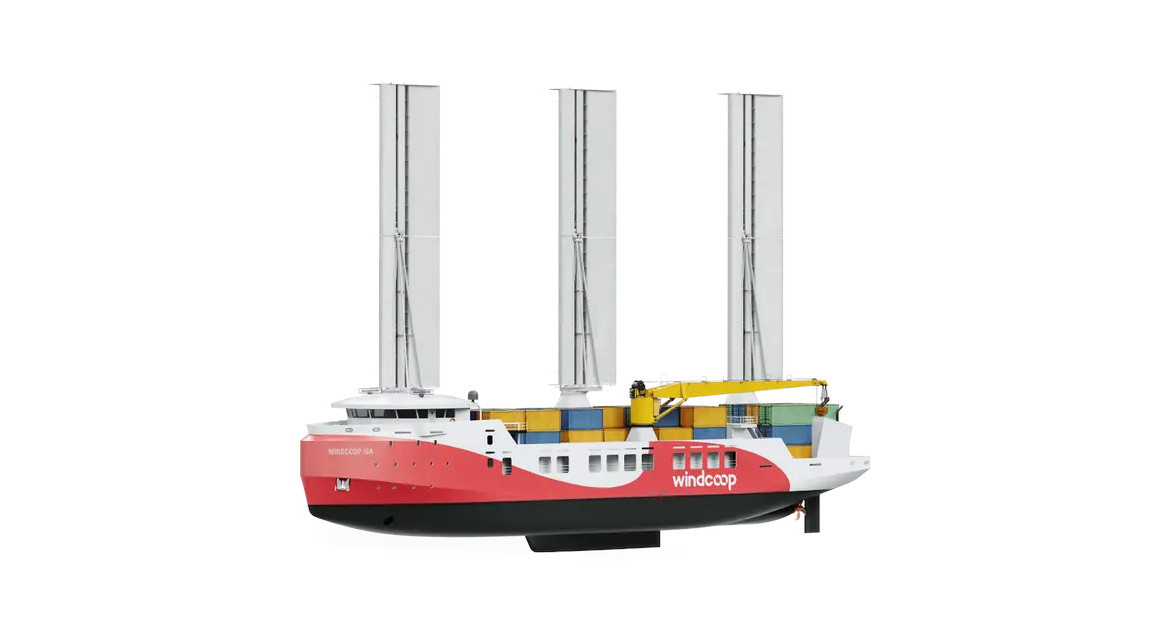
Image: Windcoop.

Windassist sponsor