

Oosterschelde wins Wouter van Dusseldorp prize
This year’s Wouter van Dusseldorp Encouragement Award for good news goes to the Oosterschelde Shipping Company. Not for what it is already doing, but for what the Reederij is planning.
Marja Goud, board chair of the Zeepost Foundation, which presented the award during the Traditional Ship Show in Den Helder, expressed the following motivation:
“When I spoke to Mattias Nab at this fair last year, he casually inquired ‘say, what do we actually have to do to win this prize?’ I replied to him then that I did not have the impression that they needed any encouragement at all. Shipping company Oosterschelde has its act together and attention is in abundance.
Still, here we are. Board and editors believe that the combination of projects and plans is extraordinary. Three-masted schooner Oosterschelde has just completed a two-year voyage, partnering with an organisation that offers young nature researchers the chance to carry out fieldwork. The combination of focusing on keeping and using a historic ship afloat, and involving young people in issues of nature research and biodiversity is one that has attracted worldwide attention.
In the same year, stevenaak Helena, the Reederij’s second ship, celebrates its 150th anniversary. This was also marked in a festive manner and with a tour of various ports. In addition to commercial cruises, the Helena is then used again for social projects.
These two projects are wonderful and well executed, but – as mentioned above – need no encouragement. The reason for the encouragement award is the intention of the Foundation ‘Het Rotterdamse Zeilschip’ and Reederij Oosterschelde to add a third ship to the Reederij: the beugsloep (longline fisherman) Johanna Hendrika (MD10). The very last of its kind, and currently in sad condition. A very thorough restoration will have to take place before this ship can be commissioned.”
Restoration not yet certain
Oosterschelde director Gerben Nab and his son Matthias accepted the award, after which Gerben Nab showed images of the Darwin Voyage with the Oosterschelde, and elaborated on the planned restoration of the Johanna Hendrika.

In the restoration, the Foundation ‘Het Rotterdamse Zeilschip’ and Reederij Oosterschelde aim not only to restore, but also to preserve sustainably. The ship should preferably be brought into service debt-free, after which it should be able to be profitably exploited. That exploitation – economic right to exist – is seen as an important means of securing long-term preservation.
The Foundation ‘Het Rotterdamse Zeilschip’ and Reederij Oosterschelde are now looking at whether restoration and exploitation are feasible. There are quite a few administrative, restoration and financial aspects to this. For instance, it is very important whether IL&T (the shipping inspectorate) will allow the ship to be restored as an ‘existing vessel’. Indeed, if not, profitable operation is not feasible anyway.
Last ‘beugsloep’ in the world
 The Johanna Hendrika is both the first and the last longline sloop in the world: the first one to be built in iron, and at the moment, as far as is known, also the last one still ‘alive’. And the latter is relative, because apart from the hull, little remains of it. That the ship is nevertheless worth restoring has everything to do with its rarity. Moreover, the Johanna Hendrika has a hull shape that connoisseurs dream of.
The ‘Johanna Hendrika’ was built as construction number 75 in 1896 at Rijkee & Co (Katendrecht) in just five months for wed. C. Kolff & Zn at Middelharnis, for longlining on the North Sea and Icelandic waters. The first voyage started in October of that year and on 1 November the first fresh fish was delivered to the fish auction in IJmuiden. In 1916, the ship was converted into a herring lugger and sailed from Scheveningen. In 1930, the ship went to Ostend and 1934 to Norway as a motor freighter.
Historical context
The so-called ‘big fishery’ consisted of herring fishing and longlining. The herring fishery was carried out with the fish cutter and the herring ‘buis’, and later with luggers, a ship type derived from the French lougre. During the herring season, these sailed to sea and moored to the vleet, a long, large fine-mesh net in which the herring swam. Outside the herring season, the ships were laid up.
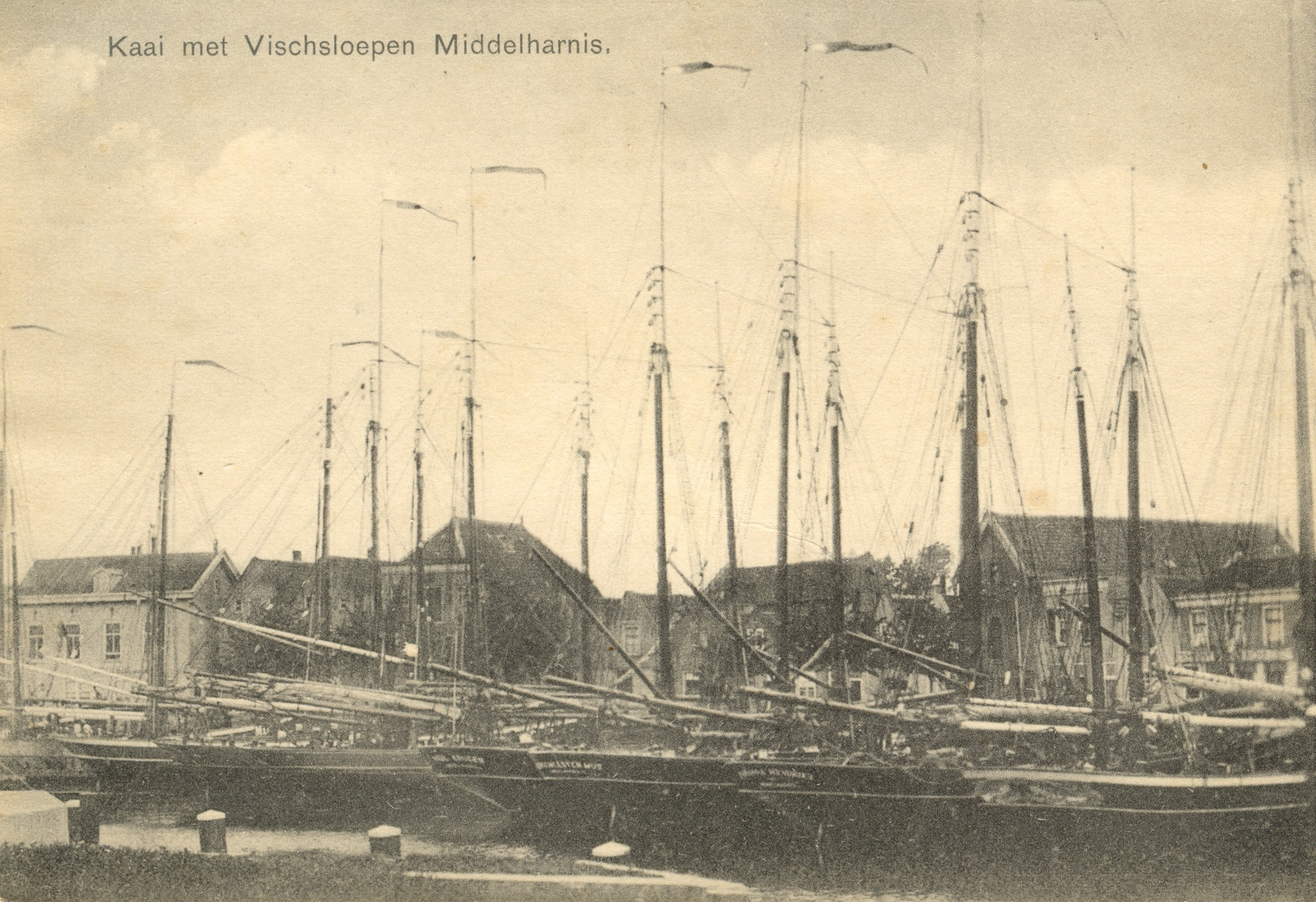
Longlining on the South Holland and Zeeland river delta and the North Sea to Dogger Bank continued throughout the year. The longline refers to the fishing gear used by the ship: a long line with side lines and hooks laid in an arc (beug = curve) from the ship across the seabed. It was carried out by several seagoing ship types. A special feature of these vessels was that the catch was brought to the auction alive as much as possible: they were therefore equipped with a bun.
After French rule in the 19th century, longline fishing was taken over by longline sloops or beugsloepen – chaloupe in French. Initially short stocky vessels, they gradually became fast larger vessels and eventually schooner rigged. They sailed all year ’round the north’ to fish cod and bring them to the auction alive in the bun. To do this, they had to be able to sail fast.
Longline sloops deployed an angle rig consisting of miles of lines with short side lines (sneuen) with a hook containing bait. Live river lamprey were often used as bait. Longline fishing took place from ports such as Rotterdam, Maassluis, Pernis (Speelman family), Vlaardingen (Hoogendijk family), Middelharnis (Kolff and Slis families) and Scheveningen. The ships were built at two innovative shipyards in Rotterdam: Rijkee & Co. and Bonn & Mees.
Source: own newsgathering and Reederij Oosterschelde.
Image: Reederij Oosterschelde

Windassist sponsor