

Rampant rise of wind propulsion
For a long time, it was a utopia: container ships with sails. But after decades of talk, the use of wind energy in shipping is booming. Dutch sailing magazine ‘Zeilen’ thought it was time for an overview.
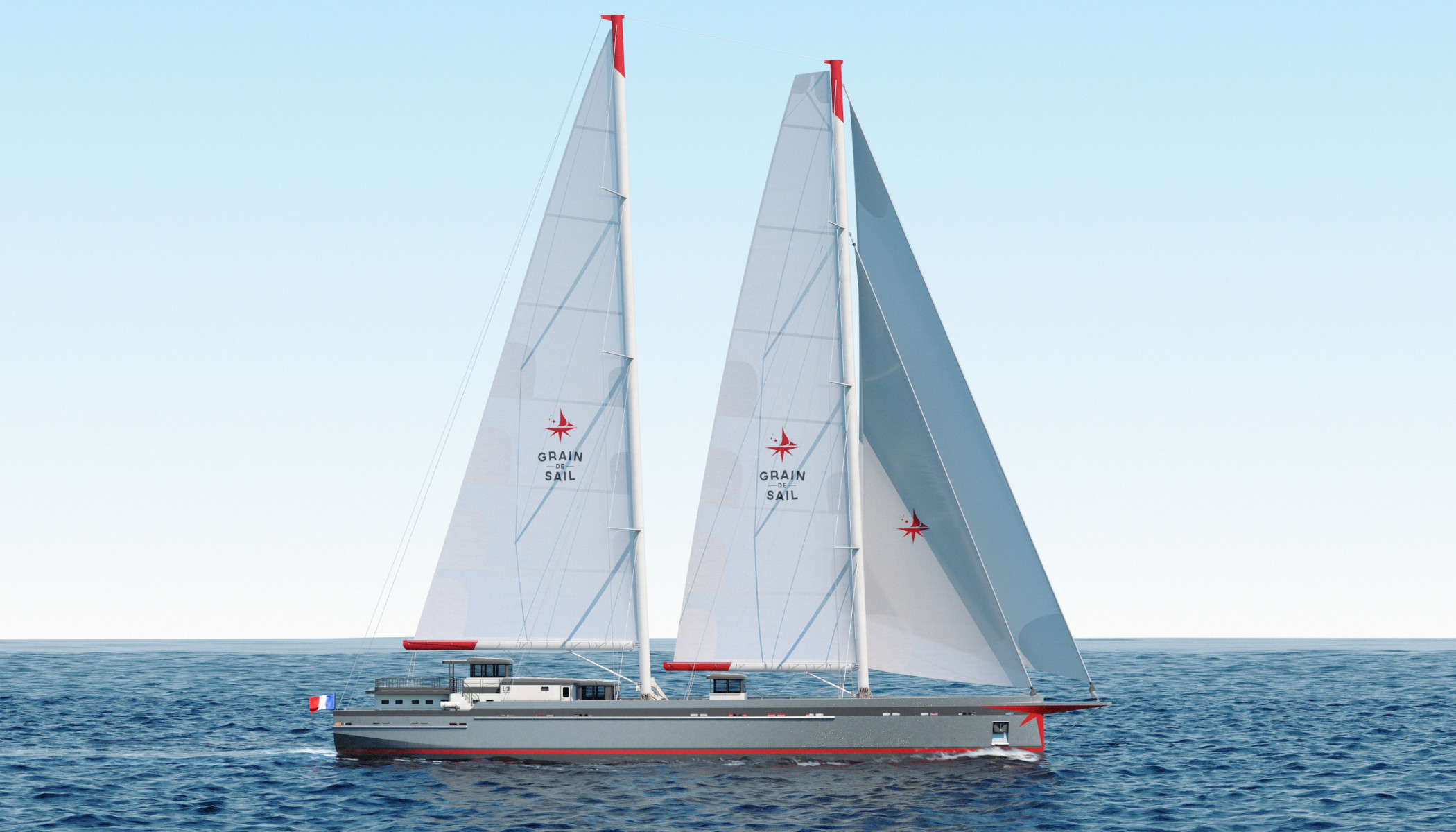
March 2024 Grain de Sail II went into the water. The mega-ship was specially built to transport coffee and chocolate between France and America. Small detail: this 52-metre schooner transports under sail. It is hard not to be impressed by this ship: it has the scale of a mega-yacht, only without superfluous trappings. Actually, it is a tallship, but with better sailing qualities. The 6-metre-deep lead keel, water ballast and an arsenal of hydraulic winches for the 1,500-square-metre rig finish it off.
This kind of sailing freighter is making a comeback. Grain de Sail, for instance, is already working on a second ship. TransOceanic Wind Transport’s 81-metre steel sister ships Anemos and Artemis also launched this year; the next six vessels are in the pipeline. In Turkey, Neoline is having two 136-metre-long sailing roll-on roll-off carriers built. Even French top sailor François Gabart’s radical idea to build a huge aluminium cargo trimaran looks set to make it. This ship should sail by 2026.
Calculation
So after an absence of barely a hundred years, windships now seem to be making a meteoric rise. This is good news, as conventional shipping is known to be a heavy polluter. But how feasible is this ‘new’ form of cargo transport really?
The answer to this question requires some calculation. The speed of the ships is certainly not the issue. Both Grain de Sail II and Anemos sail at an average of 9 knots from northern France to the US east coast in about two weeks. A difference with (smaller) conventional shipping is barely a few knots.
The big difference is in carrying capacity. The world fleet consists of 60,000 ships with a combined carrying capacity of 2,200 million tonnes, or an average of 36,000 tonnes per ship. The current generation of wind ships does not reach this capacity by far: Grain de Sail II carries 350 tonnes, Anemos 1100 tonnes and Neoliner 5000 tonnes -a capacity difference of factor ten. Like deploying a small barge on a transatlantic liner service.
However noble, the current generation of windships will not lead to the required reduction in carbon dioxide. Fortunately, there is equally good news, as wind energy is again high on the agenda. Thereby, all developments show great potential: with current innovations, it is possible to reduce CO2 emissions -significantly- in the coming decades.
Wind Assisted Ship Propulsion
An interesting development in shipping at the moment is Wind Assisted Ship Propulsion (WASP). This involves mounting large sails on the deck of conventional ships. These sails provide additional forward thrust, reducing the engine power and thus saving fuel.
This idea is by no means new. Ever since the last wind ships left the field, there have been ideas for harnessing wind energy – which still blows across the deck for free.
Read more in the monthly magazine Zeilen (subscribers only)
Sailing has done well in capturing the major developments in Wind Assisted Ship Propulsion (WASP). From traditional sailcloth to rotor sails, wing sails, suction sails, propulsion with kites, Aerorig and Dynarig. The main advantages and disadvantages of the various techniques are also discussed. Dutch companies like Maritime Research Institute Netherlands (MARIN) and Dijkstra Naval Architects play an important role in these maritime innovations, which could make a major contribution to CO2 reduction.

Windassist sponsor