
Science: The comeback of wind power in shipping
WASP technology appears to be a promising solution to accelerate the shipping industry’s decarbonisation efforts, states a group of scientists in an article on Research-Gate.
The article, “A Comeback of Wind Power in Shipping: An Economic and Operational Review on the Wind-Assisted Ship Propulsion Technology,” analyses the results of a large number of voyages with ships using a form of wind assistance. Moreover, authors Todd Chou, Vasileios Kosmas, Michele Acciaro and Katharina Renken list the main factors influencing the success of wind support.
From the abstract:
WASP technology appears to be a promising solution to accelerate the shipping industry’s decarbonisation efforts, as it uses wind to replace some of the propulsion power from fossil fuels. This article discusses the status quo of the technological growth of WASP within the maritime transport sector through an analysis of secondary data, presents the potential implications for fuel savings and identifies key factors determining the operational efficiency of the technology. Three main considerations emerge from the analysis. First, despite the existing limited number of WASP installations, there is a promising trend of diffusion of the technology within the industry. Second, companies can achieve fuel savings, which vary depending on the technology installed. Third, these fuel savings are influenced by environmental, on-board and commercial factors, presenting both opportunities and challenges for decision-makers.
Up to 60% savings reported
The researchers analysed results from several studies worldwide, on ships with Flettner rotors, kites, rigid and flexible sails, and wind turbines, respectively.
Very variable results are obtained with Flettner rotors. On longer voyages, they do fall significantly higher than on short routes. On some Atlantic voyages, results of up to 40 and even 50% fuel savings were recorded, but on shorter crossings, of the English Channel for instance, results remain below 5%.
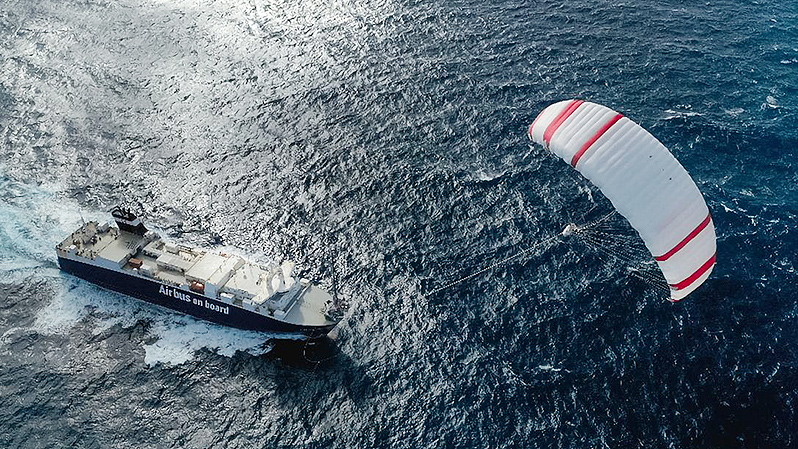
Kites ranging from 350 to 500 m² give very good results especially on Atlantic crossings, but also on shorter journeys: fuel savings of 14 – 50% are reported. Only on very short journeys, such as cross-Channel ferries, kites offer little relief.
Rigid sails, between 20 and 50 metres high, also give good results. From a 180,000 GRT bulk carrier, 20-30% savings are reported on the Yokohama – Seattle route, and from a 10,00 GRT chemical tanker between Buenos Aires and the UK west coast 20-60% savings. On the latter leg, flexible sails (Dyna-rig) on the same type of vessel give savings of only up to 35%.
The least promising are wind turbines. Reported savings remain below 4% in all cases.
Energy yield from wind
Wind speed and wind direction are two important factors determining fuel savings. The higher the wind speed, the greater the energy yield. On the other hand, wave heights tend to be higher where wind speed is higher, negatively affecting vessel performance. When modelling ship performance with WASP technologies, more sophisticated models that take into account lateral forces and yaw moments should be used to obtain more accurate predictions of fuel consumption. When route optimisation is used, according to a consulted study, the fuel economy of WASP technology increases from 14-36% to 28-53%. This increases further when the vessel is free to deviate from the great circle route to take advantage of optimal wind and waves.
Seasonal differences
Seasonal differences in fuel economy are observed in a simulation study, where Flettner rotors perform better in winter and a wingsail performs better in summer. Wind speed is higher in the northern hemisphere in winter, allowing Flettner rotors to achieve greater fuel savings then. The direction of travel also appears to cause variations in fuel savings. The prevailing west-east wind direction in the Atlantic resulted in a significant difference in fuel savings between Baltimore to Wilhelmshaven (36%) and back (14%). Longer trips appear to have lower variability in fuel savings than short ones, and they are more likely to allow for greater fuel savings because wind speeds are higher in open waters.
Read the much fuller article on ResearchGate.

Windassist sponsor