
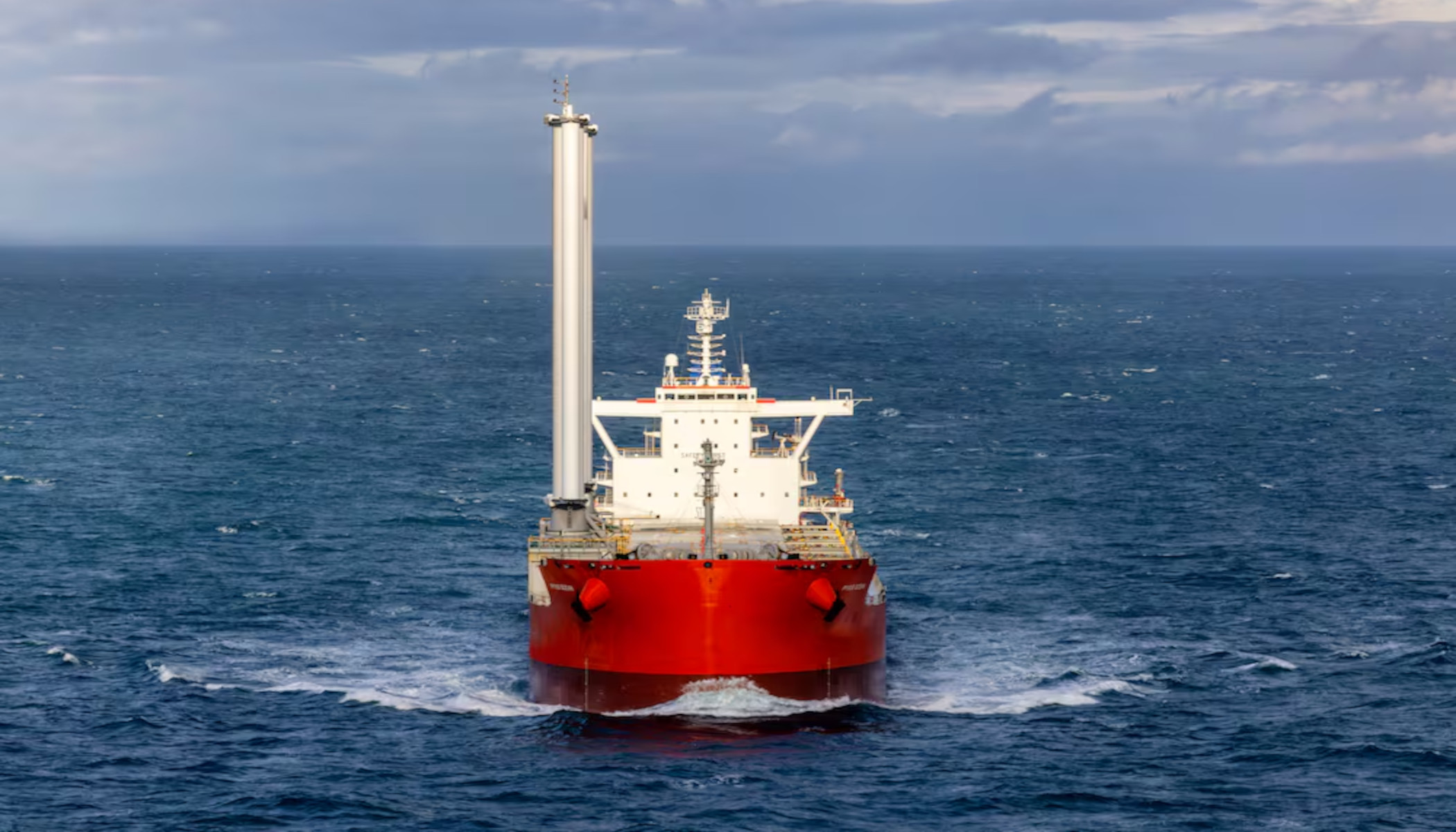
Wind-assisted freighter saves 15% fuel
In March, a sailing freighter returned from a six-month round-the-world trip. Foldable vertical sails made of steel and fibreglass saved up to 15% fuel.
The bulk carrier Pyxis Ocean left port in Singapore in August 2023 and crossed the Cape of Good Hope on its way to Brazil, eventually docking in Amsterdam. The freighter, which was chartered by food giant Cargill, has two innovative WindWings – which are 37.5 metres tall and resemble aeroplane wings. Scientists who studied the ship’s performance say the wind support allowed it to save three tonnes of fuel per day. This resulted in an effective 15 per cent reduction in the fuel it would normally consume, according to Cargill.
Cost-effective
The data “underline the potential” of wind to reduce the shipping industry’s carbon footprint, the company said. According to Jan Dieleman, president of Cargill’s ocean transportation business, the use of sails can have an even greater impact if they are installed on ships that can also run on low-carbon marine fuels, such as green methanol.
“Technologies that use wind can be an important, cost-effective way to achieve our short-, medium- and long-term decarbonisation goals,” he said.
Cargill is involved in five large ships on order that can run on green methanol, and is “actively seeking” a form of wind-assisted propulsion, Dieleman said. He cautioned that wind does have limits, partly because it does not work for all trade routes.
Automated sails
The retractable sails, designed by UK-based Bar Technologies, are fully automated and measure the wind and adjust themselves to the optimal configuration. Bar says it is now looking to showcase its technology on new-build ships and says other ships are likely to use two rather than three wings.
Environmental benefits limited
Large cargo ships carry about 80 per cent of world trade and are mainly powered by crude oil, emitting about 1 billion tonnes of CO2 every year. Sails are unlikely to be widely adopted in all ship classes and for all fuel types in the short term, limiting the environmental benefits of the technology. It is more likely that they will be used by ships burning more expensive fuels, where the cost savings are greatest.
Read the whole article in The National News’ newsletter.

Windassist sponsor