
Ocean currents in the news
Both the current affairs columns on TV and Weekblad Schuttevaer mentioned reports on ocean currents and wind areas. The Windassist editors explain.
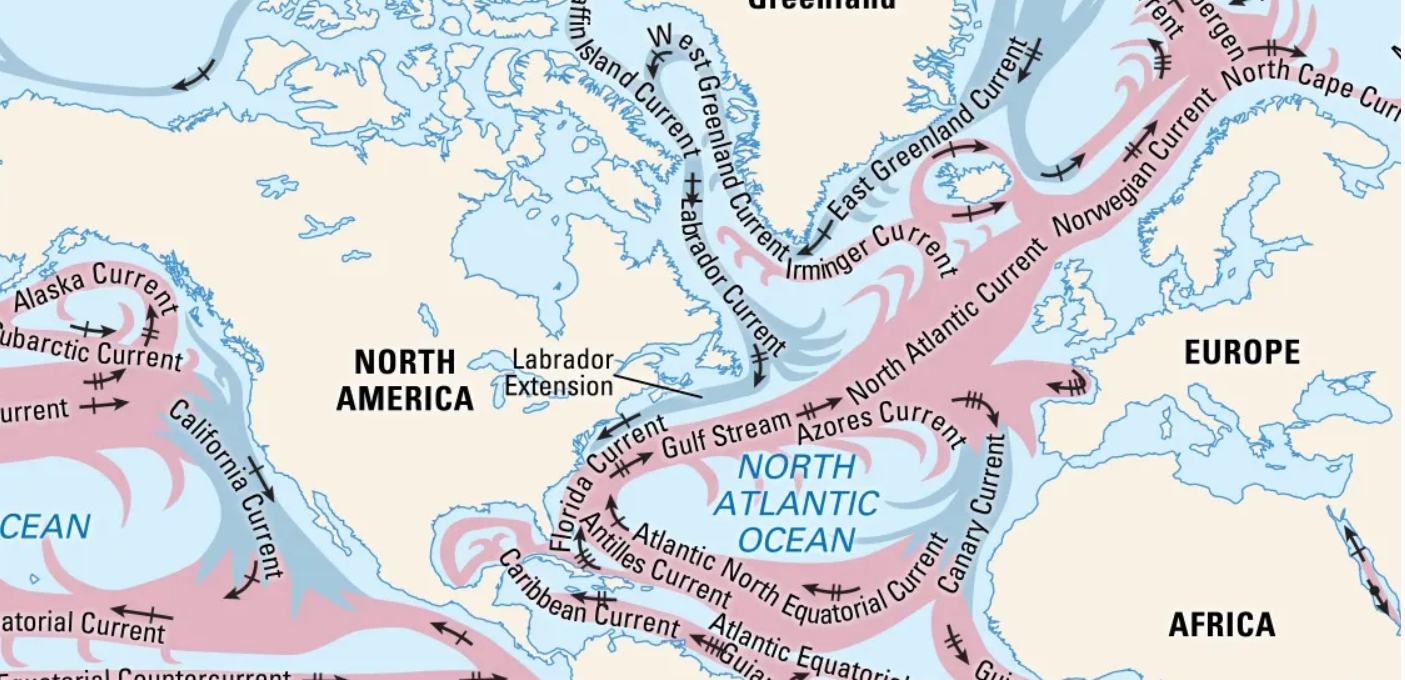
Many long-route ocean sailors use the term ‘Atlantic Round’ for the route between Europe, the Caribbean and back. That route is often called the ‘Columbus route’. From Europe via the Canary Islands south “to where the butter melts” (according to Henk Bezemer) and then west in the trade winds to the Caribbean. From there north to the latitude of Washington and back via the Azores.
The sources from which this route could be established are ‘Ocean Passages for the World’ (ed. British Admiralty) and, for yachts, ‘World Cruising Routes’ (ed. Adlard Coles). So far, nothing new.
More difficult is to determine where to find areas without wind and current. The term ‘Horse Latitudes’ is often used there. It is important to know that there are two windless areas: in the Azorean high and around the Equator. So, on both sides of the compass area with ‘wind and current on the butt’ are areas without wind.
For sailing vessels wanting to go further south, to Brazil or Cape of Good Hope, the key is to cross the Intertropical Conversion Zone; the Doldrums, where it is narrowest. Contemporary dynamic routing provides that information. The question for ocean sailors and wind-aided merchant shipping is whether the tenor of media reports affects planning and routing of ocean voyages under sail.
New Scientist provides a lot of information.
Climate change will possibly lead to a collapse of a major sea current, with devastating consequences. At issue is the Atlantic meridional overturning circulation, or AMOC for short. That is a sea current that carries warm water and nutrients through the Atlantic Ocean. Research by oceanographer René van Westen of Utrecht University and his colleagues suggests that the AMOC could cease sometime between 2037 and 2064, influenced by climate change.
If a lot of freshwater from melting ice sheets enters the North Atlantic, this ocean current could weaken and even collapse completely. So far, most scientists considered such a collapse of the AMOC very unlikely. They certainly did not expect it could happen as early as the 21st century.
But in 2023, researchers at the University of Copenhagen also predicted that the AMOC would collapse by the middle of this century. Such a collapse could have major consequences. Among other things, it could lead to a rapid sea level rise in North America, a sudden, sharp drop in temperature in northern Europe and a severe disruption of the monsoons in Asia.
The two studies produced very similar predictions. Does this make it more likely that the AMOC will collapse this century? Yes, says Van Westen. He says his team’s research calls into question the position taken by the Intergovernmental Panel on Climate Change (IPCC) in 2019.
‘Just five years ago, the scientific community thought the AMOC would be very resilient under climate change,’ says Van Westen. ‘Now it has completely shifted to the view that the AMOC is teetering. The tipping point will be reached sometime in the 21st century if no further action is taken to mitigate climate change.’
source: New Scientist
In an instructive story, Schuttevaer provides background information:
A band of high air pressure exists in both the northern and southern hemispheres of the earth. The Dutch weather forecast often mentions a high-pressure area near the Azores and a depression or low-pressure area near Iceland. It is no coincidence that the air pressure is high near the Azores and also in the Sahara, for example.
At horse latitudes, sailing ships have no wind in their sails. The sea can also be mirror-smooth. It is a situation that can persist unchanged for weeks, with rations running out. Heating near the equator causes the air there to rise and also rains empty in the famous tropical showers.
Slightly north and south, it then cools and becomes heavier. The air descends there and forms a high-pressure area, rained empty and thus bone dry. Because the wind there ‘comes from above’, there is insufficient horizontal wind to sail up. The band where there is hardly any wind is at about 30 degrees North and South latitude.
But the windless area shifts a little north in summer and a little south in winter because the sun also leaves and returns north every year. This is why the expression ‘thermal equator’ was introduced, the latitude where on that day the sun can be found exactly 90 degrees above the land. This windless band is also called the Doldrums at sea, although it is therefore not found in the same place at all times of the year.
In the days of sailing, such a windless band was accompanied by huge problems. The sailing ships sometimes lay bobbing in place for weeks. In misery, a sloop was then sometimes launched to row the sailing ship out of the area of windlessness at ‘elbow steam’. Every effort was made to get just the first breath of wind and then, of course, all sails were set to loud cheers.
Source: Schuttevaer (for subscribers only)

Windassist sponsor