
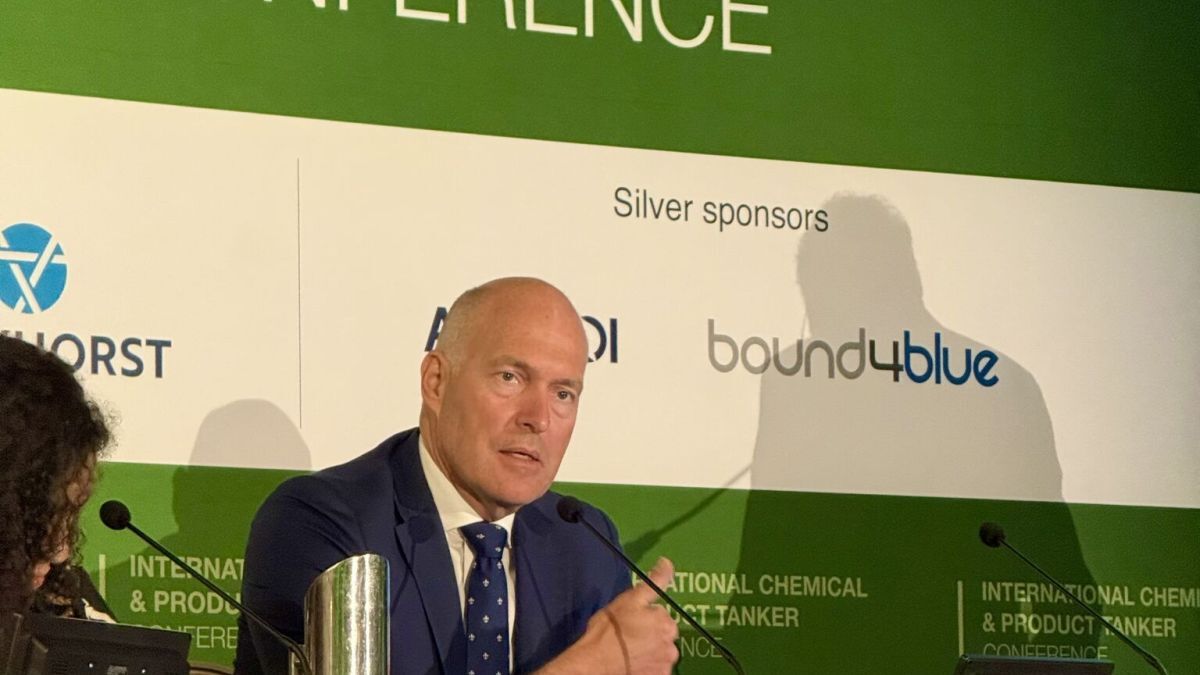
Alternative fuels create energy dilemma
Speaking at the International Chemical & Product Tanker Conference in London, Øistein Jensen, CSO at Odfjell SE, gave an incisive analysis of the major trade-offs required when switching to alternative marine fuels, such as ammonia.
Chief Sustainability Officer Øistein Jensen stressed that wind-assisted propulsion is a pragmatic response to current constraints. He noted that Odfjell has equipped one vessel, the Bow Olympus, with four suction sails from bound4blue and trained the crew in basic sailing skills. “We cannot wait for the perfect fuel,” he said. “We have to act with the resources we have now.”
Jensen cautioned that carbon-free fuels such as e-ammonia seem attractive in principle, but the energy requirements in the supply chain raise complex questions of feasibility and impact. “If you want the global fleet to run on e-ammonia tomorrow,” he said, “you will need about 5,000 TWh of green power – about half of global renewable energy production.”
He further cautioned that most of the ammonia produced today is grey, derived from natural gas. Using such fuels for ships could help individual operators reduce their direct emissions, but would increase total lifecycle emissions by as much as 40 per cent.
“It solves the shipping problem, but exacerbates the global problem,” Jensen said, adding that a well-to-wake perspective is essential to avoid shifting the environmental burden from one sector to another.
Jensen noted that the IMO’s upcoming fuel standard and economic measure – due to be formally adopted in October and come into force in 2027 – will place an increasingly heavy burden on carbon-rich fuels.
“By 2031, a chemical tanker running on heavy fuel oil could have to pay $1.2 million annually in emissions fines,” he noted, compared to just $180,000 for ships using B24 biofuel.
He also questioned the long-term viability of LNG as a transition fuel, given its diminishing cost benefits by 2035.
Instead, Jensen called for immediate investment in proven energy efficiency measures. “The best fuel is the fuel you don’t use,” he noted, referring to Odfjell’s emissions reduction of 50% compared to peers through retrofits, propeller upgrades and operational refinements.
Source: Craig Jallal at Riviera.
Photo: Chief Sustainability Officer Øistein Jensen speaking.

Windassist sponsor