

And again containers disappear into the sea
The MSC Houston V sought emergency refuge in Vigo on 20 March after it lost 15 containers. Storms and container ships remain a bad combination. Stricter rules are obvious, but the IMO is powerless.
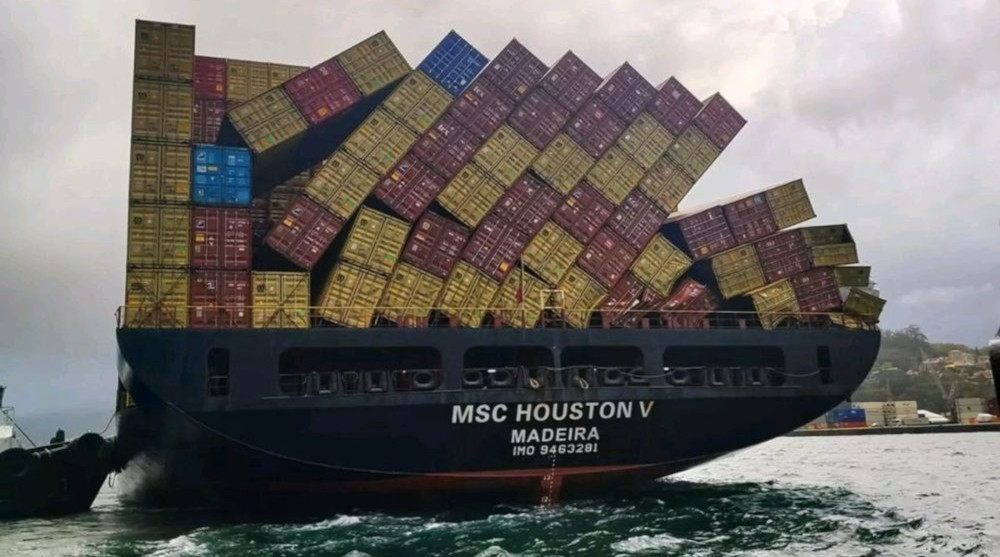
The 4,400-TEU capacity ship was en route from Piraeus, Greece, to Liverpool, UK, when it was engulfed by rough seas and wind gusts of up to 90 km/h as storm Martinho swept through the waters off Cape St Vincent on Thursday. According to footage of the ship, cargo collapsed in the aft container bays, causing several container stacks to fall on top of each other like dominoes. Some containers dangled over the starboard side near the stern, damaging the deck. The harsh conditions resulted in the loss of at least 15 containers. According to initial media reports, there was no dangerous cargo in the lost containers.
Editor’s comment
But meanwhile, those containers are floating in the open sea, and if the cargo is really not dangerous, the question is whether much effort will be made to recover them.
After the MSC Zoe accident, in 2019, in which 342 containers went overboard and the Wadden Islands were filled with microplastics and other rubbish for years to come, one thing became very clear: the effort made by the shipowner in the aftermath of the accident to take any responsibility for the accident and for the environmental damage caused, unmasked MSC as a shameless, excessively immoral and even completely unscrupulous company. Moreover, the fact that six years later the way the containers were secured still cannot withstand a big storm shows that nothing has changed.
Toothless
The problem is clear, and so is the solution. In fact, we already have a globally authoritative organisation for that: the IMO. It has only two tasks: regulate shipping and ensure safety at sea. The IMO is the body to promulgate stricter rules to prevent those containers from toppling over even in the heaviest storms, and to prohibit the largest ships from taking routes that are too shallow and close to the (Wadden) coast, which in the event of a storm creates too great a risk of ground swell and corresponding damage.
But the IMO is not such an independent authority that it can just do that. Because the IMO is governed by member states. And those member states host the big shipping companies. Who pay taxes, bring economic activity and employment in their home countries. And who can therefore nicely threaten to move to another country if they don’t like the behaviour of the member state during votes in the IMO. And that happens, continuously. In practice, it appears time and again that this has rendered the IMO completely toothless on crucial issues.
Because the lobby of the big shipping companies in the IMO is toothy. A good example is the implementation of stricter emission standards for ships. Big shipping companies have contributed to the debate on the feasibility of the regulations and the cost of compliance, leading to temporary adjustments and longer implementation deadlines. All sorts of technical arguments are thrown in there, which everyone knows should not be an impediment, but are accepted as such. Better working conditions for seafarers is another subject that can easily turn the unsuspecting observer into a despondent cynic.
OVV recommendations
Of course, in its report on the MSC Zoe accident, the OVV made a number of sharp and quite compelling recommendations to the Dutch government. One of those recommendations, to give the Coast Guard the authority to compulsorily escort ships to the northern (deeper) shipping lane above the islands, will not be implemented until the end of the third quarter of this year: six-and-a-half years later, while staff training takes three years. Another recommendation, to make an inclinometer on board ships mandatory through the IMO, will be implemented by 1-1-2026. Reporting of lost containers will then also become mandatory.
Huh? Then wasn’t that already mandatory from the time they started carrying those things in high stacks on deck? How many yachts have already been lost due to collisions with containers? Don’t those count at the IMO? The correct answer is most likely: maybe for the IMO, but not for the shipping companies.
You also get cynical when you look at what has been done with the regulations on lashings. After the Zoe accident, there was an urgent recommendation to look into that. Because there is no doubt that the boat can handle a thick storm, but of course that should also apply to the cargo on deck, otherwise you should not sail with that boat. Containers are put on deck in stacks, up to 11, 12 high. The first five layers are secured with heavy rods, but that is no longer possible above that level, because then the load would become top-heavy and you might be forced to load one or two layers less high. Now, those top layers are secured with twistlocks, which should also be able to handle the forces under incline and sway, but will, as it shows, break under a big heel. And well, as it turns out: nothing, absolutely nothing, has been changed in the lashing manual, since 2019.
Slalom
Meanwhile, smaller ships continue to slalom around all those containers. Or not, with disastrous consequences. An identification system, which equips every container – and its possibly dangerous content – with a kind of AIS transponder, could prevent this just fine and would also be a sufficient solution for salvage companies, but it is blocked by the shipping companies, because it would involve ‘company-sensitive’ information. Arguments like that can make you cry, and yes: shameless, immoral and unscrupulous. You’ll work for it….
See also: A critical comment to an article about shipping accidents north of the Wadden islands in the Zeepost (Dutch).
Sources: a.o. Transport online, Kamerbrief Voortgangsrapportage MSC Zoe, Port Technology International.
Image: Vigo Port.

Windassist sponsor