
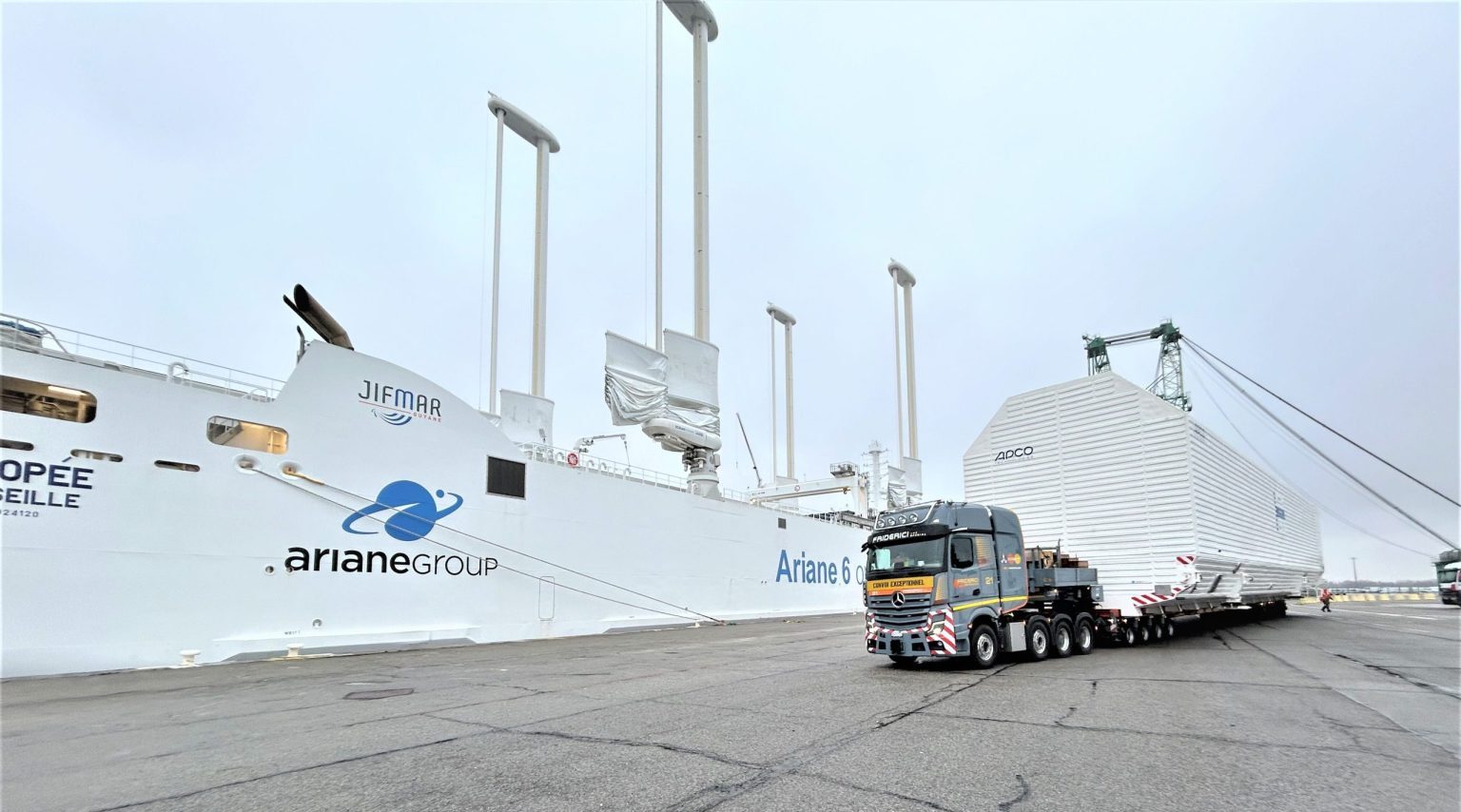
European rocket over sea to space
In a fixed rotation, the purpose-built sailing freighter Canopée transports Ariane 6 rocket components from Rotterdam, Bremen, Le Havre and Bordeaux, among others, across the Atlantic to French Guiana.
Transporting missile components is not a standard operation. The cargo is bulky, fragile and extremely expensive. The Canopé was specially designed for this cargo and the fixed route between Europe and South America. She was completed at Neptunes Shipyard in Hardinxveld-Giessendam and delivered in 2023 to the French joint venture Alizés of shipping companies Jifmar Offshore Services and Zéphyr & Borée. The special ‘rocket ship’ was named ‘Ship of the Year’ at the Maritime Awards Gala in Rotterdam in the same year.
Complete rocket
The Canopée can carry all the components of an Ariane 6 rocket in a single voyage. During a rotation, the ship calls at several European ports, each supplying a specific part of the rocket. In Bordeaux, for example, parts of the fuel boosters are loaded. In Le Havre, the ‘core stage’ goes on board. In Rotterdam, the top of the rocket and body parts will be loaded and in Bremen the final components. The ship then sets sail for French Guiana. There, the rocket will be unloaded and assembled for launch for the European Space Agency’s (ESA) space programme.
Vulnerable cargo
The demands on the ship are high. Rocket components are not only large and heavy, but also sensitive to vibrations, moisture and other external influences. The 121-metre-long Canopée has a cargo capacity of about 5,000 tonnes and makes the crossing at a speed of about 16.5 knots. This allows her to make several voyages a year quite easily. Le-Nechet: ‘It all listens very closely, but being in control means we can respond to problems immediately.’
Sailing ocean across
The Canopée is equipped with four so-called ‘Oceanwings’. These are 37-metre-high wing sails that automatically turn with the direction and force of the wind. The ship also has an advanced routing system that continuously takes wind, currents and waves into account. The system is linked to the sails, automatically adjusting course and sail position to make the most efficient use of the conditions.
Wind support is used to supplement the regular engines. ‘We can save around 30% fuel with the sails.’
Dutch touch
Apart from building the rocket ship, more Dutch companies are involved in the Ariane 6 programme on a daily basis. For instance, the Dutch branch of Airbus is building the structures that hold the rocket’s engines in place. These parts ensure that the thrust is properly distributed throughout the rocket. Aerospace Propulsion Products (APP) in Klundert is also helping to build the spacecraft. The company developed the igniters that trigger the rocket motors at launch.
Source: read the whole article by Joost Meily in the Schuttevaer (for subscribers only)
Image: Arianegroup.

Windassist sponsor