
‘Grutte Pier’ kicks off Frisian steel sail industry
The ‘Grutte Pier’ is the first but many more are to follow: thirty-metre-high steel sails that allow seagoing vessels to sail much more economically.
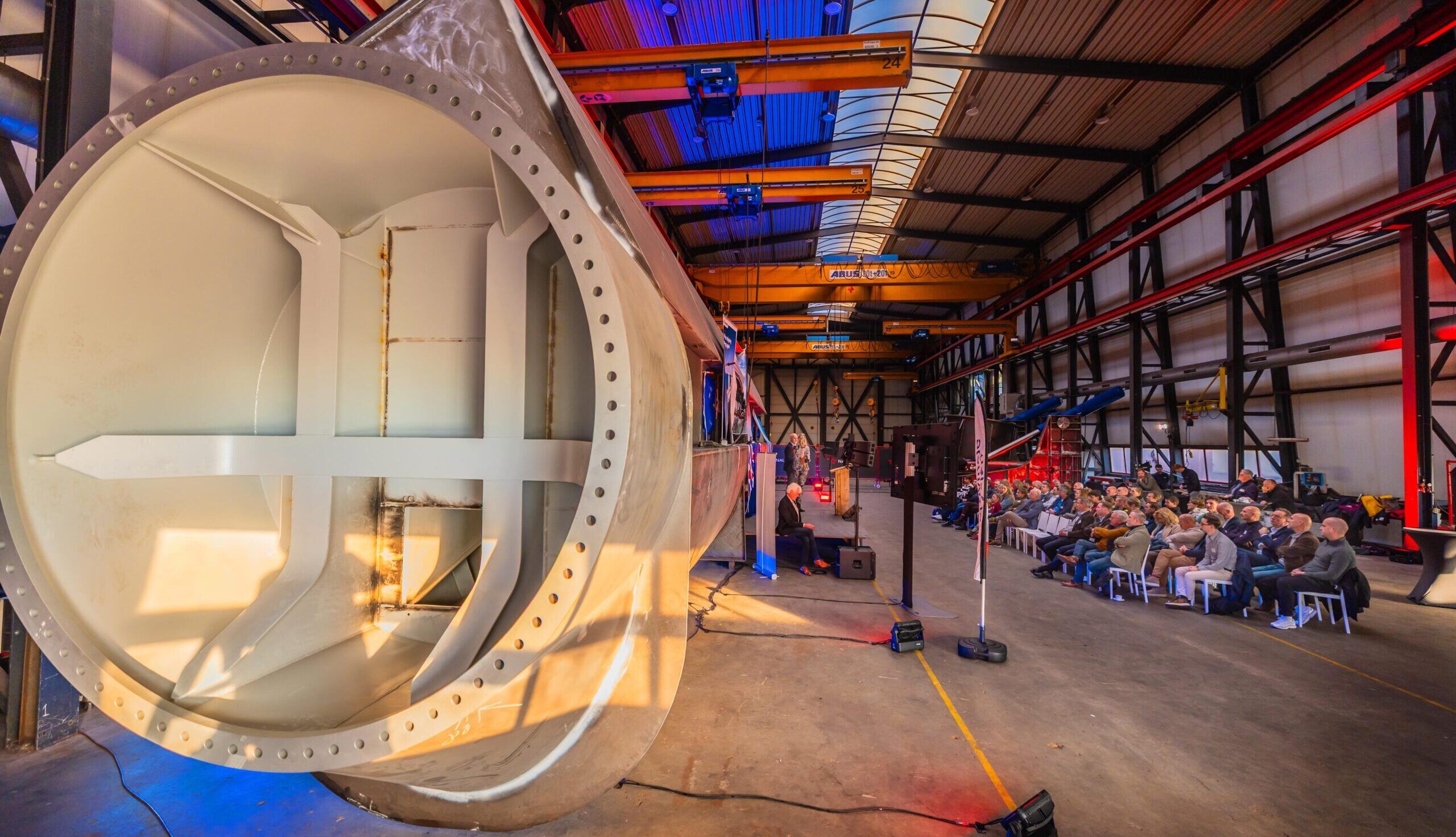
On Friday afternoon, it was presented in Heeg with a plan to build more soon. So on its side, it does have something of a large sword. Not surprisingly, deputy Friso Douwstra – when asked on stage what he thinks of the name ‘Grutte Pier’ just unveiled by him and two children – but starts freely associating about the Frisian primal warrior’s sword. “Although I don’t think he could have lifted this one.”
Ventofoil XL
The ‘Grutte Pier’ is a steel sail conceived and designed by Zeewolde-based Econowind, called Ventofoil XL, built at steel builder Nauta in Heeg. Although it is called a sail, wing is a better description. The 30-metre-long colossus is mounted vertically on a ship, but works pretty much like the horizontal wings of an aeroplane. Whereas in the latter the lift pushes the plane upwards, in this case it propels the ship forward.
Ten percent less fuel needed
In this way, considerable savings can be made on fuel consumption. Econowind calculates averages of about ten per cent per sail. That sounds like not a lot, but the savings are significant, says COO Rens Groot. “A large ocean-going vessel consumes 50 to 100 tonnes of oil per day. If you take ten per cent off that, it adds up quite a bit.” We can save a lot with a lot of sails, by the way, but run into other objections, Frank Nieuwenhuis, spiritual father of the sails, explains a little later. “Then at some point you become classified as a sailing ship. And that has its limitations. For example, that you have too little power to sail when there is no wind.”
Pioneering phase is now over
Nieuwenhuis was general manager of Econowind in recent years but now focuses more on product development. As managing director, he guided the company through the first years of pioneering. From the first small trial designs to the regular Ventofoils, sails of sixteen metres high, which are already being produced in Zeewolde and, until recently, also in Warten at Bijlsma shipyard. They are already being sailed. Boomsma Shipping from Sneek, among others, has been operating a ship with these smaller sails for several years. A second ship is currently under construction.
Econowind has now reached the stage where it is time to scale up. More sails need to be built and installed. Its sights are set on Friesland in this respect; according to the company, the province is optimally equipped for this task. “There is a very strong maritime cluster here,” says Groot. “Moreover, it is close to one of the busiest sea routes. And entrepreneurs here do dare to take risks.” Production would then be at companies like Nauta. There, they do believe there is a future in it. “Worldwide, there are 30,000 ships suitable for this technology. The potential is very great,” says managing director Harald Booij.
Installation biggest stumbling block
In the process, there is another major obstacle: installing the sails. “That is more difficult than we had thought beforehand,” says Nieuwenhuis. “And that has mainly to do with the fact that these ships cannot be idle for too long. Every moment they are not underway costs money.” An assembly hub in Harlingen is now being considered as a solution. Experienced teams could quickly do the installation there. “A coaster is there in two hours. That’s doable. But we might also have to rely on a combination of different things. That’s still searching.” To give the scale-up some extra wind in its sails, there is funding from Europe. From the Interreg programme comes €3.4 million that has been supplemented to €5.7 million by other partners. “Very nice,” says Nieuwenhuis. “It is not enough of course but helps. Although in the future we would also like to see subsidies for shipowners to buy a sail. Then it really starts to take off.”
Besides Friesland, also in China
Incidentally, production and assembly should not be the sole responsibility of Friesland. Econowind recently signed an agreement with Japanese shipowner Nissen Kaiun to also build sails at its shipyard in China. This will make it possible to serve the Asian market. From Europe, this is actually impossible, says Nieuwenhuis. “They are such big things. Transport costs as much as construction. That can’t work out.”
Source and photo: Leeuwarder Courant (subscribers only)

Windassist sponsor