
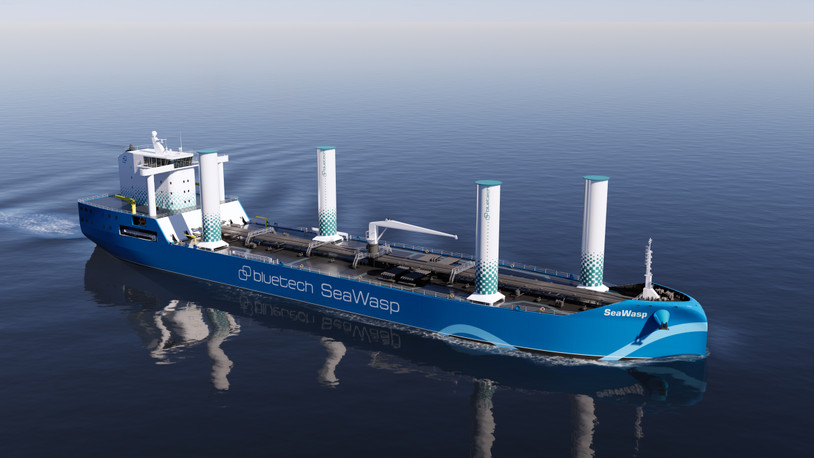
IS evaluates wind-optimised tanker design
Tanker shipping company International Seaways (IS) has conducted a study on the benefits of wind propulsion on its mid-range tankers. The project studied wind as well as hull optimisation.
International Seaways led a joint research project to evaluate a specially designed, wind-optimised MR tanker concept, analysing modelled reductions in propulsion power and annual fuel consumption during representative voyages.
The concept is intended to test whether wind support can add usable power to future vessels, while maintaining operational capabilities for mid-range (MR) shipping.
Michael LaGrassa, director of performance and newbuilding at International Seaways, says: “We didn’t just focus on energy savings and emissions reduction – our goal was a concept design that works in real-world MR trading. That meant we had to ensure reasonable construction costs, equivalent cargo capacity and a design fit for purpose. Our approach was to test a wide range of scenarios in the MR trade, rather than relying on selectively favourable assumptions.”
Substantial savings
International Seaways reported that advanced simulations on a representative MR route from San Francisco to South Korea showed total propulsion savings of up to 876 kW, equivalent to about 597 tonnes of fuel per year, compared to a conventionally powered reference vessel.
The same analysis package reported a lower scenario on a route from South Korea to Singapore, where prevailing winds reduced the benefit to 275 kW and 186 tonnes per year.
The wind-oriented concept was based on a modified MR baseline, which was described as about 12% more efficient than the typical performance profiles of tankers in the sample fleet, with further gains thanks to refinements above and below the waterline developed during the study phase.
Modified hull
The project also examined a new fin arrangement under the hull that reduces power requirements in computer simulations, and to an aerodynamically treated upper deck and superstructure designed to reduce wind disruption.
International Seaways worked with Bluetech Finland Ltd, which adapted its BT50 design to extract maximum forward thrust from two 35-metre Norsepower rotor sails.
“We wanted to develop a vessel that is fully WASP-optimised but retains all essential operational features and complies with all trade-specific terminal and port restrictions,” said Sam Robin, director of energy-saving solutions at Bluetech.
Bigger is better
The project also investigated which configuration of rotor sails, four smaller 24-metre units instead of two 35-metre units, provided the best combination of cost and thrust.
“Each configuration had slightly better performance profiles in different conditions of apparent wind,” said Severi Sarsila, sales engineer at Norsepower, with the larger pair having higher potential at the upper end of the savings spectrum and lower overall costs.
Source: Craig Jallal on Rivieramm.
Image: International Seaways.

Windassist sponsor