
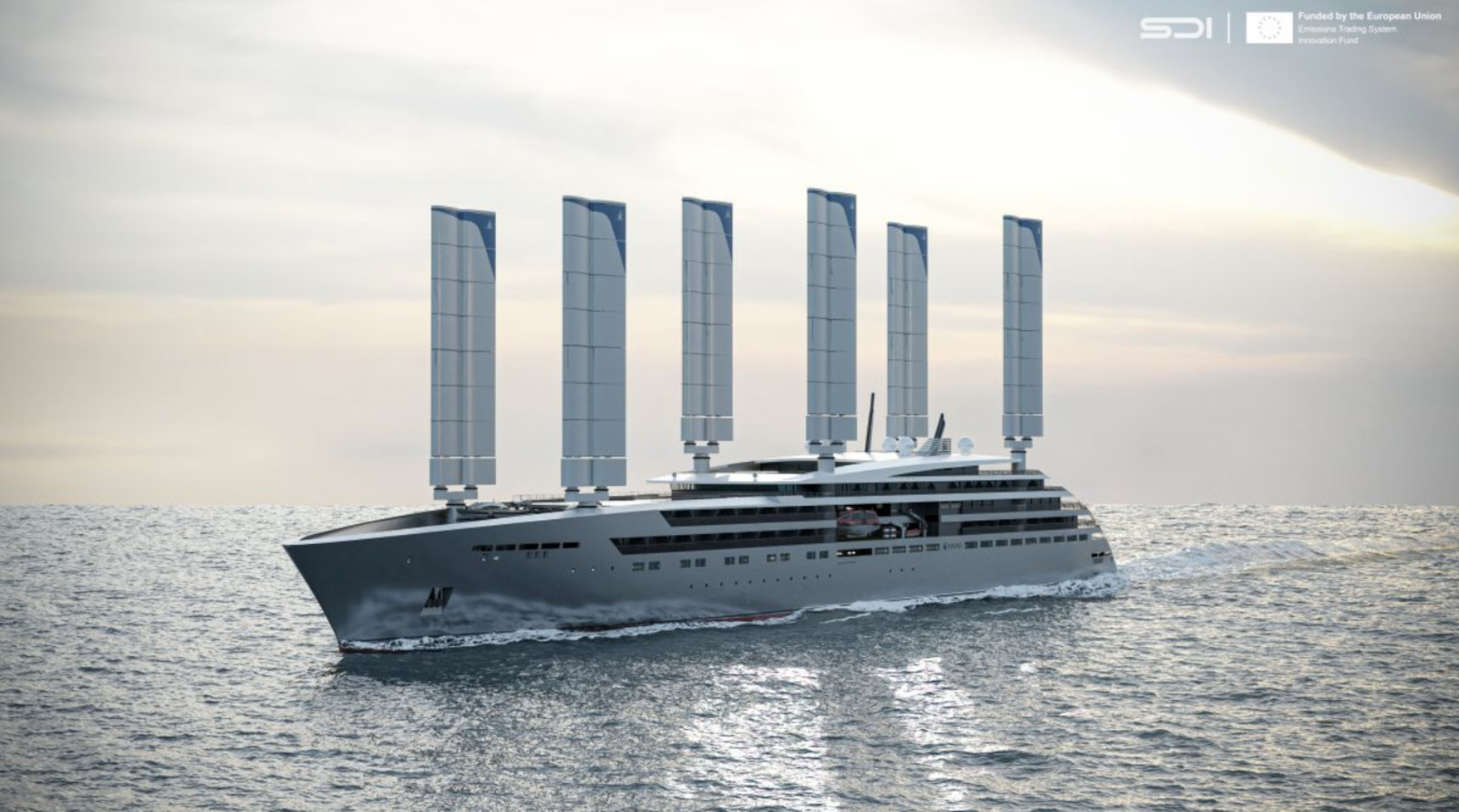
Net-Zero cruise ship in the making
Ponant Explorations’ Swap2Zero has been awarded two financial grants, has identified shipyards for the contract and has been awarded an AiP by Bureau Veritas, for a net-zero cruise ship, that should be launched in 2030.
It has been a challenging path to get here. Ponant Explorations newbuilding director Mathieu Petiteau tells PST, “Since the end of 2023, we have been in discussions with several shipyards to find an available slot and to get an indication about vessel price. We built a detailed technical specification and package for a quotation. We received price indications from major shipyards and were shocked because prices have increased by about 80% since Covid. We tried to understand more after those first cost estimations.”
Overbooked ship yards
The French cruise operator faced another obstacle: main shipyards in Europe are fully booked with big vessels up to 2033 and 2034. “They are more interested in big vessels to reduce risk and better occupy their docks. This pushed us to look at other shipyards in Europe not initially focused on cruise. The problem is the very high price and low number of available slots,” comments Mr Petiteau.
EU grants
Since these initial setbacks, the project has moved from strength to strength. The European Commission chose the project for its innovation fund, which resulted in a €40 million grant. Swap2Zero has also received financial support from the French government and the French Public Investment Bank as part of the national Government Grant France 2030.
Furthermore, Ponant Explorations has identified shipyards in Finland, Germany, Portugal and Italy which are working on price estimations.
Aero- and hydrodynamics
The company is currently completing its concept design phase, is about to start basic design and aims to sign with a shipyard at the beginning of 2026.
Mr Petiteau says, “We are starting to get some numbers and studies together regarding the aerodynamics. We’ve completed aero-CFD analysis and are now working on the hull shape and hydrodynamics. When building a vessel using wind propulsion, you need a sail and a very efficient hull. We need to start working on the hull design to improve that. Our technical specification is becoming more and more precise because of the studies carried out.”
Six building blocks
Swap2Zero aims for zero CO2 emissions in operation by combining six major decarbonisation technology building blocks:
- A sail power system and hull providing an average of 50% of the propulsion energy using the force of the wind.
- A surface area totalling more than 1,000 m2 of photovoltaic panels, with generation of light and efficient solar eco-designed devices integrated into the structures.
- A low-temperature fuel cell operating on liquid hydrogen for propulsion, with the water and heat produced being recycled.
- A high-temperature fuel cell to meet the ship’s hotel load requirements, with the heat emitted being recovered and used to produce hot water.
- Onboard carbon capture technology, coupled with the high-temperature fuel cell.
- An innovative bespoke energy-management system and mutli-level digital twin to control and distribute power without generators enabling the vessel to be operated most efficiently.
Mr Petiteau elaborates, “We have defined the size and volume of the vessel based on the wind-assisted propulsion system to get up to 50% of the propulsion energy and keep an autonomy of one month. If we do not have wind, we will use fuel cells and if there is enough wind, the vessel will operate only on wind. Most of the time, the vessel will be operating in hybrid mode. We now have a clear idea of the operating profile of the vessel.”
He sums up, “We want to demonstrate that we can sail one month with a transoceanic vessel with net-zero carbon with our multi-energetic concept. We are committed to this challenge with the collaboration of regulatory bodies French Flag and Bureau Veritas, design companies LMG Marin and Stirling Design International, industrial partners Actemium Marine and innovative SME D-ICE Engineering.”
Source: Rebecca Moore at Riviera.
Photo: Swap2Zero.

Windassist sponsor