
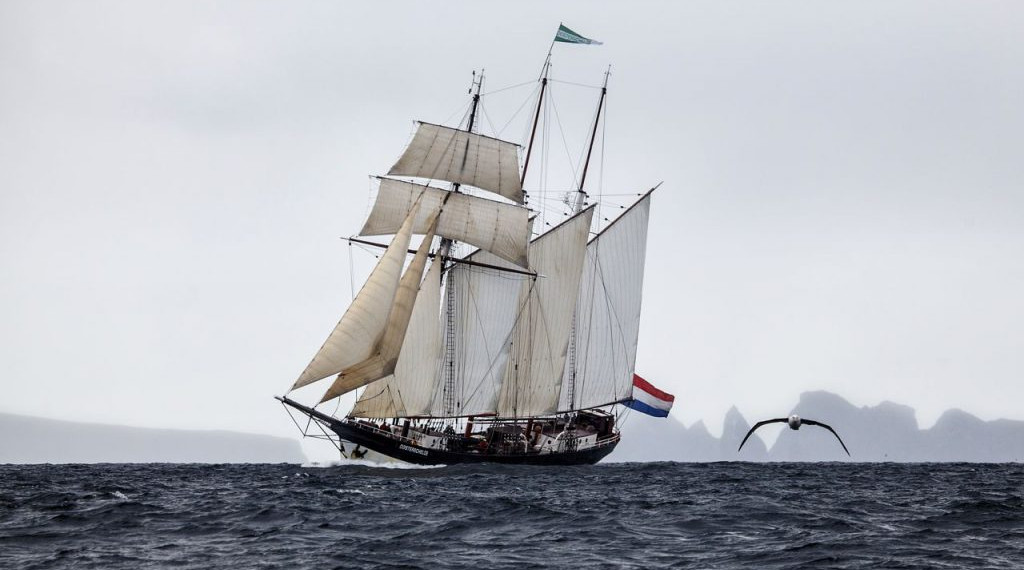
Oosterschelde is back from world tour
The Oosterschelde was welcomed by a historic ships parade in home port Rotterdam, after two years around the world in the footsteps of Charles Darwin. Captain Jan-Willem Bos: ‘I would do it again without hesitating.’
The Oosterschelde’s passengers are tired after a London – Rotterdam leg, which also involved night watches. The seven-member crew that sailed around the world is full of energy on board. They are used to some things and are looking forward to coming home, although they are also just as happy to board again next week. “This is just my job,” Bos says soberly, “but it’s the best job there is.”
Leaving the Thames takes several hours, with high-rise buildings giving way to seaports, after which wind farms loom out to sea. At night, the sea is quiet and we and the ship seem to be the only ones at sea. At dawn, we see jellyfish swimming past the ship, visibility is up to six metres deep with the bright sunlight on the water.
The wind is changeable, sometimes we reach 7 knots, but there are also periods when we chug ahead at just 1 knot. ‘We leave the ho-mo out hear!’, says a boarding officer. Ho-mo, it turns out, stands for Main Engine in Dutch. Whoever wants to go up and down quickly takes a ferry, here on board it’s all about old-fashioned sailing.
Darwin
 The ship spent the last two years making a round-the-world voyage around the places Darwin called at, plus some additional special locations. The whole idea for this venture came from geographer Stewart McPherson. He set up a foundation, secured sponsors and mapped out a journey around four continents. He first searched in England for a historic sailing ship large enough to carry passengers but also suitable for sailing the world’s oceans. That proved to be a tricky task. ‘Actually, only Tall Ship Lord Nelson was suitable, but it went bankrupt in 2019.’ The search was extended to the Netherlands, where Oosterschelde came into the picture. ‘We have a lot of experience, have gone around the world before and were keen to cooperate.’
McPherson himself flew to the ports where, each time the ship arrived, there was a Darwin event with young researchers and scientists. The organiser sailed an occasional leg, but was still mainly on the organising side. ‘His efforts were of crucial value, says Bos. ‘Thanks to publicity, we got the trips full.’
A professional photographer always went along from the organisation, something that caused some tension around the Easter Islands. Photographer Tom: ‘I just had my drone in the air when the Coast Guard of Chile called us. They said it was forbidden to film, while I neatly have all the permits and certificates.’
Suddenly, a police boat came alongside and Tom had to join them. ‘That was a bit exciting. They wanted to take my drone, which I refused. They did take the usb card, fortunately I had already backed up all my footage, including the rest of the trip.’ The somewhat unfriendly welcome contrasts with how the rest of the world reacts as soon as the ship enters port under sail. It is almost everywhere a special moment for locals to be able to admire such a large ship under sail. On the spot, people can come on board, or join a short sailing trip. A good way to keep the ship running profitably.
Crew
 Working on board are mainly young people who have yet to start studying and have taken this on as an adventure. Bos: ‘We don’t select on experience, but on willingness to work. You have to be a doer, you learn to sail on board. In addition, people need to be sociable, because you get a new group of about 24 boarders on board every time and they are your guests.’
An army marches on its stomach, a ship sails on its galley. Ship’s cook Vicky (41) from the Shetlands makes sure everyone is well fed. ‘I learned to cook from my grandmother, who sadly died at the age of 91 this year. After my studies, I went to work in an office, but that was not for me. I was able to work aboard a ship and was immediately smitten. This world is small and you find work via mouth-to-mouth, which is how I was asked to work on this ship,’ she says as a tray full of muffins goes into the oven. When she has time off, she doesn’t always go home. ‘I get a month’s leave every time, the last time I went travelling through Uganda. That was amazing.’ You have to have good sea legs to work in the galley, because the ship rolls quite a bit at times.
First mate Jenny (30) from Germany now speaks fluent Dutch and English and learned to sail from a young age on her own initiative. ‘Usually parents teach their children to sail, I wanted to learn to sail and eventually persuaded them to get on board too. They now have their own sailing boat, but I wanted bigger than a pleasure boat.’ She attended nautical college in Enkhuizen and came to work for Oosterschelde 11 years ago.
Jenny: ‘I have seen the most beautiful parts of the world, such as South Georgia and the Pacific. Nevertheless, I will disembark after this voyage. I don’t want to become a captain at the moment, but I want more qualifications than just being a first mate.’ She will study biology and then look further. ‘I do want to keep sailing.’
Maintenance
The ship will undergo major maintenance in the coming weeks. First in Rotterdam harbour by our own staff, then at Padmos shipyard in Stellendam. ‘We have very good experience there,’ says Bos. After that, it will be time for Sail Amsterdam and then some short trips. In winter, the ship will travel to Africa and make a six-week crossing to Suriname. Bos: ‘Then you do get tired after such a long crossing, but it is a wonderful trip. Just like every trip actually.’
Sail New York
Meanwhile, it is also already known that the Oosterschelde will be at Sail New York next year. There, the 250th anniversary of the US will be celebrated; it promises to be the biggest sailing event in the world. Until now, that title was reserved for Sail Amsterdam.
The promotion of Sail New York began in May this year, but ended in a fiasco. The Mexican Tall Ship ARM Cuauhtemoc became rudderless on the East River and sailed her masts into the Brooklyn Bridge. This resulted in several deaths and injuries. That ship was supposed to be at Sail Amsterdam, but is still at the shipyard for repairs. The investigation into what happened is still ongoing.
Sail New York will continue as usual, however, and the organisation is already hard at work behind the scenes. ‘We will soon start a major media campaign,’ a spokesperson told Schuttevaer. Then more will also be known about next year’s programme.
 The sailing naval vessel Zr. Ms. Urania will also be present, the US organisation confirmed. The 2004 ship is used for aspiring naval officers, the midshipmen. They receive their training at the Royal Naval Institute. In terms of layout, the 27-metre-long ship is typically Dutch, as the berths are 2.10 metres instead of previously 1.80 metres. Large enough, therefore, for taller Dutchmen. The ship has 11 sails on board with about 300 square metres of sail combined, as well as a Caterpillar 253 hp propulsion system.
Source: two articles by Tessa Heerschop in the Schuttevaer (for subscribers only)
Images: Oosterschelde and Kon. Marine.

Windassist sponsor