
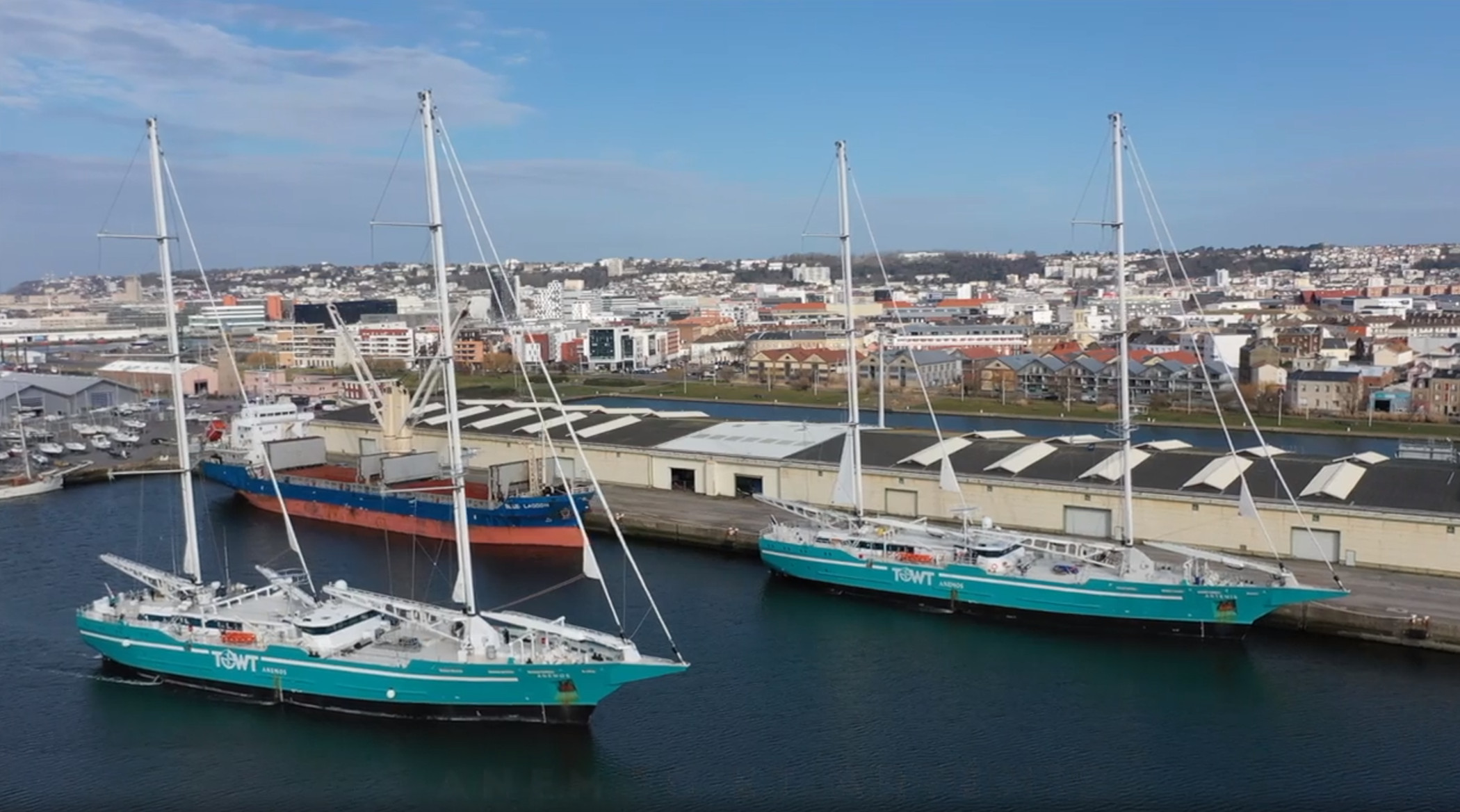
Sailcargo pioneer Trans Oceanic Wind Transport goes down
From France, for many years we have only heard wonderful stories about ever new, wealthy new building projects for sailing cargo ships. Therefore, the news that TOWT, which had four newbuilds in service, is bankrupt, hits hard.
Trans Oceanic Wind Transport (TOWT) , which for many years has symbolised the revival of cargo transport under sail, sees its operations continued for the time being under the supervision of the court in Le Havre, while a takeover candidate is sought.
Founder Guillaume Le Grand himself spoke of “a model that has been unlucky”. “36 Transatlantic crossings, 1,100 europallets transported per crossing and some 5,000 tonnes of CO2 saved. So much work on making ships reliable and optimising them and the 48 people I think about above all. We will see what happens, but rest assured, I have tried everything and I have no desire to stop there.”
Transatlantic routes
From its base in Le Havre, TOWT built a network of transatlantic routes to New York, Canada, Guadeloupe, Guatemala, Colombia and Brazil, among others. A crossing usually takes between two and three weeks.
Twelve passengers can also sail on board. Besides transport, the voyages sometimes serve for scientific research, with measurements of air quality, temperature and salinity on the open sea.
Perspective
A spokesman for Grain de Sail, another player in the sector, put the news in perspective, saying that one company’s situation should not be confused with that of an entire industry.
The key message: sail transport is no longer a niche experiment, but a response to a structural challenge – reducing the carbon footprint of shipping. However, the transition between the experimental phase and industrial operation seems longer and riskier than expected due to changing economic realities.
Whereas TOWT relied heavily on rapid scale-up, Grain de Sail takes a gradual approach:
- a first vessel as a prototype
- a second, larger and more robust vessel
- and soon a third ship of more than 100 metres, integrated into global logistics
What went wrong with TOWT?
TOWT was founded in 2011 with a clear mission: to transport goods across the ocean again with wind power.
The next step was to build its own fleet of modern cargo sailing ships. The first two, ‘Artemis’ and ‘Anemos’, are 81 metres long and can each carry about 1,000 to 1,100 tonnes of cargo, good for about 1,100 euro pallets. Thanks to their sail drive, CO₂ emissions can be up to 95 per cent lower than a conventional cargo ship of similar size, according to the company . The company built a strong brand around sustainable, high-quality products such as coffee, cocoa, rum and wine.
Disruptive influence of Trump
However, as was the case with other sectors, Donald Trump’s re-election had a disruptive impact on the market, and the volumes to be carried and the climate issue melted away like snow in the sun. According to the company, US tariff policy, low freight rates and the crisis in wine and spirits are creating undue financial pressure. Shrinking demand caused a decline in the customer portfolio. This especially causes ships returning from North America to suffer from very low load factors. This worsened the profitability of the return voyages. Despite a turnover of almost €5 million last year, the company struggled to keep up with investments.
The problems arose mainly in the planned scale-up :
- high investments in its own fleet.
- delays in the delivery of new ships
- geopolitical pressures, including US trade policy.
- crisis in the wine sector, an important market.
- incidents such as the fire on the Artemis in Brest
The real challenge: size and reliability
Today, the industry is at a tipping point. Customers expect not only sustainability, but also:
- reliable departure times
- predictable delivery times
- constant service quality
- demonstrable CO₂ reduction
The big challenge is clear: cost per tonne, increased capacity and standardised logistics flows – without losing sight of the ecological ambition.
Future remains open
Despite the bankruptcy, TOWT’s activity will continue for now. Interested acquirers still have until mid-April to come forward. At the end of April, the court will decide on the company’s future. If a takeover succeeds, TOWT could still continue to play a role in the development of low-emission marine transport.
TOWT’s bankruptcy is undoubtedly a setback for the sailing cargo shipping sector, but it does not mean the end. There is optimism in the industry, as the need for sustainable shipping grows, and technology and markets continue to develop. Sailing shipping has good prospects in the medium term, driven by climate requirements and the development of European and international regulations.
Sources: Seatalk, Voiles et Voiliers, Actnautique.

Windassist sponsor