
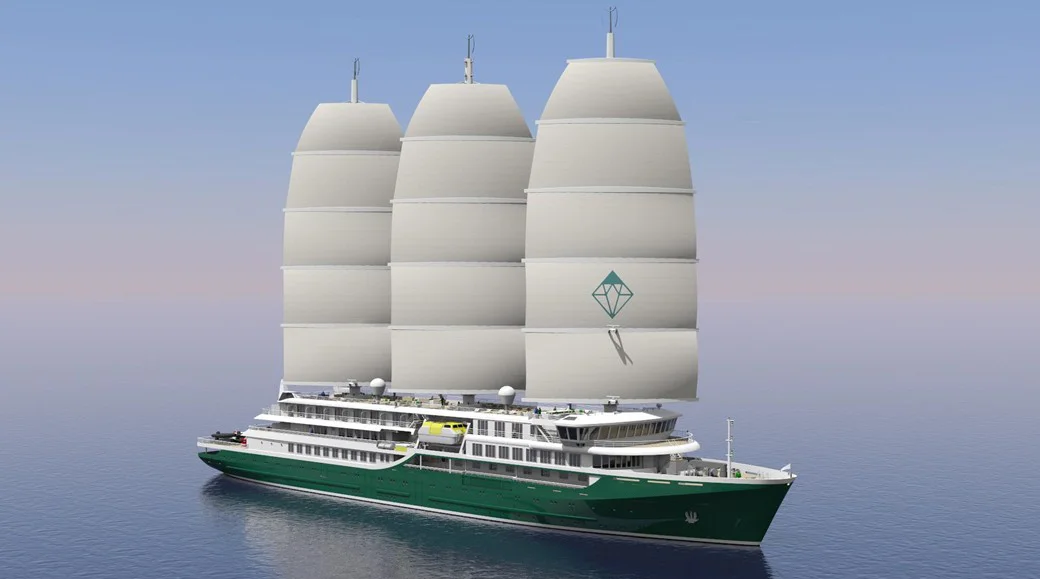
Oceanwide goes under sail
Dutch company Oceanwide Expeditions, an experienced pool and expedition cruise provider, has signed a letter of intent for the construction and delivery of two eco-sail expedition cruise ships.
The unique-looking vessels, shown in artist impressions with three huge dynarig yard sails, are in line with a trend in the expedition segment of the cruise industry, which is leading the way in the adoption of wind-assisted propulsion. Few details were provided about the proposed order, except that the two ships would be equipped with a hybrid sail-drive system.
The company reports that various sustainability options will be built into the design. Details about the shipyard and construction schedule will be announced when the contract is finalised. Marketing for the ships would start in 2027.
The ships, which are expected to enter service in 2029 and 2030, would be part of Oceanwide Expedition’s goal to support a future for environmentally conscious polar tourism.
Sailing in the DNA
The company, which has been in business for more than 30 years, currently owns and operates a fleet of four expedition vessels, including the s/v Rembrandt van Rijn, a three-masted schooner used for expedition cruises between the fjords of Greenland and Svalbard, and the ice-strengthened vessels m/v Hondius, m/v Ortelius and m/v Plancius, which are deployed in the Arctic and Antarctic.
“Sailing has been in our DNA from the beginning, and these eco-sailing vessels will integrate modern sustainability features, hybrid propulsion and a smaller carbon footprint into the same authentic, immersive Oceanwide guest experience. These ships are an essential part of our long-term vision to remain small-scale, operationally flexible and environmentally friendly,” said Rémi Bouysset, CEO of Oceanwide Expeditions.
The company reports that the design of the eco-sailing vessels will be based on the HONDIUS, which launched in 2019. The ship is 107 metres (351 feet) long and can accommodate 170 passengers. It was built by Brodosplit in Croatia and has Polar Class 6.
The ship would be joined by a sister ship called Janssonius in 2021. Construction began in 2020 and the ship was launched in March 2021, but has not yet been delivered due to financial problems at the shipyard.
The new ships will include “significant improvements” in both operations and passenger experience, reports Oceanwide Expeditions. Each ship will accommodate 146 passengers.
Niche
Sailing cruise ships have traditionally been a niche in the industry, with companies such as Windstar starting in the 1980s. From later this year, Orient Express will enter the ultra-luxury cruise segment with the first of two cruise ships equipped with sails.
The first ship, the Orient Express Corinthian, recently set a speed record for a large sail-powered vessel. The drive for sustainability, especially in expedition cruises, has led to increased interest in batteries and wind-assisted propulsion.
Another expedition cruise company, Atlas Ocean Voyages, recently announced its plans for a 26,000 gross tonne sail-supported expedition cruise ship that will accommodate 400 passengers.
Hurtigruten, in collaboration with Vard, has also discussed its efforts to design a zero-emission ship for its coastal Norway cruise, which would feature retractable sails, while Ponant has released details of a concept involving sails, carbon capture and fuel cells.
Source: the Maritime Executive.

Windassist sponsor