
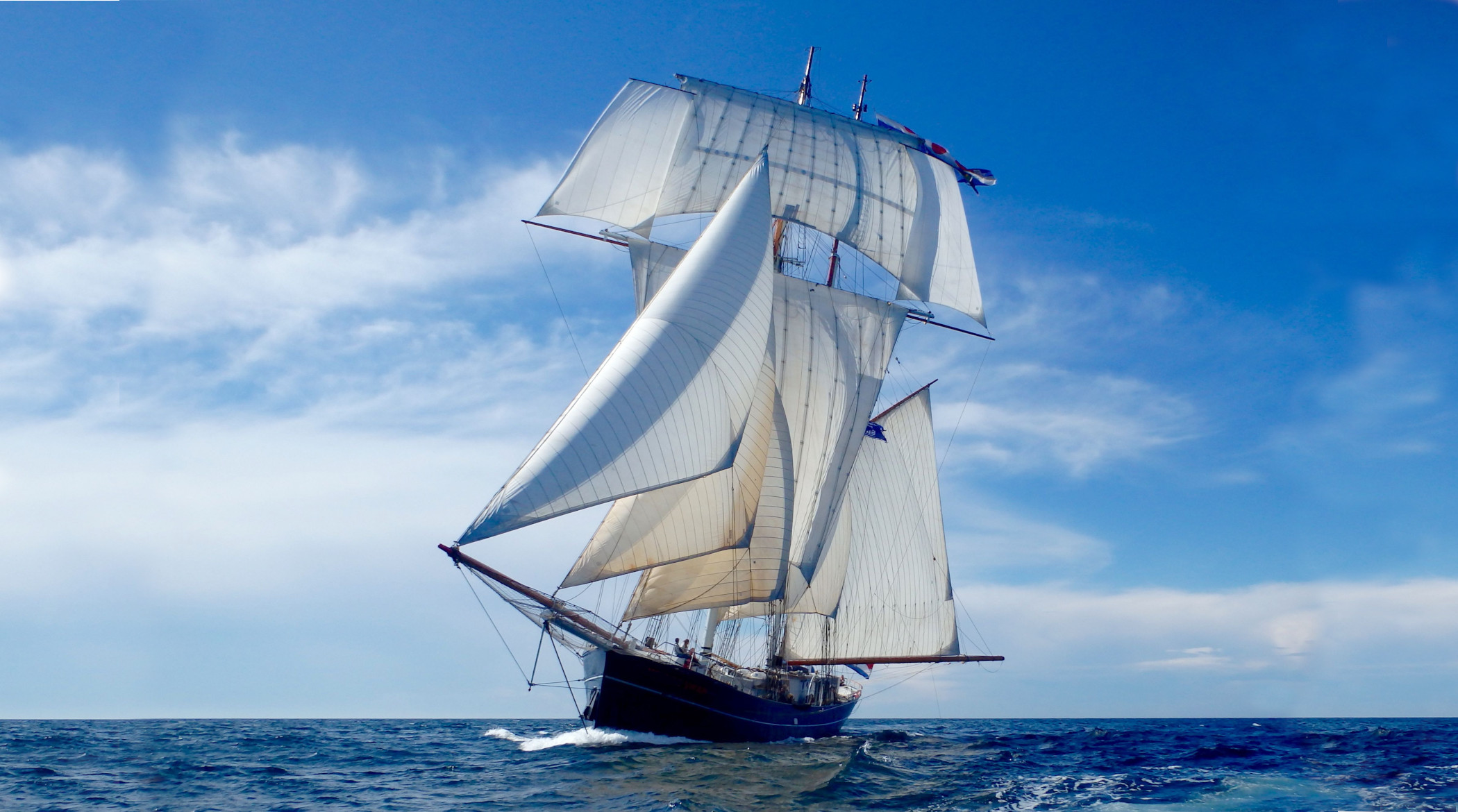
Wylde Swan sails from Harlingen to Curaçao
Six weeks of sailing to Curaçao during the school year, compulsory schooling and all. Aboard the Wylde Swan, 34 pupils combine online lessons with watchkeeping and sail setting. ‘Those six weeks at sea are life-changing.’
The Friesian two-master is moored at the Kleine Werf in Willemstad’s Anna Bay. The previous batch of students has just flown back to the Netherlands. The new group is preparing the ship for departure. A truck from a local wholesaler delivers boxes of pasta, bags of chips, squeeze bottles of mayonnaise, pepper crisps, cans of beer, bananas, watermelons and, above all, lots of toilet paper. In a pass-through chain, the supplies disappear down the gangway to the hold. The crew adjusts where necessary.
Cheeky
Three years ago, the ship got a Spanish captain. Alvaro Moratalla (46) grew up in Barcelona and is the only one in his family who chose the sea. ‘As a child, I read adventure stories centred on the sea, like Robinson Crusoe,’ he says. He obtained his Dutch papers at the Enkhuizer Zeevaartschool. On the back dock, overlooking the colourful facades of Willemstad, he says: ‘I don’t speak Dutch. I don’t have to, because for safety reasons, English is the language of communication on board.’

After several days of sailing, the students take over the work on the ship in the afternoons. They bake bread, stand helm watch and hoist sails. ‘Obviously under the supervision of our crew, who are partly volunteers and partly paid.’
All levels
Head teacher on board is Margot Sauer (46), in daily life attached to the MBO-College in Lelystad. She recently boarded a plane to Curaçao in Amsterdam. ‘It started with a day trip Harlingen-Terschelling. This was followed by a trip to Denmark. I got seasick, so it’s still exciting to leave again.’
Education continues unabated for these compulsory school students. Sauer maintains contact with the home schools and monitors the programme. ‘They are given a full curriculum. We coordinate constantly.’
The group consists of pupils from vmbo-tl to vwo. Most are 16, 17 or 18 years old. Sauer: ‘The world needs ambitious young people. That is why we organise ocean trips for high school students. Those who want to come along have to go through a preparation process of sometimes several years, in addition to normal school work. Participants save part of the amount themselves. That requires discipline.’ Remarkably, the majority are girls. ‘Girls know how to find and motivate each other well through social media.’
Passaatwind
The outward journey to the Caribbean is different from the return journey. Moratalla: ‘We left Harlingen in October. Via Scotland, Spain and the Cape Verde Islands, we sailed to Saint Martin. Then past Saint Lucia, Dominica and Trinidad & Tobago, among others, to Curaçao. The return trip requires a different route due to the trade winds. We first set course to the Dominican Republic and then to Bermuda. Only then will we cross to St Maarten.’
Six weeks together on board, with young people aged between 14 and 18. Does that create tensions? Sauer laughs. ‘We play games in the evening or project a film on the sail. There are clear rules: “No sex, no drugs, but lots of rock and roll.”
Source: an article by Marius Bremmer in the Schuttevaer (subscribers only).
Image: ©Marius Bremmer and Wylde Swan.

Windassist sponsor