
Sailing cargo, oceanwide, without a crew
The American start-up Clippership aims to revolutionise the market for small-scale sailing cargo with autonomous vessels. The first prototype is being built in the Netherlands and will soon be launched.
For anyone who thinks the French will remain the global leaders in modern sailing cargo ships for the time being, this is big news. Three Americans from the world of Big Tech are getting involved, and their plans are nothing short of ambitious. Started in 2024, they managed to get funding of over 1M dollar within a year, and their first prototype ship is already under construction. Remarkably, the Dutch contribution to their plans is significant: Dykstra Naval Architects were responsible for the hull design, which is currently under construction at KM Yachtbuilders in Makkum.
Maritime robotics
All three Americans have a background in engineering. As seems to be the norm for this sort of start-up, they too began in a garage in Los Angeles, according to the information they have released. However, all three also worked for renowned companies and organisations before throwing themselves into the development of maritime robotics. Their aim: to enable unmanned sailing vessels to cross the ocean autonomously. With the help of AI – what else? – the route can be plotted using meteorological data to seek out the best wind conditions wherever they may be, thereby sailing from A to B as efficiently as possible.
The men developed the sails for their vessels entirely in-house. These are rigid wing sails, which can rotate on a fixed base and be folded down whilst in port. A test setup featuring a wing sail over five metres high on a sailing yacht over seven metres long generated a thrust which, according to the creators, is roughly comparable to a 40 Pk diesel engine. That sounds like a lot, but the information on the Clippership website is so detailed and technical in nature that they must have calculated it carefully. With that much energy generation, you can do more than just sail, say the inventors, and so you can also use it to power other systems on board, such as the computers, and, for example, the hold cooling system if you want to carry cargo.
First prototype
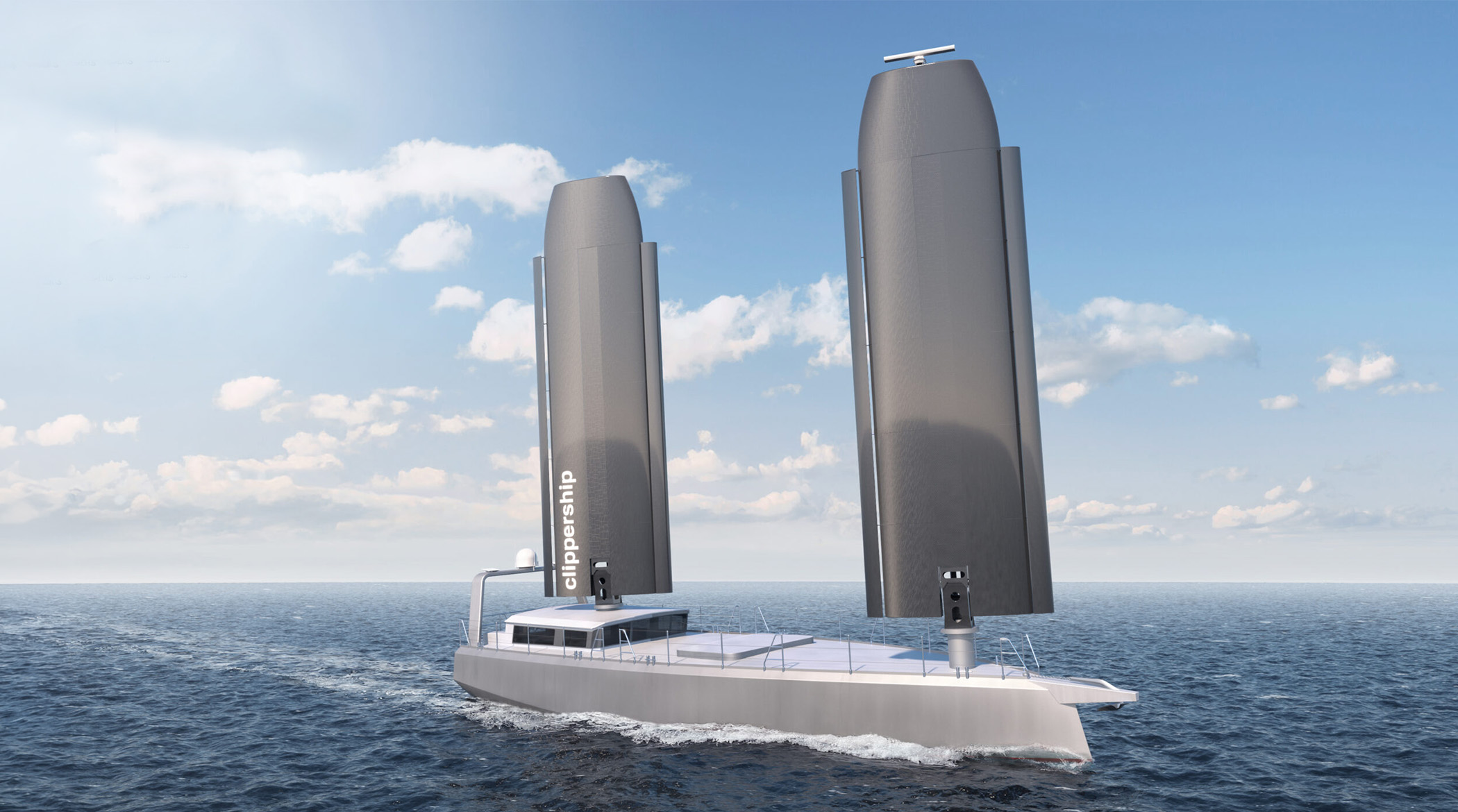
Clippership’s first vessel is almost ready. KM Yachtbuilders has not disclosed the launch date, but the plan is for it to take place before the end of this year. It is a monohull measuring just under 24 metres, designed to comply with maritime regulations for small vessels. The hull is that of a modern-looking yacht with a raked bow and a broad stern. The drawings show two wing sails, each approximately 19 metres high. The hold can carry 75 Euro pallets under climate-controlled conditions.
According to Mark Leslie-Miller, who is overseeing the design at Dykstra Naval Architects, this prototype is an initial ‘proof of concept’. The final design could also be a catamaran: ‘In the search for the right form and function, everything still can change.’
In the press release issued by KM Yachtbuilders regarding the vessel, it states that the ship will be ‘built in accordance with RINA regulations and inspected during construction to be classified as a WAPS General Cargo Ship’. It will fly the Maltese flag and is scheduled to be launched at the end of 2026, after which commercial operations will commence shortly afterwards on trial routes across the Atlantic Ocean, to the Caribbean and South America.’
New ambition
Clippership describes its mission as developing a new and better way to transport cargo across oceans and waterways: ‘If we succeed in this, we will open up new point-to-point trade routes, breathe new life into small ports and drastically reduce the environmental impact of maritime freight transport. To this end, we design, build and operate compact, highly automated cargo ships that are primarily wind-powered.’ On their website, the builders state that they have already found enough shipyards in their own region to be able to build hundreds of ships in a short space of time. If this succeeds, it may be possible to compete with larger shipping companies, as economies of scale will be achieved through many vessels rather than just a few large ones.
Meanwhile, that ambition has already been expanded further. One of the founders of Clippership, Kai Matsuka, posted on LinkedIn that over the past two years the focus has shifted from solving the problem of clean energy in long-distance maritime transport to ‘harvesting’ clean energy at sea using autonomously sailing ships to power floating data centres: ‘We are in an excellent position to tackle this challenge with the technology we have developed over the past two years. Our ships can extract megawatts of electricity from the ocean using wind energy combined with hydrokinetic turbines, with a capacity factor approaching 90 per cent. Cooling is in abundance, as is space on the ocean. That is why we have shifted our efforts towards building and commissioning our ships, which convert clean ocean energy into abundant intelligence.’
The Clippership website currently focuses mainly on information regarding this latest ambition. It is not yet clear whether this will overshadow the plan to revolutionise the international sail cargo market. The editorial team intends to enquire about this with the team behind Clippership for a future article.
Sources: Own research via the websites of KM Yachtbuilders and Clippership, with assistance from Dykstra Naval Architects.
Header photo: The 24-metre vessel as it is currently being built.

Windassist sponsor