
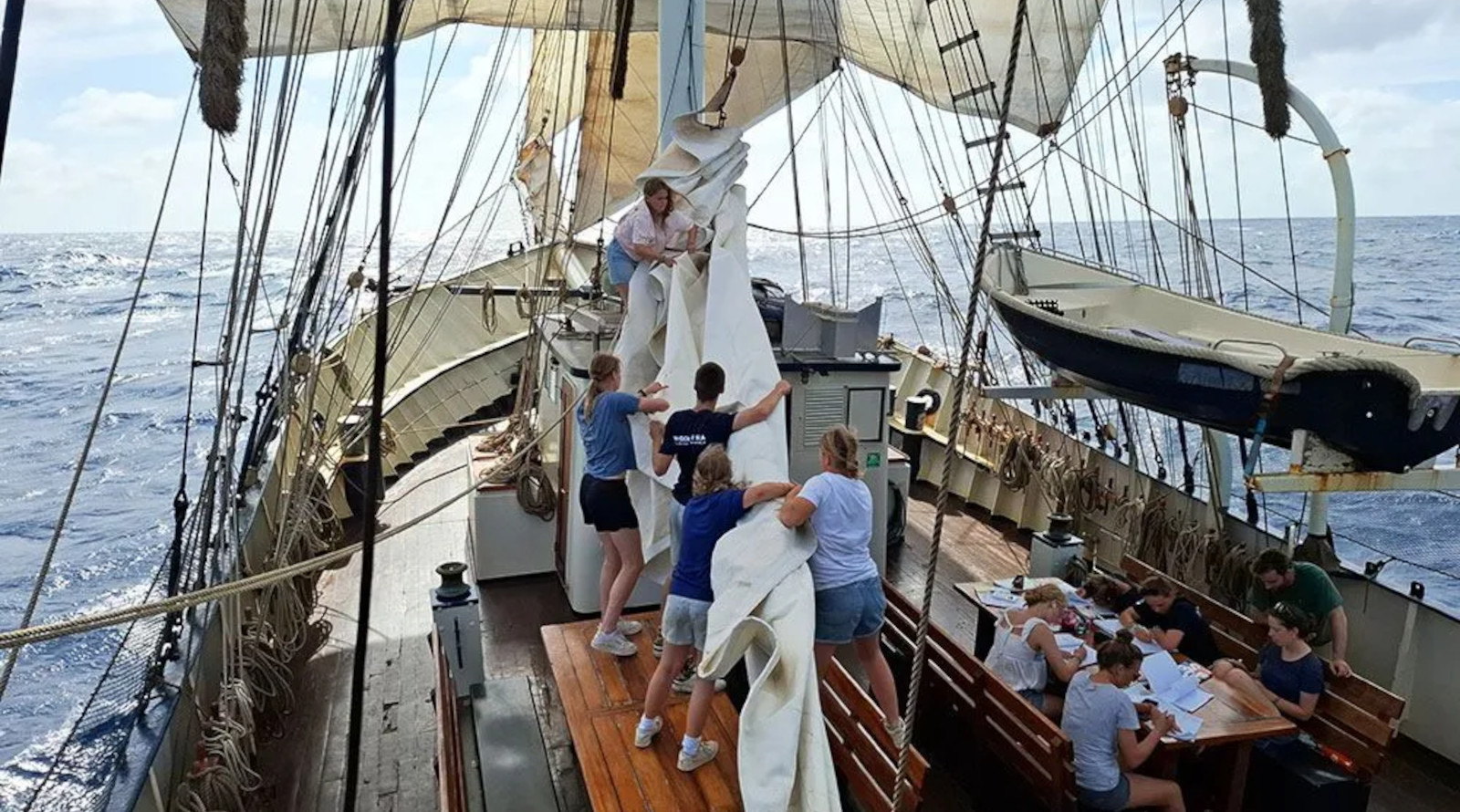
15 years of School at Sea
Monique Touw launched the School at Sea initiative in 2011. During and after her own studies, she realised just how valuable it can be to cross the ocean as part of a team.
Thirty-five school pupils sail to the Caribbean and back over a period of six months: that is the trip and the challenge organised by School at Sea. It is certainly no walk in the park. ‘Tough luck,’ says director Monique Touw with a laugh when asked what happens when things get tense on board the tall ship Thalassa.
Growing and discovering yourself
‘On a journey like this, you’re forced to work together,’ Monique explains enthusiastically. ‘You’re living in a group that’s more important than you as an individual. That gives you so much insight into who you really are deep down. You discover what your most important values are.’
Once on board, you can’t walk away from difficulties. ‘How will the pupils organise a harmonious community together? They don’t have the luxury of choosing who they spend time with. The value of the project is that, over those six months, you learn to set your prejudices aside. You’re dependent on one another and have to be able to rely on others to stand watch properly or bake bread. That’s how you really learn to take responsibility. This isn’t a game or a management exercise.’
Community
‘In October 2019, as a sixteen-year-old, I stepped aboard the Thalassa,’ says Elisa Breger, a former School at Sea student and chair of the alumni association. ‘We sailed for six months in total. I had to face myself more than once during that time, but above all, the journey boosted my self-confidence and taught me that I can try things, even if I’m not entirely sure yet, and that leadership is about trusting myself and others. I still apply these lessons in my daily life: for example, during my studies, on committees, on the board or at work.’
As well as discipline and self-confidence, the voyage was also an unforgettable adventure. With sunrises at sea, the wind in your face and meeting people on the other side of the world. You can see how something like this stays with you – and can change the course of your life – in the connections you make along the way.
‘Together with three others, I’m working on relaunching the alumni association,’ says Elisa, ‘where we’re building a community that supports one another and where we can share memories of our time there.’
A powerful tool
According to Captain Sam Dubois, the fact that the students are suddenly reliant on one another is also School at Sea’s most powerful tool: ‘With similar projects on a mountain, in a forest or in a desert, you can, in theory, always leave. At sea, that’s not possible; you can’t leave. As humans, we’re capable of a great deal, but the sea is still in charge. So you have to sort out your problems. That takes a lot of getting used to for the participants at first, but they realise that it’s also nice to take responsibility for yourself and the group. Our society is quite patronising; on board, it’s very different. If you’ve got a problem, you have to deal with it, and the whole team pitches in to help. Once they get that, everything runs like clockwork.’
Personal growth
‘I can really see them growing, and it happens very quickly. At the start, there are always a few participants who treat the ship or each other disrespectfully. Just like at school, they stick chewing gum under tables. The difference from school is that they don’t get away with it here. I only have six months with them, so I set clear boundaries and address any inappropriate behaviour straight away. It’s also a safety issue. They’re taken aback by this at first, but afterwards they tell me they appreciate it being made so clear. It’s a different structure to that in society. No ‘yes, but’. I sometimes read posts by former School at Sea participants on LinkedIn along the lines of: ‘It’s only now that I realise what the teachers there meant to me.’ Former participants also regularly come along in their spare time to help with the maintenance of the Thalassa. That says something about the bond you build with one another and with the ship.’
Fundraising
The School at Sea adventure comes at a price. It’s obviously not cheap to be accommodated for months on your own tall ship, where a full programme of survival training, port visits and education is organised, complete with a crew and everything. To be able to afford this, every prospective student must complete the fundraising programme. This is an important part of the preparation, as it allows you to take the first steps towards your personal growth.
‘That was quite a journey in itself,’ explains Sara Pfann, who took part last academic year. ‘I started with all sorts of fundraising activities, such as a St Nicholas-themed sale and a doughnut sale, but I soon realised I’d never raise the €30,000 that way. So I decided to approach companies for sponsorship. I found that incredibly nerve-wracking. In the end, I phoned about 350 of them and, together with another participant, organised a sponsored cycle ride, during which we cycled the entire length of the Dutch coast.’
Elisa also felt that her real journey began long before she stepped on board. ‘A year and a half of fundraising to be able to take part was a key part of my adventure. Even during this period, I stepped well outside my comfort zone and learnt an awful lot about myself. When I was finally allowed to board after all that hard work, I already felt like a completely different person to the one I was before School at Sea came into my life.’
Captain Dubois emphasises that School at Sea is for everyone, not just privileged pupils: ‘We give participants the tools to raise the necessary funds themselves. In addition, there is a fund you can apply to for financial assistance. EOC contributes to this every year as a sponsor, which we’re very pleased about. It helps us to make the programme accessible and keep it that way. Everyone is welcome.’
Source: various articles in the ‘Varende Vrienden’ newsletter published by insurer EOC.
Image: School at Sea

Windassist sponsor