
Econowind enters deep-sea market with giant suction sail
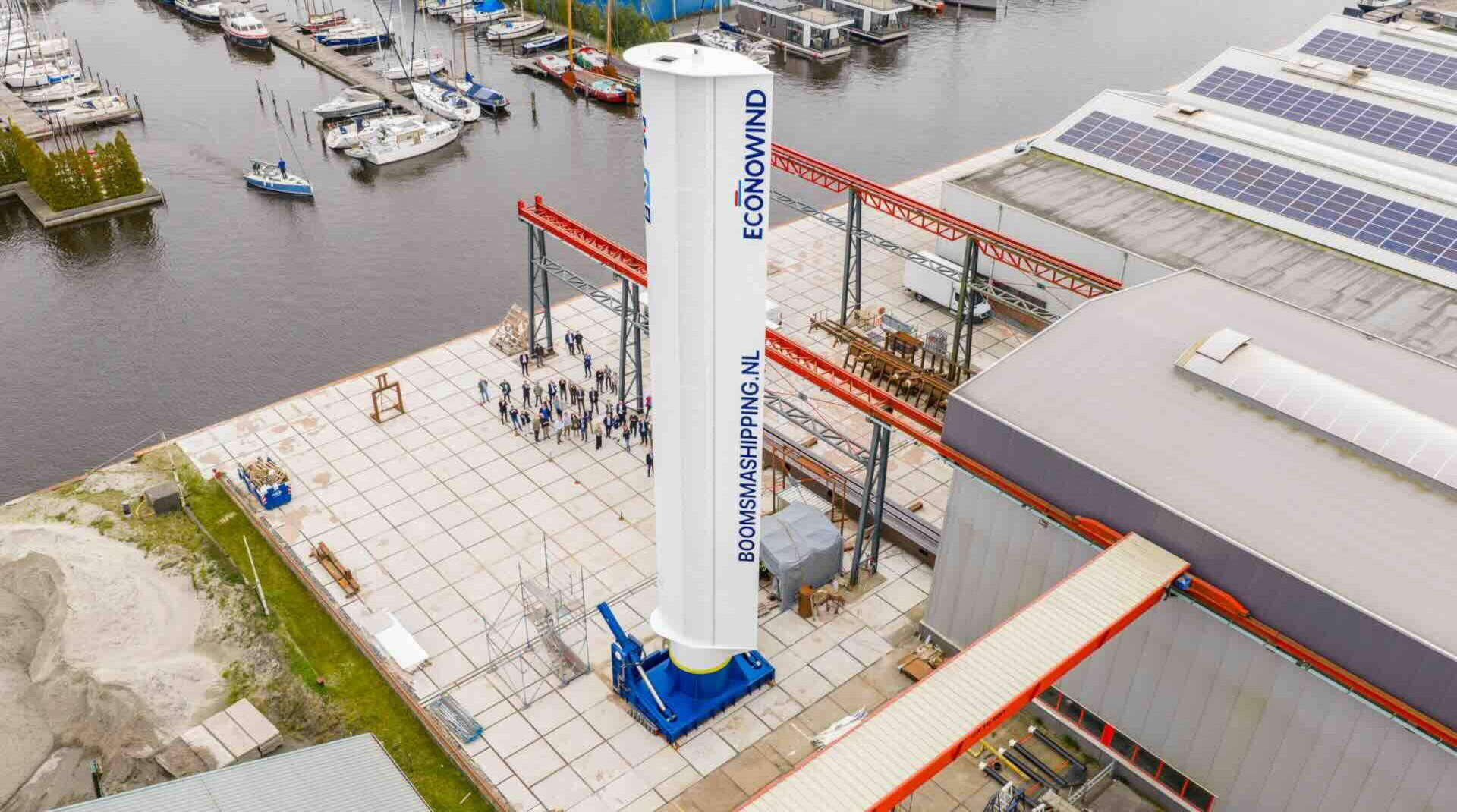
The Dutch specialist in wind-assisted ship propulsion launches the VentoFoil 5, a larger steel suction wing system for seagoing vessels. The 30-metre model was unveiled in Heeg last week.
In the presence of dozens of invited guests, Boomsma Shipping sustainability manager Tessa Remery had the honour of cutting the ribbon, after which the impressive steel construction was hydraulically set upright on the quay of Nauta Staalbouw in Heeg, Friesland. The first 5-series unit will be installed on a Boomsma Shipping ship this summer, marking the new model’s commercial debut. Nauta latest built the VentoFoil for Econowind, which itself does not build in steel but in aluminium at its Zeewolde factory. The lowerable steel sail is, at 58 tonnes, by far the heaviest VentoFoil to date.
Trust
The launch is the next step for Econowind, after selling more than 150 suction sails for a wide range of ship types and trade routes. According to founder and current CTO Frank Nieuwenhuis, Econowind now has a 50% global market share. “When I started 10 years ago, I was hoping for 20%,” he says.
Having gained a foothold in short-haul and regional shipping markets, the Dutch company is now focusing on larger vessels and longer trade routes, where the fuel-saving potential of wind-assisted ship propulsion becomes even more attractive.
The order reflects the Dutch shipowner’s continued confidence in VentoFoils as a practical way to reduce fuel consumption and support more sustainable operations.
Johan Boomsma of Boomsma Shipping: “Wind propulsion has proven its value, both economically and environmentally. With high fuel prices increasing the urgency, this is a logical next step for us. Energy efficiency is high on our agenda, which is why our eight newbuild vessels will all be delivered wind-propelled. The first, the Frisian Future, will be launched in May.”
New 4 series
According to Nieuwenhuis, the company’s portfolio will soon be further expanded. Apart from the original 3-series and the 5-series presented in Heeg, there will also be a 4-series. ‘The 3-series is 10 to 16 metres long, the 5-series 24 to 30 metres and the 4-series will have a range of 16 to 24 metres. This allows us to offer even more ship owners a tailor-made solution.’
The numbers 3, 4 and 5 refer to the width of the sails, 3, 4 and 5 metres. Econowind thus offers sails from 10 x 3 to 30 x 5 metres, ranging in weight from 7 to 58 tonnes.
Although the heaviest VentoFoil will not be installed in the middle of the Frisiana, but more to the port side, no counterweight needs to be added. CCO Chiel de Leeuw of VentoFoil: ‘The 58 tonnes does not really have much impact on an ocean going vessel where these wings are placed on. That can be solved with some ballasting and if these ships are fitted with a crane, that can also serve as a counterweight.’
Econowind makes no announcements about the difference in efficiency created by carrying more weight. De Leeuw: ‘That too is only small and depends on so many factors. It is different for each trip. What we always suggest to the buyer is that the payback period is within five years. And how much he has to earn back then? Only we and the buyer know.’
IMO wind rules
Head of safety environment Niels van de Minkelis of shipowners’ association KVNR praised the VentoFoil technology in Heeg as a ‘high-tech step forward’. He also pointed out possible consequences for safety rules on board. ‘The view from the bridge can sometimes be obstructed too much by obstacles in front of the bridge. A new Dutch regulation may then offer a solution, using cameras on the bridge wings with additional screens at the central conning position.’
According to Van de Minkelis, the IMO is also currently examining whether stability regulations should be adapted for wind-propelled ships, or whether there should be separate safety guidelines for this type of ship. The stability factor plays an increasing role as the systems become larger.
Expansion in Asia
To support its expansion into deep-sea shipping, Econowind is also organising production in the Far East. The aim is to bring production closer to major shipbuilding centres and make it easier for shipowners and shipyards to integrate the larger VentoFoil units into new construction projects.
“The 3-series demonstrated that our technology works in day-to-day operations,” said Chiel de Leeuw, Chief Commercial Officer of Econowind. “With the 5-series, we are bringing that proven concept to the deepwater market.”
The launch underlines Econowind’s vision that deep-sea shipping is the next growth market for wind-assisted ship propulsion. Econowinds VentoFoil uses boundary layer suction technology to generate additional thrust from the wind, reducing the power required from the main engine. The company positions the system as a practical and robust solution with limited impact on the deck, operation from the bridge and the ability to tilt the units when required for loading and unloading operations or clearance restrictions.
Source: SWZ Maritime and an article by Willem de Niet in the Schuttevaer (subscribers only).
Photo: Econowind.

Windassist sponsor