
More large wind rotors on bulk carriers
Anemoi is partnering with a subsidiary of China’s Cosco to install Flettner rotors on medium-sized bulk carriers.
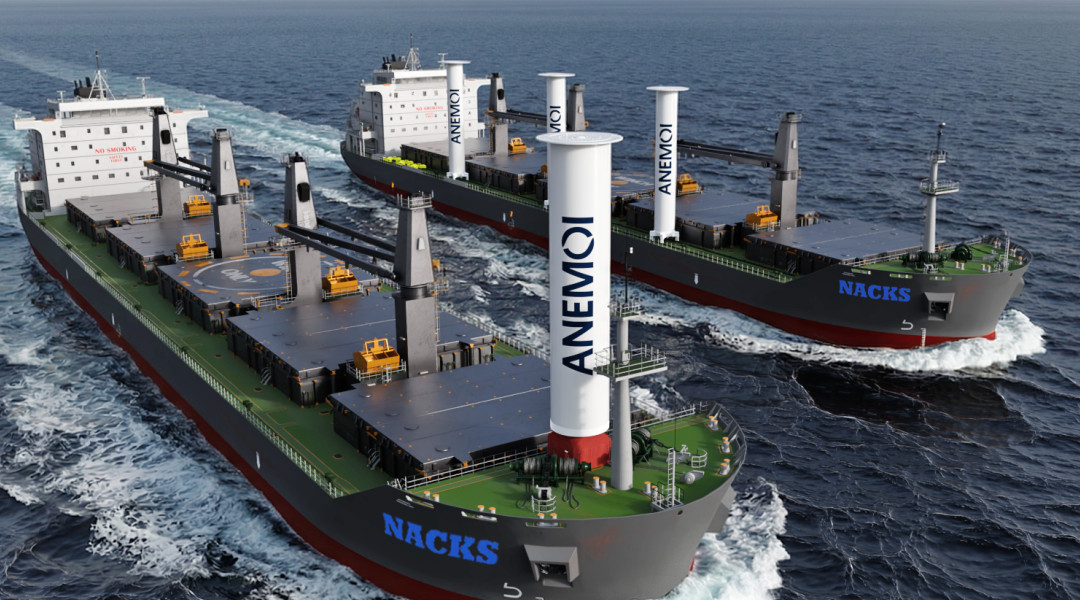
UK-based Anemoi has teamed up with NACKS, a subsidiary of Chinese giant Cosco, to develop solutions for the integration of Flettner rotor systems on medium-sized bulk carriers of the Ultramax class (60,000 to 65,000 tonnes deadweight and about 200 metres long). Two configurations were worked out for these versatile vessels, which are often equipped with on-board cranes to operate independently in port: one to install a latest-generation rotor (24.5 metres high, with a diameter of 3.5 metres) on the bow; the other uses longitudinal rails to integrate three rotors on deck.
Both designs have received approval in principle (AiP) from Japanese classification society ClassNK. This confirms the feasibility of these concepts, in line with ClassNK’s guidelines for sail support systems. The elements taken into account, Anemoi explains, are the characteristics of the systems and their arrangement, foundations and support structures, trim and stability calculations, safety and firefighting provisions, as well as energy efficiency calculations under the International Maritime Organisation’s (IMO) EEDI.
Rapid growth
The large bulk carrier segment is being targeted as this fleet is growing rapidly. Anemoi, which already installed a system on a bulk carrier in 2018, has been working closely with Chinese shipyards for several years, further strengthening its presence. According to the UK company, quoting DNV, 25% of new bulk carriers are built in China, up from 5% a decade ago.
Several sail system suppliers have established themselves in China to be closer to major shipyards, both for new builds and repairs, allowing them to integrate their systems. Anemoi, which has been operating in the country since 2018, opened a factory in Jingjiang in July 2025, capable of producing 250 rotors a year. Its main competitor, Finnish Norsepower, opened a plant in Yancheng in 2024, which is expected to be able to produce 100 rotors a year by the end of next year.
In addition, Britain’s Bar Technologies has chosen to outsource production of its WindWings rotor blades to China Merchants Energy Tech, which is part of the China Merchants group, owner of numerous shipyards. Asian rotor manufacturers have also recently made a name for themselves, such as Korea’s Hanwha Ocean, formerly Daewoo Shipbuilding & Marine Engineering, or China’s Dealfeng New Energy Technology, which has installed rotors on some ships.
Source: Mer et Marine.
Photo: Anemoi

Windassist sponsor