
Funding sailcargo in the Pacific
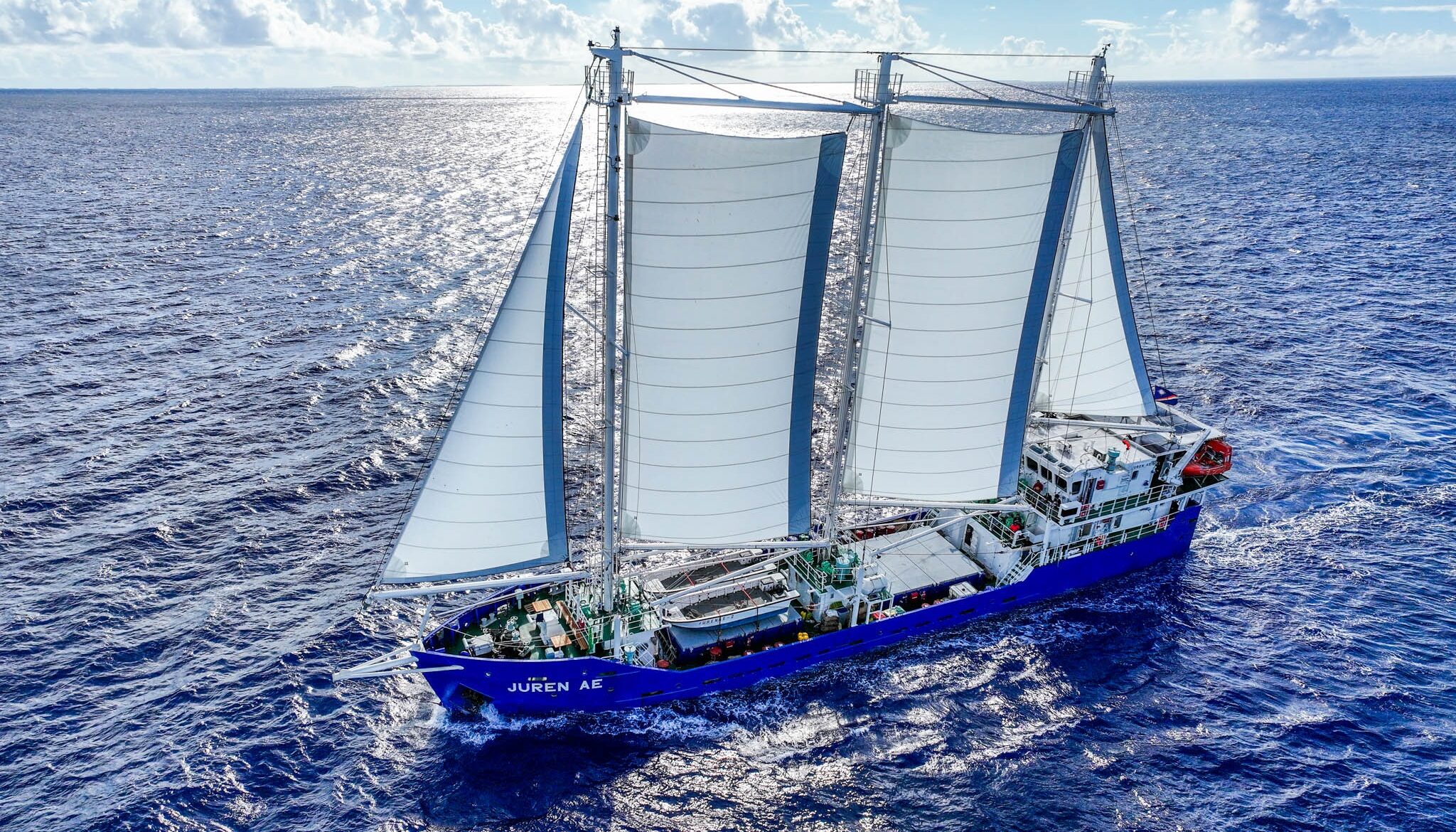
In a previous article in Windassist, we highlighted a project in the Pacific. Now that the vessel Juren Ae has been commissioned in the Marshall Islands, Hochschule Emden Leer of Applied Sciences, is looking for a larger version and is seeking co-financers.
Pacific nations
The Republic of the Marshall Islands took delivery of the sailing cargo vessel Juren Ae in October 2024, and it marked a new era in wind-propelled transport in Oceania. The vessel’s name refers to the “steering paddle” on a Marshallese canoe, and its construction was the result of the efforts of the Pacific Blue Shipping Partnership, co-chaired by Fiji and the Marshall Islands. The partnership includes other nations such as Kiribati, Solomon Islands, Tonga, Vanuatu, Tuvalu, the Federated States of Micronesia, and Palau. They are all committed to decarbonizing domestic and regional maritime transport. The phasing out of the existing fossil fuel-powered fleet would also help reduce the region’s need for expensive fossil fuels which must be imported.
Funding
However, the commitment needs funding. The small cargo and passenger volumes and the long distances between islands mean that investment in new tonnage purely for commercial gain is not likely to be viable. Public/private partnerships for more wind-powered vessels are therefore being sought. The ability to explore, discover and settle the world’s largest ocean and subsequently maintain intra-and inter-archipelago networks relied on the development of canoes with sails, so wind power has a strong historical meaning for the people of the region, say the researchers of paper recently published in Global Policy.
Partly funded by the German NGO Society for International Cooperation (giz.de), sailing cargo vessels are currently being used for inter-island transport in the Pacific Ocean. Further investment is needed to develop wind propulsion in the region. However, the characteristics of shipping in that region do not meet the conventional criteria for a successful economic investment. Furthermore, low freight and passenger volumes make it unlikely that economic motives alone will be sufficient to convince potential investors. Nevertheless, the need for the wind-assisted transition remains.
The practical connection between canoe technology and sustainable sea transport is already being put to use in the Marshall Islands, for example, with the recent building of a low-cost catamaran for transporting copra within the lagoons of atolls.
Eye on tradition
“By exploring the wisdom of the past, contemporary societies can and have found innovative solutions for a sustainable future,” say the researchers. “This requires both ships and historically and culturally grounded skills. All too often, wind propulsion maintains a paradoxical reputation of being disruptively innovative and hopelessly outdated – a perspective similarly laid upon the bicycle in land transport discourse.”
The 481 gross tonne Juren Ae is a general-purpose cargo vessel and an initial proof of concept for the partnership. It was funded by the International Climate Initiative of the German Government, designed with German partners at Hochschule Emden Leer, and built at the Asia-Pacific Shipbuilding yard in Korea. It uses direct wind propulsion for 80% of its propulsive energy needs. The design can easily be scaled into a 60-meter, 600 gross tonne version.
Beyond building new general-purpose cargo vessels like the Juren Ae, there is an urgent need to replace the aged second-hand ro-ro vessels, like the Lomaiviti Princess fleet in Fiji, say the researchers. The French ro-ro operated by Neoline could serve as the basis for the design of a Pacific vessel of similar size and type.
The entirety of the transition
“While the partnership is planning a multi-country submission to the Green Climate Fund to fund a demonstrator fleet, slipways and seafarer training, the big question remains: Who is going to finance the entirety of the transition that is so badly needed, particularly in Pacific Island States across Oceania?”
The partnership proposes a country-led process of change that considers the needs, capabilities and challenges of the communities involved. “Focusing on the dollar value alone cannot deliver the transformative change for which the partnership strives.”
Source: Online Library.
Foto: Changing Transport

Windassist sponsor