
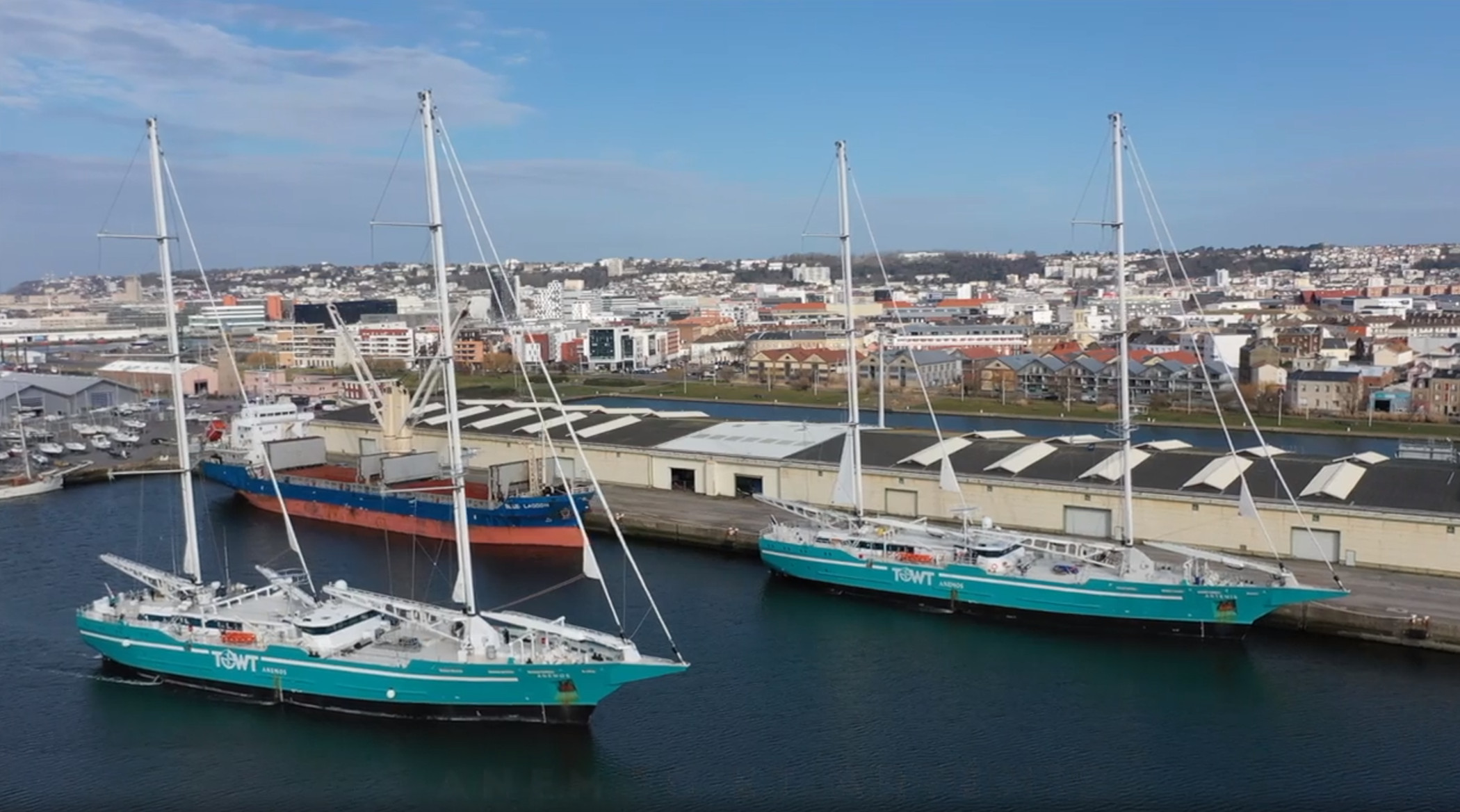
TOWT celebrates successes
It is often said that figures are better than long speeches. TOWT, the French firm that operates two innovative sailing freighters, comes out with the figures for 2024: “A crucial year for TOWT and shipping.”
TOWT does so on its own LinkedIn page, which the company uses as a signboard for the activities undertaken and to be undertaken:
🌍 TOWT’s two ships, the Anemos and the Artemis, made nine transatlantic voyages – a distance of 33,407 nautical miles
📍 Strategic stopovers in 5 countries: France, the United States, Canada, Colombia and Brazil
📦 Over 350,000 products transported: tea, coffee, wines, champagnes but also internet boxes and much more
⚡ A transatlantic record from New York to Le Havre in 16 days (16 knots at peak)
🌱 300,000 kg of CO2 avoided. Exemplary decarbonisation capacity: less than 2gC02/t/km
✨ 30 loyal customers and more and more with each crossing
And 2025 continues on this momentum:
⛵ 28 scheduled trips
🌍 6 ports – including Le Havre, New York, Pointe-à-Pitre, Guatemala, Colombia, Brazil
👉 A fleet of 8 ships by 2027 – 6 new cargo sailboats under construction
The ambition remains the same: to make wind the future of maritime transport!
Source and image: TOWT.
Editor’s comment
It is both encouraging and amazing that the French have managed to launch sailing cargo ships that use sail as their main propulsion at such a rapid pace. Apart from TOWT, more French initiatives are active, such as Eco Trans Océan, which we reported on recently, and also Grain de Sail. The question arises why the Netherlands cannot be equally active.
The answer leaves one to guess, but a few characteristics of the French companies stand out. For instance, they rigorously opt for modern designs, which may attract investors faster than – for instance – the high-profile but very traditional-looking 500-tonne Ecoclipper.
And perhaps the old colonial contacts between the motherland and various distant overseas destinations also play a role. For instance, some transport lines focus on former French colonies in the Pacific. The Netherlands does not have or no longer has such contacts.
It is also questionable whether the almost ideological choice of a traditional square-rigged design can sufficiently resonate with owners of the ‘big money’ that is needed to realise these kind of projects. The past decades, if not centuries, have shown time and again that big investors look around for interesting projects mainly in their own circles.
The distance between the hardly ever in designer suits and skyboxes appearing ‘tycoons’ of Fairtransport, for instance, and their counterparts at the top of the mainstream shipping industry may still be too great.
Moreover, venture investors seem to have a hard time connecting tradition and innovation, associating the latter concept with futuristic rather than historical designs.
So there is still a considerable gap to bridge for the Dutch pioneers, before they can come alongside their French counterparts.

Windassist sponsor