
Airbus is heading for the seas
A French shipping company and a Chinese shipyard are reinventing the Atlantic supply chain with ro-ro sailing cargo ships.
The ship launched on the Yangtze, named Spirit of Mobile, is one of three purpose-built vessels that will transport Airbus aircraft parts across the Atlantic. With this, the French shipping company Louis Dreyfus Armateurs (LDA) is testing whether a combination of centuries-old wind technology, alternative fuels and route-planning software based on artificial intelligence can actually halve the maritime carbon footprint of one of the world’s largest aerospace programmes.
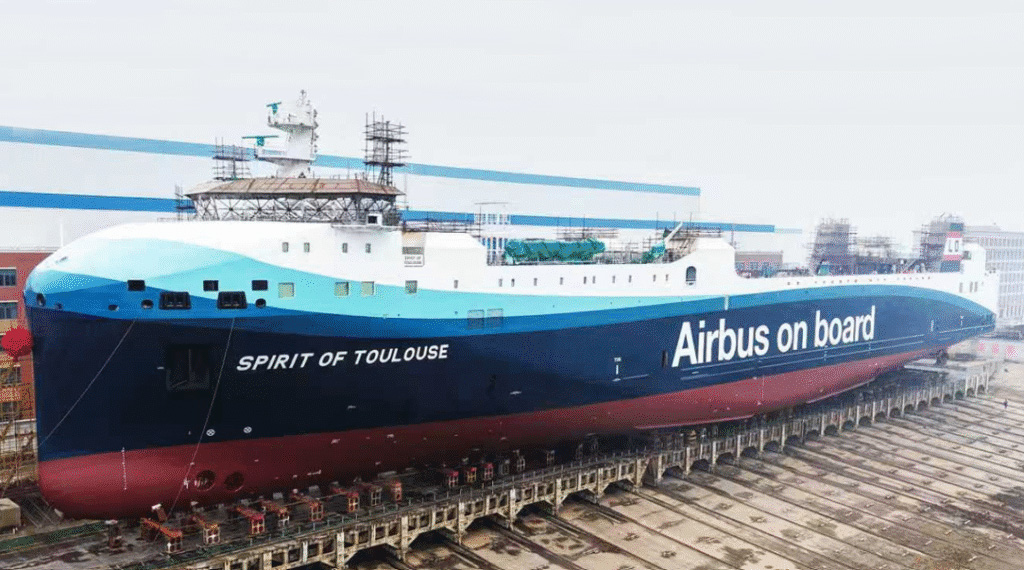
Spirit of Mobile is the second of three vessels that LDA has ordered from Wuchang, a subsidiary of China State Shipbuilding Corporation. The first, Spirit of Toulouse, was launched in early February 2026 and is currently undergoing sea trials prior to delivery. The third, Spirit of Mirabel, is still on the slipway. All three are scheduled for delivery in 2026 and will be deployed on the route between Saint-Nazaire in France, where Airbus produces key sub-assemblies for the A320 family, and Mobile, Alabama, where the final assembly line completes the aircraft before it is handed over to customers. The ship names are in themselves a statement of intent and refer to the three cities that form the basis of the production system the ships will serve.
The commercial significance of the vessels is considerable. In October 2023, Airbus selected LDA to renew the entire chartered fleet serving the transatlantic logistics chain, a decision that committed the shipowner to a substantial €1 billion investment programme to double the fleet size and accelerate the deployment of technology. The three Airbus vessels form the core of that ambition.
The vessels themselves represent a significant increase in capacity compared to the ships they are replacing. LDA currently operates two vessels on the transatlantic route for Airbus, the largest of which, the Ville de Bordeaux, can carry the equivalent of six complete sets of aircraft parts per voyage. The new vessels will match that capacity in terms of aircraft units whilst also carrying approximately 70 40-foot containers per voyage, thereby making more efficient use of the available deck and cargo space on both legs of the crossing.
At fleet level, the replacement of the existing tonnage with three new ships is expected to reduce average annual transatlantic CO2 emissions from approximately 68,000 tonnes in 2023 to 33,000 tonnes in 2030, a fleet-level reduction of approximately 50 per cent. Per vessel, the expected CO2 reduction compared to the previous generation is 70 per cent per year, a figure which, even with the necessary caution regarding the assumptions in the life-cycle modelling, represents a step forward in the emissions profile of what is ultimately an industrial logistics operation.
The technical means by which these reductions are to be achieved are more complex and have been designed with greater care than much of the initial reporting suggested. Wind-assisted propulsion is central to the design, and the six rotor sails mounted on each ship, each 35 metres high, are supplied by Norsepower of Finland.
Ultimately, the programme is not a story about Chinese shipbuilding, although Wuchang’s role is significant. It is a story about whether the maritime sector can build a credible industrial business case for wind-assisted propulsion combined with alternative fuels, on a scale and with specifications demanding enough to be of interest to a blue-chip charterer with strict supply chain requirements and a legally binding commitment to emissions reduction. The initial results of this test will be closely monitored in both the shipping and aerospace industries.
Source: Paul Morgan on GCaptain.
Image: Airbus.

Windassist sponsor