
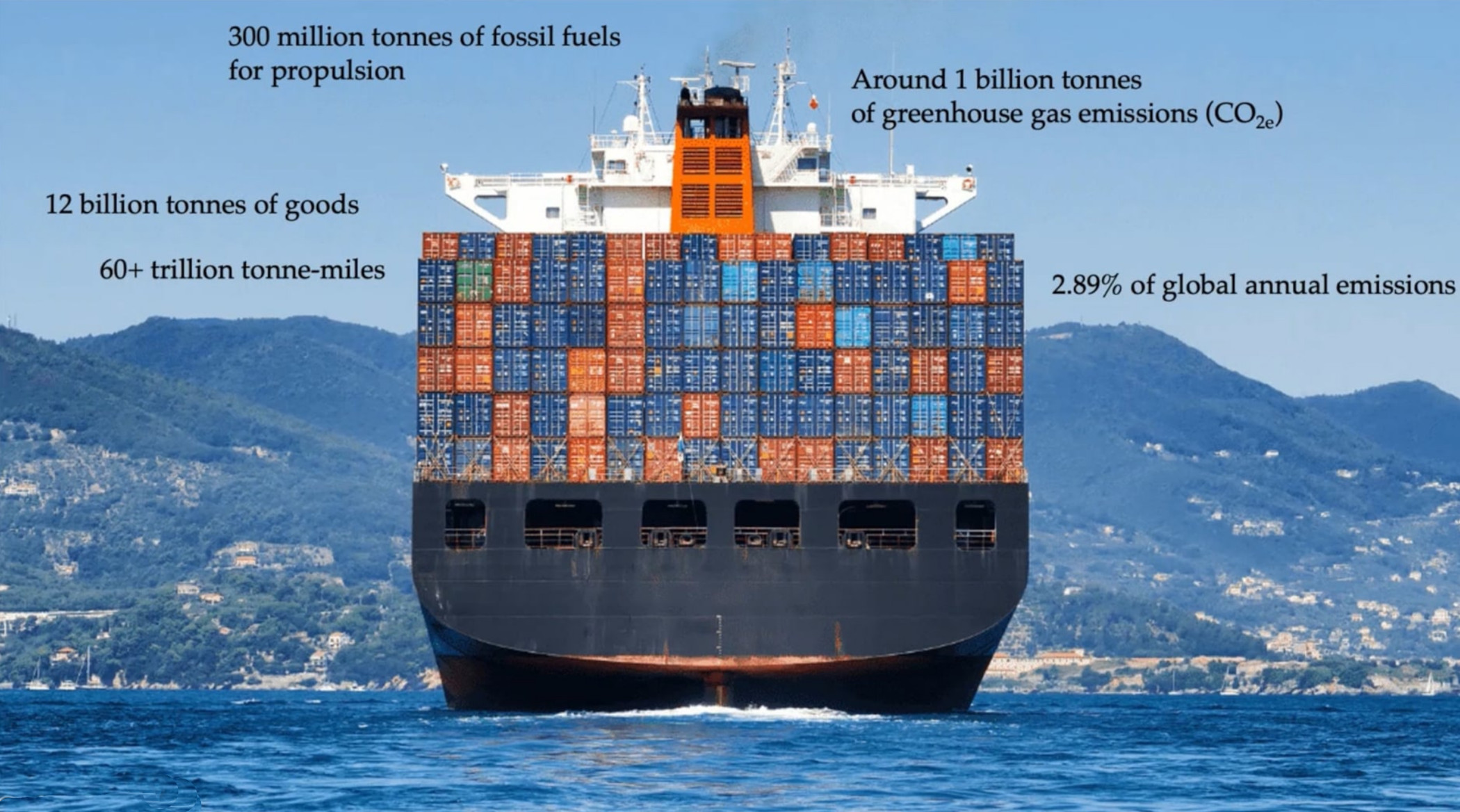
Alarming facts about ‘neo-colonial’ shipping industry
Scientist and author Christiaan de Beukelaer wrote a critical-positive book on sailcargo. However, he considers the shipping industry as a whole responsible for global overconsumption. And he has good arguments for that.
De Beukelaer sailed for a while on the sailing freighter Avontuur, and as a result of that voyage wrote the book ‘Tradewinds,’ in which he analyses how the overconsumption that has made us ‘use up’ more than one and a half earths at such a rapid pace has come about. The colonialism that so greatly enriched the Western world, at the expense of poorer countries, is largely due to shipping, he argues, and that mechanism continues to this day. In a fascinating lecture recently, he explained this pictorially.
This also affects the idealistic new sailing cargo initiatives, according to de Beukelaer: sailing cargo ships fetch high-quality raw materials, such as coffee and cocoa, from Central and South America and Africa, but offer nothing in return except a fair price: the ships often sail empty, because no (sailing) cargo is offered for those countries.
Neocolonialism
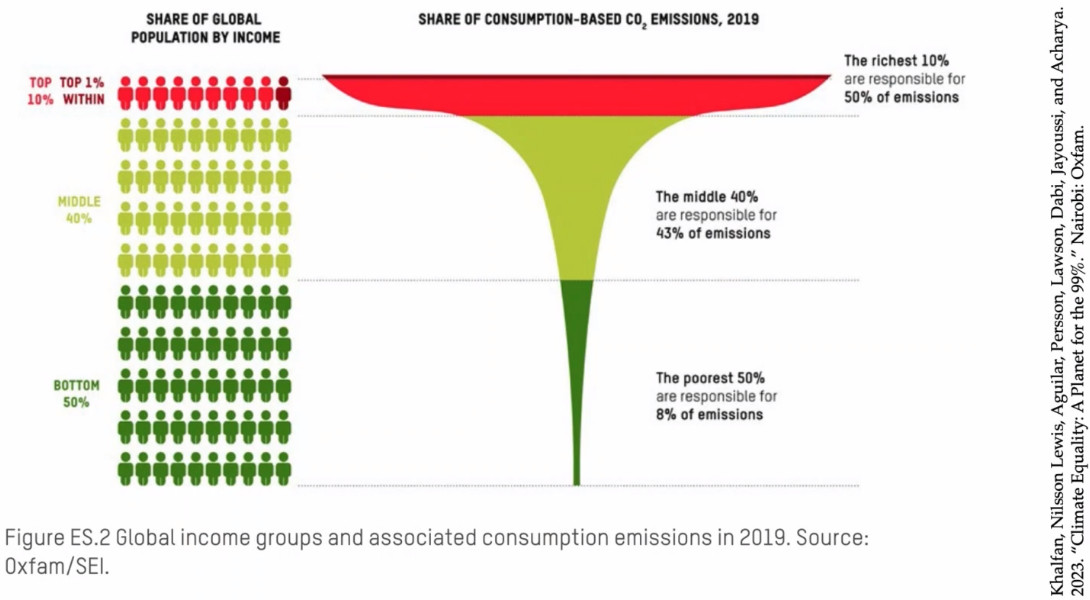 Meanwhile, shipping is responsible for a huge share of global air and water pollution, and still makes barely reduced use of fossil fuels. And because that shipping also serves transport by and for rich countries, that pollution also comes at the expense of poorer countries. A new kind of colonialism, according to De Beukelaer, as Western countries once again parasitise poorer countries.
At the same time, the oil-producing countries, in particular BRICS (Brazil, Russia, India, China and South Africa) and OPEC (11 African countries besides Venezuela, including all Arab oil states), supplemented by the United States, Australia and Norway, are trying to block any form of regulation by the IMO (International Maritime Organisation). Not surprisingly, as together they soup up $7 trillion (7,000 billion) a year in fossil subsidies.
Reversal of burden
In recent years, however, there has been an interesting reversal in the balance of power. Led by the independent Marshall Islands in the Pacific, which is used as a flag state by much of the shipping industry, a number of Polynesian and Micronesian states have devised a tax-and-reward system that taxes big polluters and rewards clean ships. This would return a significant part of the money spent on fossil fuels to the countries most affected by climate change: most Polynesian and Micronesian states are mere metres above sea level. It could enable those countries, at least in part, to achieve a ‘just and equitable transition’, by taking steps towards a climate transition that does not disproportionately disadvantage them.
Overconsumption
Whether that will be enough to bring about a just and equitable turnaround, is still highly questionable. De Beukelaer shows that, over the last 100 years, growth of global shipping transport has been as much as 75 times higher than the growth of the world population. He also shows, that the estimated necessary footprint for all necessities of life combined, is far exceeded by many countries: China uses three times as much per capita, a country like Germany six times, and the United States as much as seven times as much. And between 80 and 90 per cent of everything we consume as a global population is transported by ship.
Simple solutions
Fortunately, it is not all so bleak. As an example, De Beukelaer mentions that one ship with solar panels can generate as much energy as the gas transported by 50 LNG tankers, or the coal transported by 100 bulk carriers. He also shows that much transport is rather questionable, such as the back and forth of products that are shipped to a low-wage country and back again only for processing. Simple solutions, but not easily implemented.
It makes the solution of sailing cargo, which is relatively cheap and easy to implement, an attractive alternative, were it not for many inhibiting forces, including the scale of global shipping traffic.
Christiaan de Beukelaer’s lecture can be viewed here.
Source: own news gathering.

Windassist sponsor