
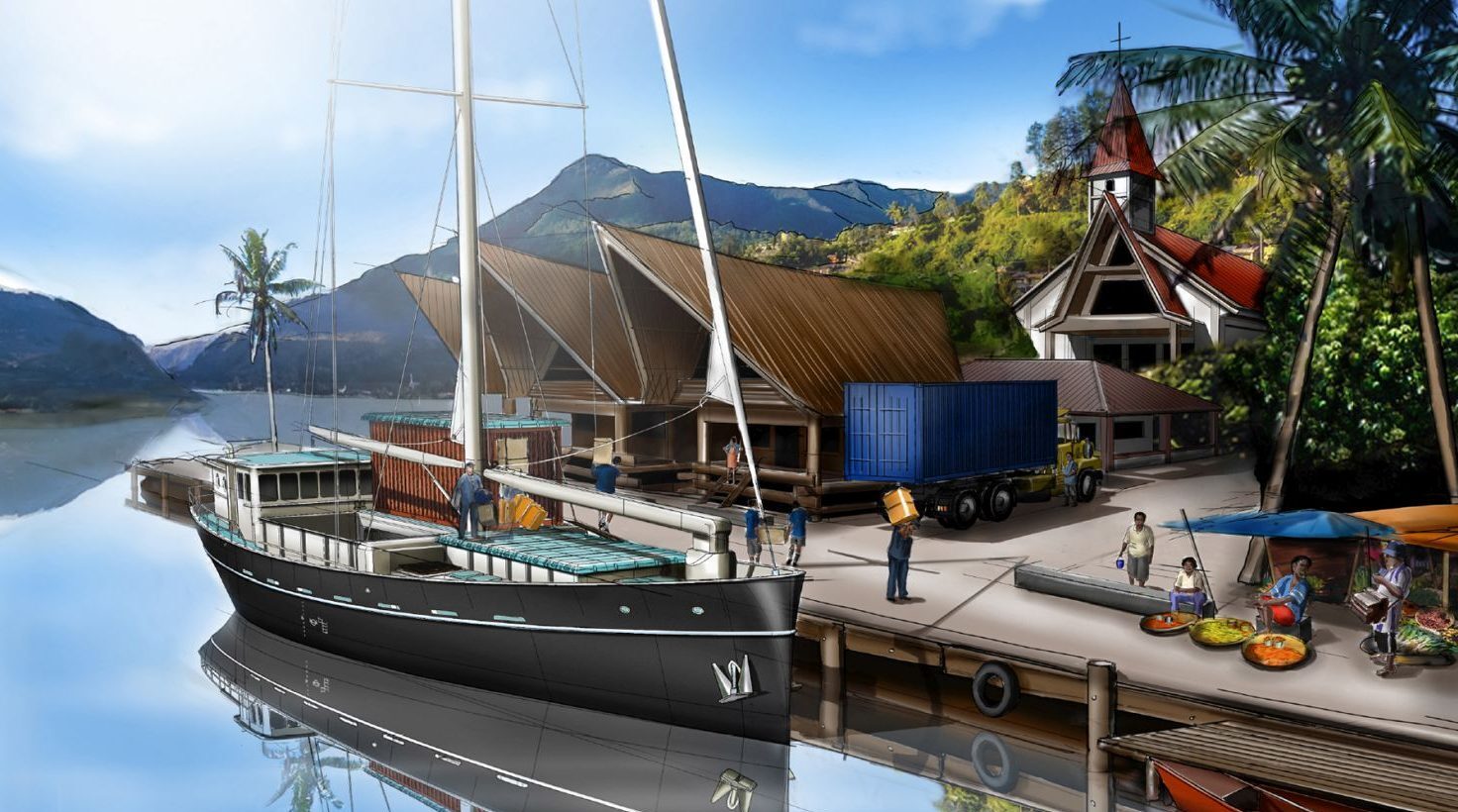
Sail cargo made feasable
Olivier van Meer has presented a design for a sailing cargo ship: green, multi purpose, labor friendly and competative.
At first glance, the design isn’t very special; we’ve seen the layout of the hull and rigging before. What is special, however, is the approach of the design, which is entirely focused on small-scale feasibility. Because of this, it should be possible to build and operate the ship, even in a developing country.
General characteristics
The 24 m cargo-passenger-sailing ship is an environment-friendly flexible alternative for transport over sea for small- to moderate distances (up to 200 nm or so) where sailing/delivery time is of less importance. With some modifications she can be used for transocean voyages. The main propulsion is provided by the wind, either converted by a ‘traditional’ sail rig- or, as an alternative, by Flettner rotors into propulsion power.
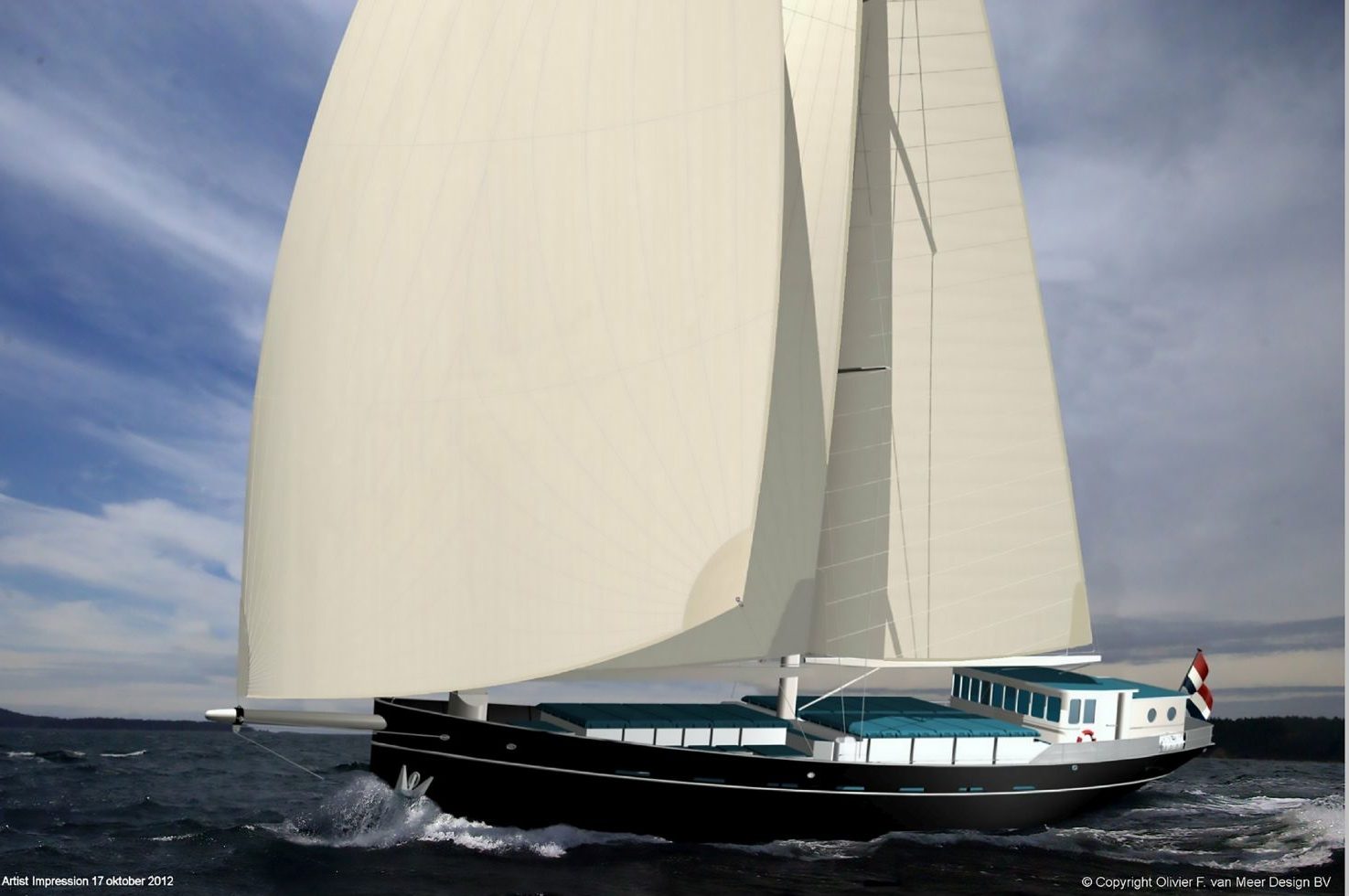 The ship has a yacht-like hull form with a sharp waterline entry, a hydrofoil like keel and round bilges to minimize drag and to ensure good sailing performances. The ship’s load line length (ICLL) is 23,95m, just under 24m to avoid extra design- and building criteria from Class and flag administration societies. As a result the ship will be cheaper and easier to built because of minimized mandatory rules.
Sailing performance
The ship’s hull is made out of 5083 aluminium alloy (seawater resistance) to save weight and to minimize maintainance. The weight saving part gives 38 mton more loading capacity in comparison with a steel hull. Even important, the sailing performance will be better with a lighter ship. The absence of paint on the hull above the waterline gives a lower ‘pollution footprint’ during building and during lifetime of the ship.
No exotic options
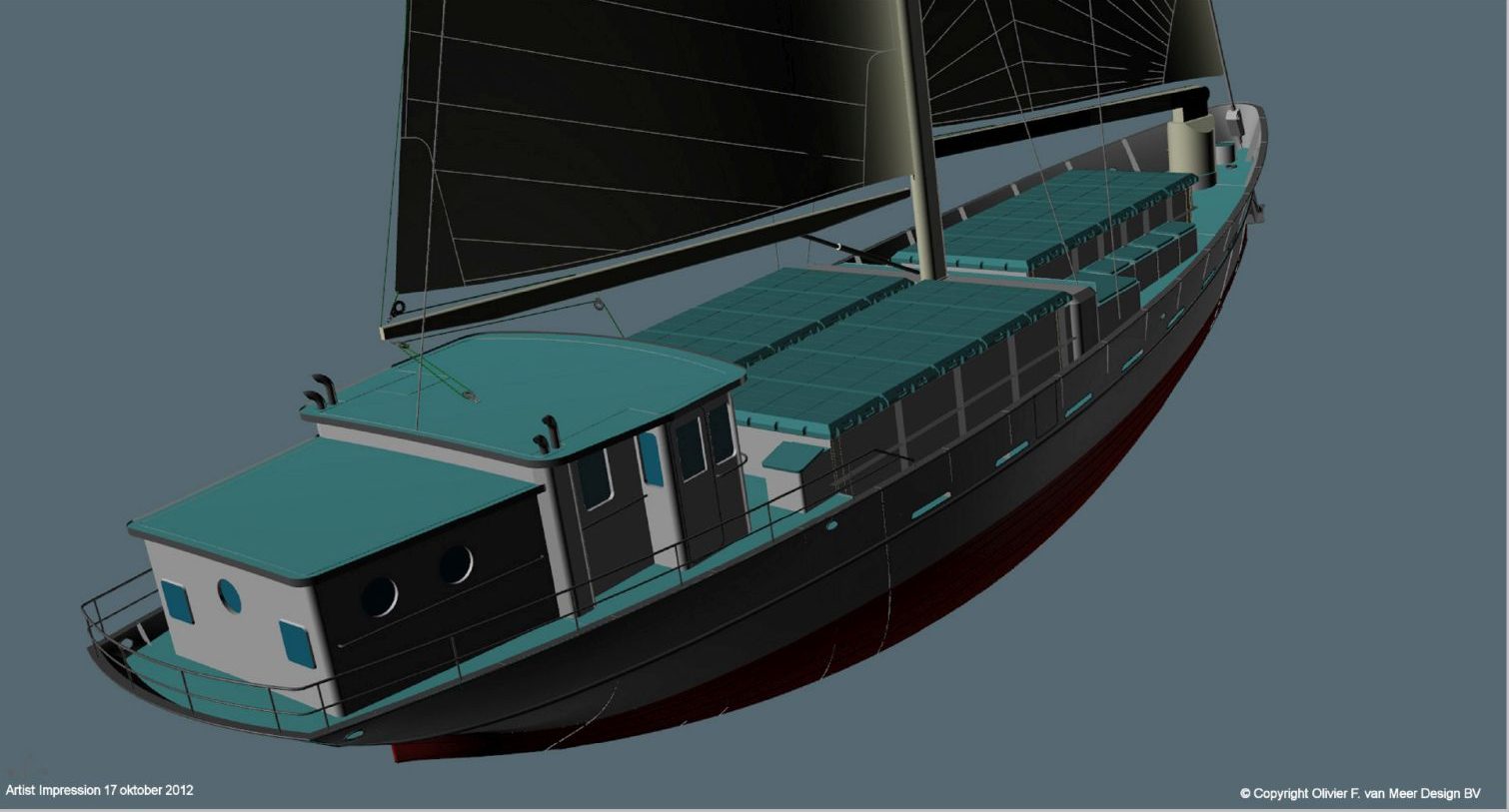 The ‘traditional’ sail rig consists out of a straight forward, no-nonsense, bermuda rig. Mainsail and staysail (total 305 m²) either to be rolled in and out or hoistable, Mast and mainboom made out of standard aluminium extrusions. All rig parts are regular items, no exotic options required. The mainsailboom can act as a cargo handling boom up to approx. 750 kg. A small, but well equipped crew accommodation has been provided for the crew including a protecting bridge for navigational tasks. Accommodation for 3 crew maximum. The ship is equipped with waterballast tanks to limit the heeling angle under sail for a more comfortable journey. The ballasttanks can also be used as a counter weight during loading and unloading. Electrical ballast pump of a large capacity is provided. The ship is provided with 3 large holds, which can be used to fit three 20 feet containers.
The ship is provided with 2 main diesel engine (generators) to feed the electro-propulsion ac motor and/or batteries. A harbour generator is installed for smaller tasks when loading and unloading or just laying in a harbor or alike only when battery capacity has runned down. The electro propulsion is choosen to avoid air pollution as much as possible when inside an atol or harbor.
The design brief:
“Length of the load line should be less than 24 m to avoid SOLAS, ICLL and other regulations that could require excessively high investments.To minimize preservation work (paint job), maintenance and the associated costs, we are proposing a hull made of aluminum instead of steel. A steel hull would weigh approximately 71 tons compared to around 33 tons for an aluminum hull. Benefits of the lower weight of the aluminum hull include reduced resistance while sailing, particularly in heavy weather. This results in less fuel consumption as well as better sailing characteristics. Last but not least, an aluminum hull can accommodate some 38 tons more cargo.
The propulsion system features a variable-pitch propeller which can be placed in a feathered position
to reduce resistance while sailing when not being used. To enable the use of a normal merchant crew, the rigging should be kept as simple as possible and have pushbutton controls. Complex solutions that cost manpower and energy should be avoided.
To sail as efficiently as possible, the vessel should have a relatively slim hull shape (yacht-like), which means that the waterline should be at a sharp angle. Electric propulsion to prevent local pollution and thus increase operational opportunities.”
Main characteristics:
- An aluminum hull with a load length of 23.95 m.
- Beam of 7.50 m.
- Displacement with maximum cargo (91.5 tons) and fully loaded with fuel and drinking water (17 tons): approximately 225 tons.
- Draft of around 3.15 m.
More information is available on the architects website.
Source and pictures: Oliver van Meer

Windassist sponsor