
A stiff wing sail, but not really stiff
Wind propulsion by a wing-shaped sail that automatically flattens or curves under the influence of the wind. Earlydays a Cunningham hole did just that; now a French company is developing aerodynamic profiles using ‘passive morphing’.
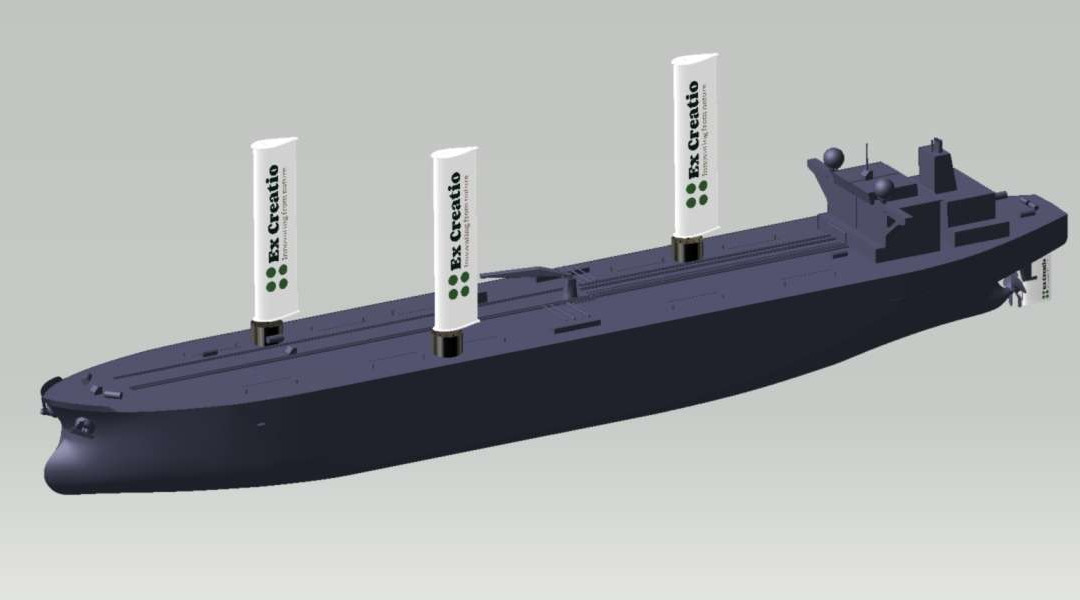
The company Ex Creatio draws inspiration from mechanisms observed in biomechanics. It is currently working on propulsion wings for ships. These are inspired by the fins of fish, allowing the curvature to be passively adjusted to the force of the wind, thereby optimising efficiency. This technology is known as ‘passive morphing’, or an aerodynamic structure with variable curvature that adapts in response to the forces acting upon it, explains designer Guilhem Colombiès. Tests on an initial prototype are scheduled for the summer.
Biomimicry
The idea came to him whilst observing fish swimming upstream, managing to swim against the current and overcome the eddies. As a specialist in biomimicry, he drew on a phenomenon described in the scientific literature as the ‘Fin-Ray effect’. “This is the ability of a fin to flex. The fish generates a wave-like motion by contracting its muscles, but its fins, which have no muscles, follow the same movement and even amplify the amplitude at the tip of the fin, thereby increasing the fish’s propulsive efficiency. This is made possible by the way the skin, bones and cartilage are arranged. “I have translated this into an aerodynamic profile,” he explains. “We refer to it as morphing because we can increase the curvature, and it is passive because there is no internal drive. Only the forces of the wind acting on the profile change its shape. It is a mechanical response that changes the shape to increase lift.” A feature that sets this technology apart from existing wing systems with a fixed profile or with flaps to alter their shape.
Upwind
 Colombiès previously worked for Airbus. He developed his technology at the BizLab incubator (now Airbus Scale). Tests were carried out at IRENav (Institut de Recherche et d’Etudes Navales) in Brest. A passive morphing airfoil was compared with a conventional airfoil. For the passive morphing profile, “we measured up to 53 per cent extra lift in the laboratory at small angles, even at less than 5 degrees” relative to the wind, explains Colombiès. This is an interesting feature for ships that generate wind speed whilst sailing and thereby create an apparent wind at narrower angles. He therefore decided to take the plunge and continue independently with his patents, which have been filed in France, the United States and China.
Since its foundation, the company – which has been a member of the Wind Ship association since 29 May – has received various support measures for innovation. Ex Creatio is collaborating with ZELIN, which specialises in high-precision numerical simulations (aerodynamics, hydrodynamics, energetics, structural analysis) and offers route-planning solutions using digital twins for wind-powered merchant vessels. “We carry out efficiency calculations for a wing mounted on a ship’s deck, using a digital twin simulation on a real trading route,” explains Colombiès.
First prototype
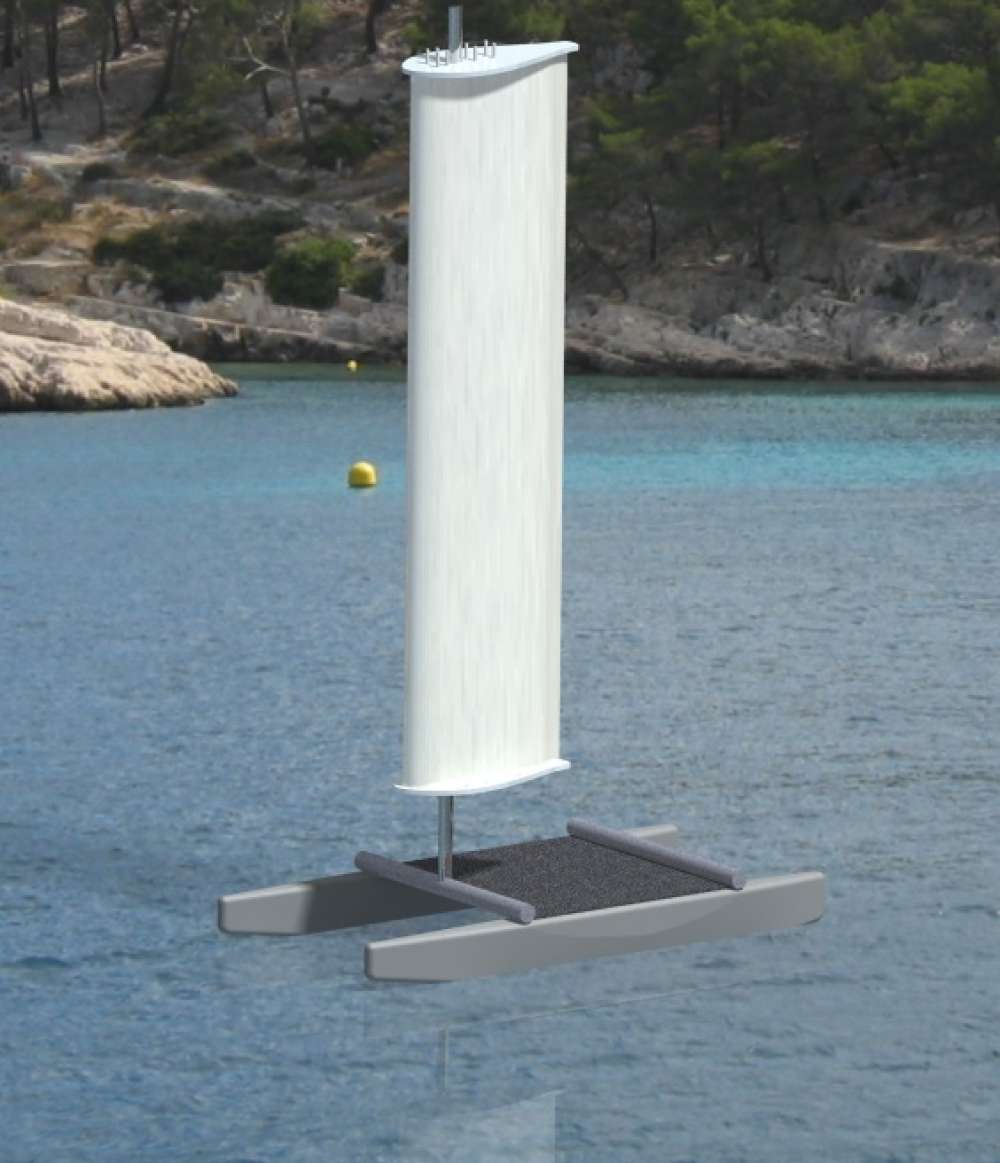
At the same time, Ex Creatio is working on an 8 m² prototype to be fitted to a small recreational catamaran. This will consist of 3D-printed profiles made from deformable polymers, over which a heat-shrinkable membrane – such as those used in light aviation – will be stretched to achieve the desired aerodynamic profile. This first version will be tested on an inland waterway in August to validate its behaviour under real-world conditions and to collect the first sailing performance data, which will serve as a reference for future upscaling.
The upscaling to a merchant vessel involves the assembly of a certified wing measuring between 100 and 300 m², with an expected return on investment (ROI) of 5 years. Like most sail-powered propulsion systems, this wing can be installed on a wide range of vessels.
Source: Gaël Cogné in Mer et Marine (accessible to subscribers only).
Images: Ex Creatio.

Windassist sponsor