
Fishing under sail
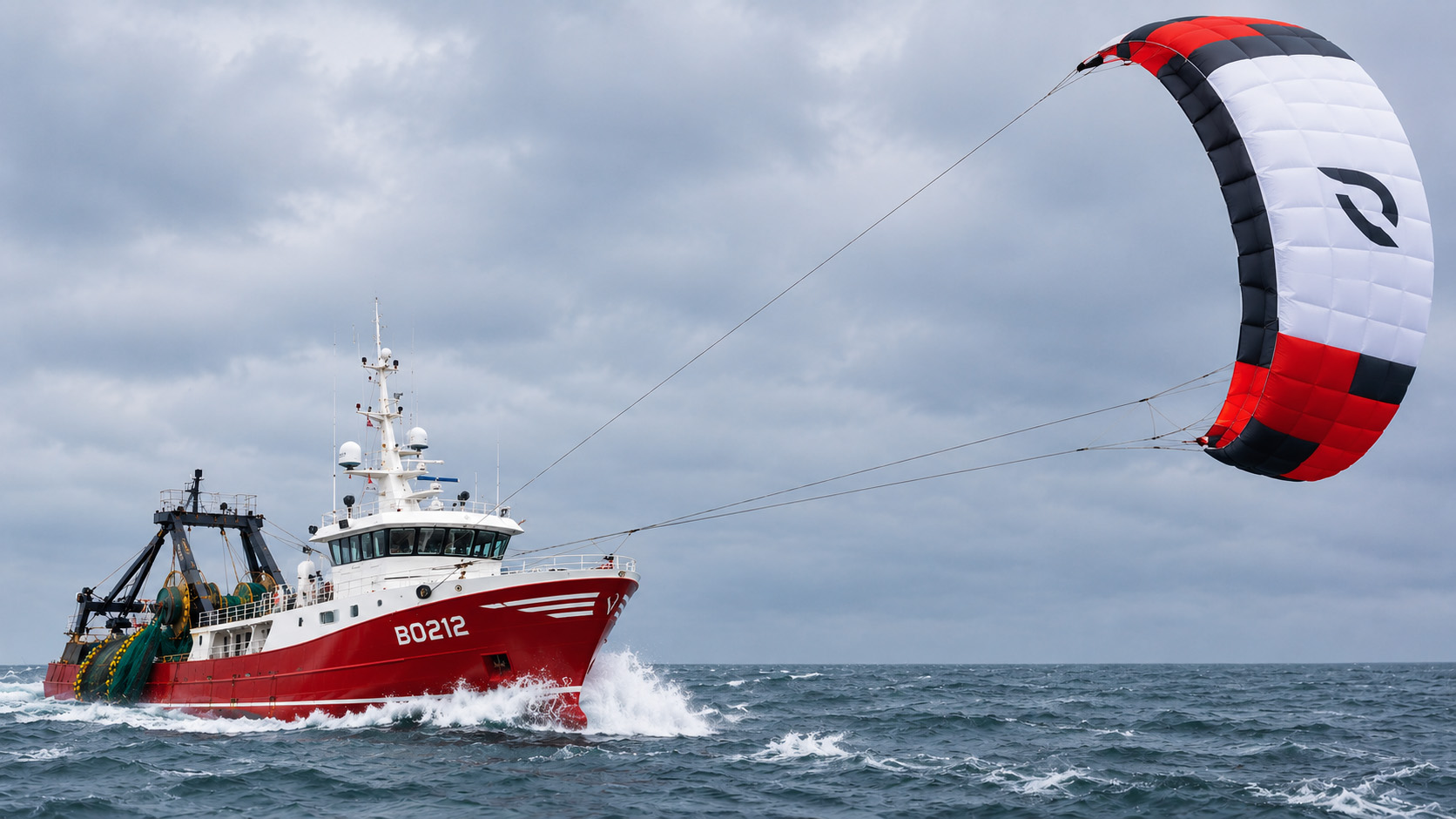
Transporting cargo under sail is gradually gaining acceptance, but there is still much to be gained in the fishing industry. And here, too, the French are leading the way.
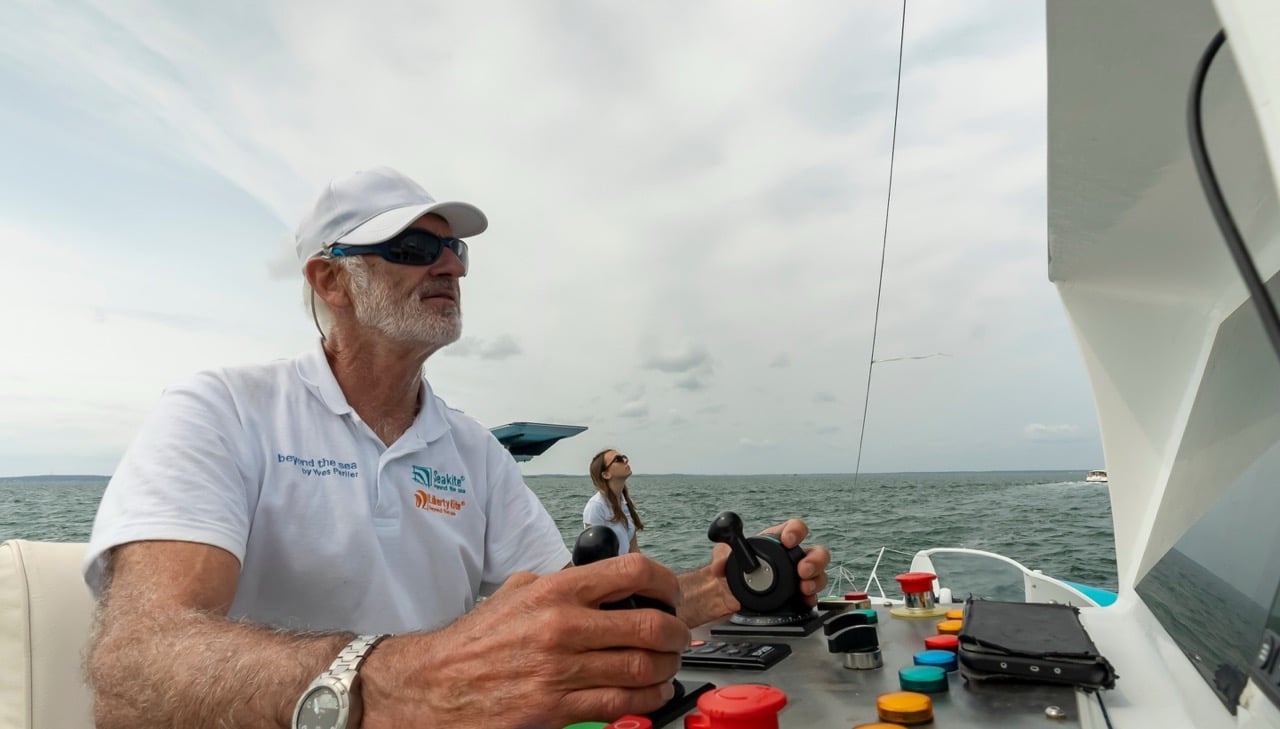 French sailing legend Yves Parlier is lending his expertise to ‘Beyond The Sea’, an ambitious project aimed at getting the shipping industry to fly kites. The Gironde-based company is set to fit two 18-metre-long longliners, intended for the Polynesian shipping company Te Aito, with its new DynaKite wing-traction system. This is a compact, automated solution suitable for fishing vessels or small merchant ships. These vessels, which will initially use their kite whilst transiting to their fishing grounds, are expected to be delivered next month by the Aresa shipyard in Arenys de Mar, near Barcelona.
The DynaKite is a new solution from Beyond the Sea. It is currently intended for vessels ranging from around twelve metres to 30 to 40 metres in length, such as medium-sized fishing boats or small merchant vessels.
This system, which can be deployed and perform both static and dynamic flights (for greater power), resembles the LibertyKite safety wing, but “with greater finesse and more pulling power”, explains Marc Thienpont, managing director of Beyond the Sea. And, unlike the SeaKite model – which is used, amongst others, on Cap Bourbon’s longliner Cap Kersaint, Ultranav’s chemical tanker Huemul, the tugboat Jason operated by Les Abeilles International and the Forbin operated by Gazocean, it is not inflated and is attached to the ship with just two lines, rather than five. “The two lines are brought back onto the deck via a shaft that can rotate 360 degrees. The system is powered by a motor, which allows the wing’s differential to be adjusted to control its flight. This gives us a powerful, automated system with a wing that has just two lines,” explains Marc Thienpont.
“The aim is to have a smaller wing and a smaller system, whilst retaining the autopilot.” The DynaKite takes up very little space on board and can easily be transferred from one ship to another. “It’s very small, taking up less than one cubic metre, with a shaft secured to the deck by five bolts holding a bracket with the motor, which weighs about ten kilos. It really is a very space-saving system that’s very easy to install, in just a few hours. It is then connected to the vessel’s electrical circuit or to batteries, as it is very energy-efficient. A standard car battery is enough to keep it running for hours.” The kite is hauled in using a winch.
Tugdual Poirier, director of Cap Bourbon: “As the drive towards increasingly sustainable fishing also requires innovation, Cap Bourbon has chosen to fit one of its vessels with a kite. Thorough consideration was given in advance to how this technology could be adapted to the vessel and the operating conditions. The initial tests are promising: they are already showing a speed gain of 1 to 1.5 knots and promise fuel savings of up to 20 per cent.”
There are currently two wing sizes available: one measuring 20 m² and another 40 m². The larger one can generate “up to 120 kW” of thrust, which corresponds to approximately two tonnes of thrust at 12 knots of wind.
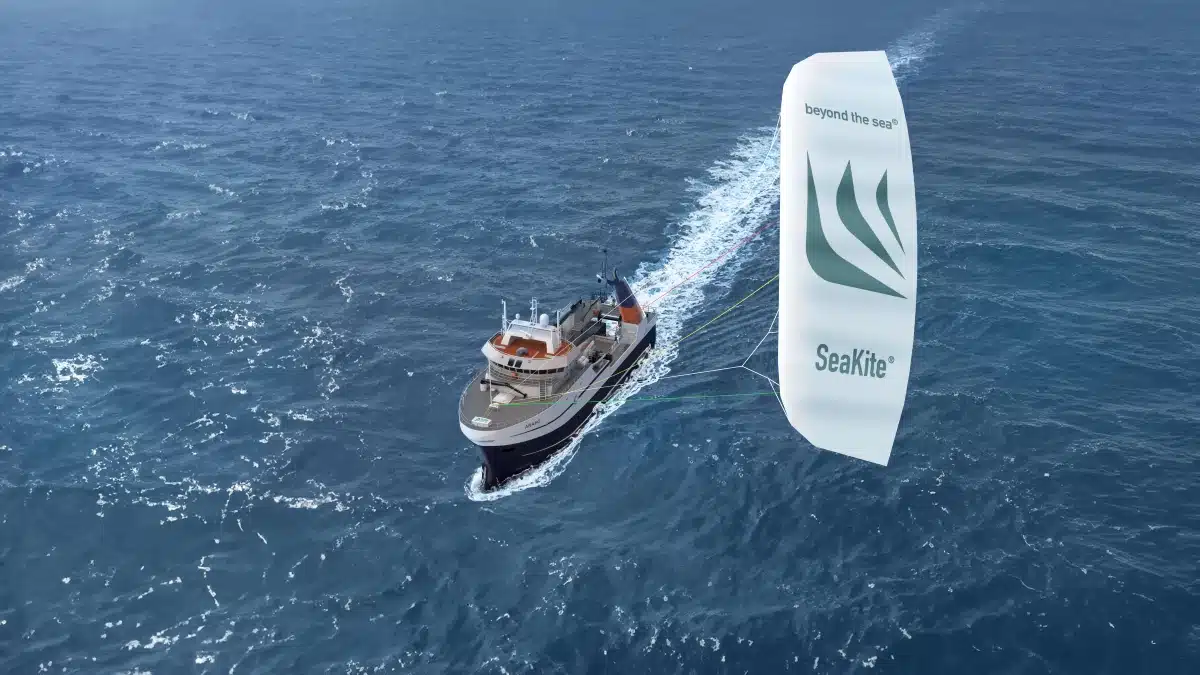 In addition, Beyond the Sea is collaborating with Madintec (navigation and automation systems for ships) and the engineering firm Zelin to offer a comprehensive solution featuring meteorological route planning tailored to the kite’s flight path and to improve the ship’s energy balance.
Depending on the options chosen, fitting out a vessel currently costs between 60,000 and 120,000 euros, according to Marc Thienpont.
Sources: Beyond the Sea,Baird Maritime,Mer et Marine.
Video: YouTube. Leading image: Photo augmented with AI.

Windassist sponsor