
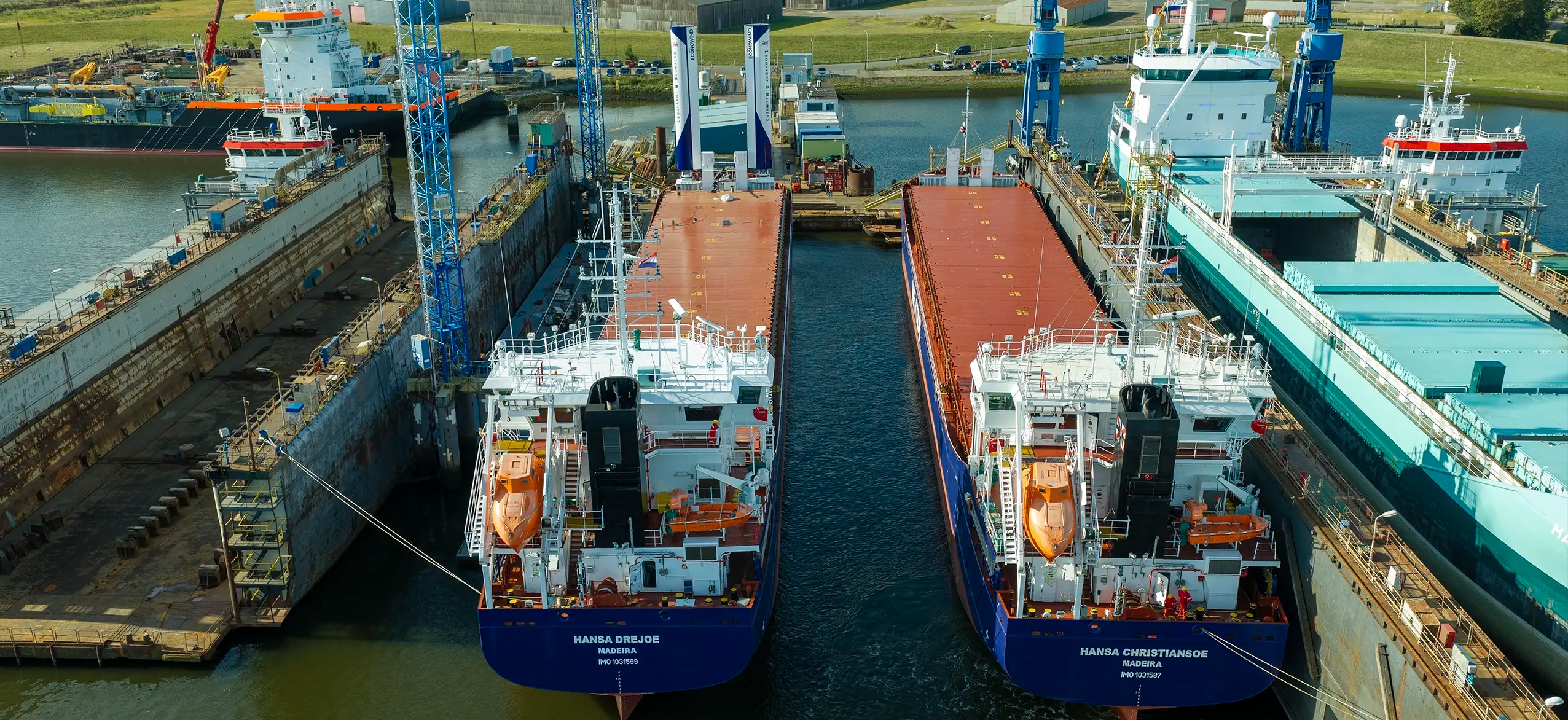
Leonhardt and Blumberg goes for wind
German owner Leonhardt & Blumberg has retrofitted the first of four general cargo newbuilds with a wind-assisted propulsion system and sees wind-assisted propulsion as ‘logical next step’ in greener operations.
A logical step
With an eye on taking a “logical next step” in reducing CO2 and greenhouse gas (GHG) emissions and improving fuel consumption, German shipowner Leonhardt & Blumberg has retrofitted the first of four general cargo newbuilds with a wind-assisted propulsion system (WAPS). Built in China and delivered in 2025, 6,000-dwt Hansa Drejoe was fitted with Econowind VentoFoils at Royal Niestern Sander Shipyard in early August. Next in line for retrofit is sister vessel Hansa Christiansoe, which is currently at the yard. According to Econowind, the VentoFoils will deliver roughly 10% additional thrust, reducing fuel consumption and lowering CO2 emissions. The assessment is based on the vessel’s actual trading routes throughout the year.
“We see wind-assisted ship propulsion as a logical next step in our journey toward greener operations,” said Leonhardt & Blumberg naval architect Christoph Meier. “Of course, the business case is important, but we also feel a responsibility to move the industry forward. Econowind’s practical and well-developed technology allows us to do both, while gaining real operational experience along the way,” observed Mr Meier.
Groot Ship Design designed the four Groot XL-type breakbulk cargo vessels for easy integration of a WAPS. Ventofoils are installed on the weather deck in front of the first cargo hold. The remaining two vessels in the series, Hansa Fanoe and Hansa Graesholm, are under construction in China and will also be fitted with the rigid, wing-shaped units. The newbuilds will arrive in Europe in H1 2027 for final outfitting and commissioning. All four vessels are under the commercial ship management of Rotterdam-based NewTide Chartering.
The benefits of wind
While all vessels can’t benefit from wind propulsion, those that can will reap benefits under international and regional regulations. By lowering fuel consumption, a ship reduces its exposure under the EU Emissions Trading System (EU ETS). Additionally, WAPS-equipped ships obtain a Wind Reward Factor, lowering their greenhouse gas (GHG) intensity score under FuelEU Maritime. They can also accumulate a compliance surplus.
Furthermore, using wind assistance can lower an existing ship’s carbon intensity by reducing its fuel consumption, helping the vessel attain or surpass its Energy Efficiency Existing Ship Design Index (EEXI) requirement under IMO regulations. Leonhardt & Blumberg is not alone in believing in the benefits of WAPS technology. There are a growing number of existing and newbuild ships being equipped with WAPS technology. As of Q2 2026, the International Windship Association reported 107 ships were equipped with rotor sails, suction sails, rigid wing sails and kits. It categorised another 16 as ‘wind-ready’.
Source: Riviera Maritime Photo and information: Econowind

Windassist sponsor