
Across the ocean without a crew
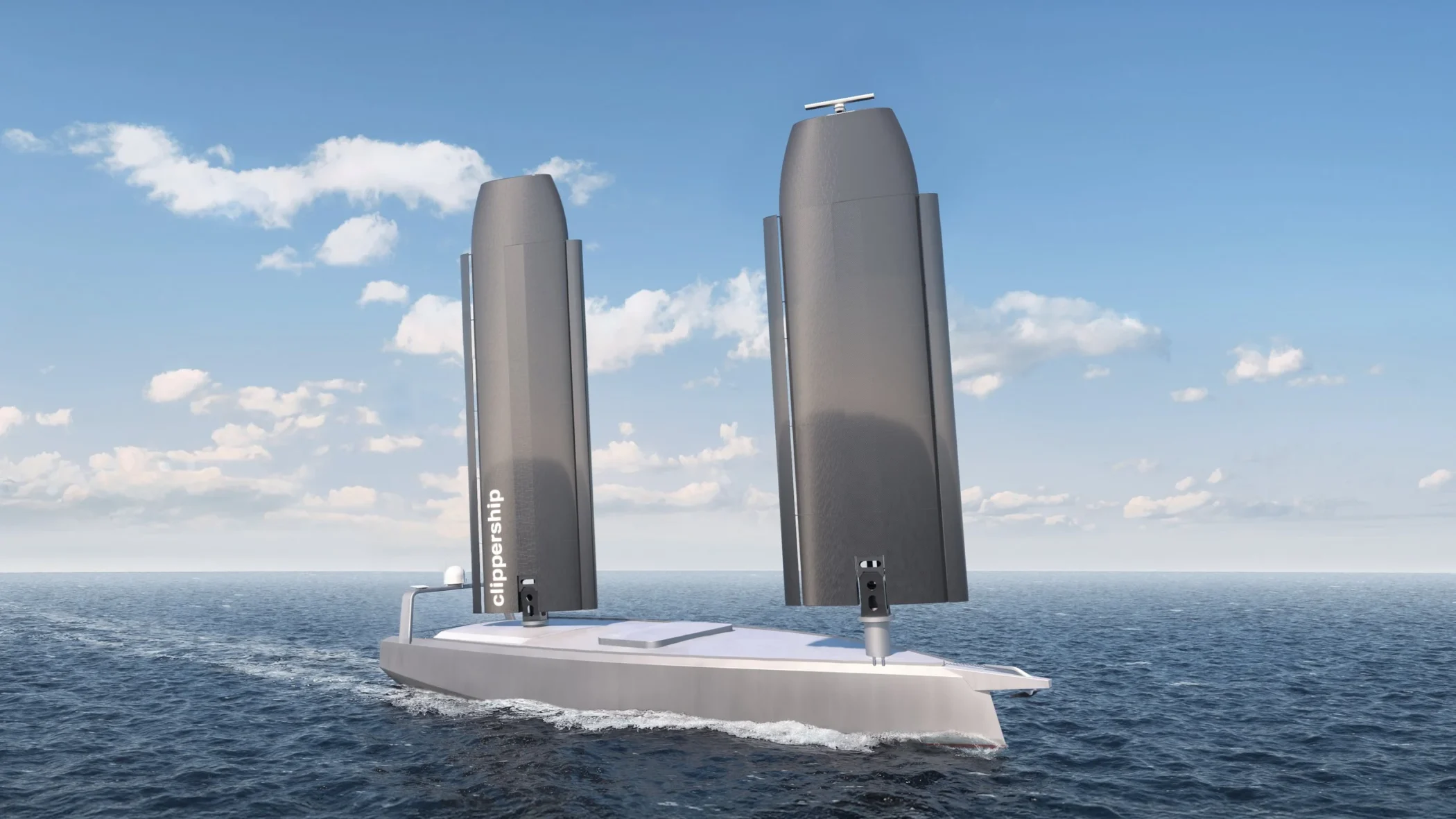
Clippership, a start-up based in Los Angeles, is developing an autonomous sailing cargo ship. The design is by Dykstra Naval Architects, and KM Yachtbuilders in Makkum is building a prototype. The launch is scheduled for the end of this year.
We reported on this earlier, but at that time the artist’s impression still featured a cabin. In the latest rendering, this has disappeared. The vessel is intended to be able to sail with little or no crew and is designed for use on transatlantic routes and connections to the Caribbean and South America. With these so-called pilot routes, Clippership aims to gain experience with emission-free, autonomous freight transport on the high seas.
Propulsion is provided by two foldable, rigid wings which form the primary propulsion system and have been developed for unmanned ocean voyages. The autonomy and propulsion systems have been designed in-house by Clippership.
A flying start
Clippership was founded by three people in Los Angeles, with little more than an idea. Shortly afterwards, they had fitted an old J/24 sailing boat with the first prototype of a wing sail. The company combines insights and expertise gained from decades of collective experience: aerodynamics; engineering, applied physics and systems thinking. The founders have worked for organisations including NASA and Tesla, and are using their technical and operational knowledge to find new ways to achieve more with less
Every design, every trial-and-error phase and every operational test helps them to create ever simpler solutions for using wind rather than fuel to transport cargo across water – which the inventors describe as ‘a deceptively complex problem’.
Smaller is better
Conventional large ships can only call at a limited number of deep-water ports, which entails significant costs for overland transport to get goods from producers to consumers. By utilising wind power whilst simultaneously reducing the number of crew members on board (and eventually eliminating them altogether), Clippership can operate profitably between smaller ports that are closer to the products’ points of origin and destination.
On busy routes for large vessels, capital expenditure can run to nearly 1 billion dollars per trade route. Clippership operates point-to-point routes for small volumes at a fraction of the cost.
Euro pallets instead of containers
The vessel will have a climate-controlled cargo hold with a capacity of up to 75 Euro pallets. (A Euro pallet measures 80 by 120 cm and can carry 1,500 kilos, ed.) Construction will take place in accordance with RINA regulations and the vessel will be classified as a “General Cargo Ship – Powered Sailing Ship”, with an additional WAPS notation. The vessel will fly the Maltese flag.
For the design, Clippership is collaborating with Dykstra Naval Architects, responsible for the naval architecture, and with the American firm Glosten for the structural engineering. Construction is being carried out by KM Yachtbuilders in Makkum, known for its aluminium sailing and expedition vessels.
Sources: Bootmag and Clippership.
Image: Clippership.

Windassist sponsor