
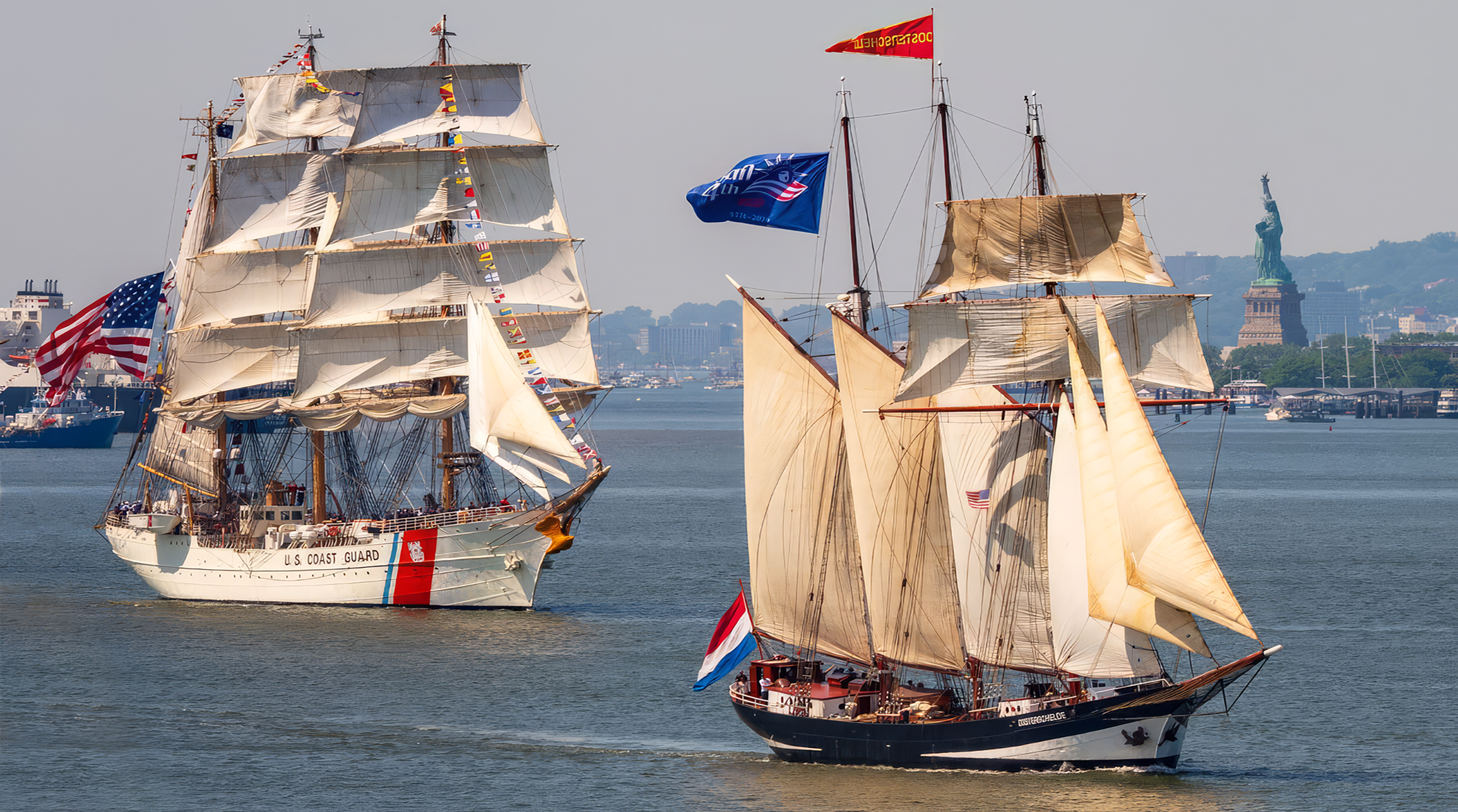
Oosterschelde kicks off 250 years of America parade
Will the Oosterschelde lead the international fleet in New York during America’s 250th anniversary? Duh! Captain Gerben Nab didn’t have to think twice when the organisers asked him. “What an honour.”
And so, on Saturday during Sail4th 250, the three-masted ship was the first to sail under the imposing Verrazzano Bridge, followed by dozens of other large historic sailing ships from all over the world. The American USS Eagle sailed directly behind the Rotterdam three-masted ship, but the Dutch vessel lead the parade.
“It’s a mystery to me why they didn’t just let this American training ship lead the way, with all the bigwigs on board,” says Nab with a laugh over the phone. “But of course I’m absolutely delighted. We set the pace. That’s actually quite nice, too. Being first means you don’t have to keep reacting to what the ships in front of you are doing.”
All sorts of festivities
 The seven-strong crew of the Oosterschelde have been on the move for weeks to mark 250 years of American independence, attending all sorts of festivities. The journey began in Richmond, Virginia, where the Oosterschelde sailed more than 150 kilometres inland up a winding river.
“By American standards, that might not seem like much, but for us it was fantastic. A river like that gets narrower and more winding the further you go. We were moored there with three other tall ships and were really the star of the show.”
Next came Norfolk, one of the largest naval ports in the world. “It’s really intimidating. Nothing but grey warships, aircraft carriers and everything that goes with them. Fortunately, there were also Dutch and other NATO ships there. They regularly carry out joint exercises.”
Cannon fire
Via affluent Greenwich, with multi-million-dollar villas lining the riverbank, the Oosterschelde eventually arrived in Yonkers. This New York suburb has a completely different feel to it. “Many different nationalities live here. There’s also more poverty.”
It is precisely these contrasts that make the journey so special, according to Nab. “In Greenwich, we were welcomed with cannon fire. In Norfolk, it was one big funfair. People were walking around with grilled turkey legs as big as a toddler’s lower leg,” says Nab with a laugh. “And here we’re moored at an old pier and everyone’s warning us: whatever you do, don’t stay too long on the wrong side of the railway tracks.”
The Oosterschelde is a sailing monument dating from 1917 and is internationally recognised for its historical value. Following an extensive restoration in 1992, the ship became an ambassador for Dutch maritime heritage. Since then, the three-masted ship has circumnavigated the globe three times and visited more than seventy countries.
Sailing parade
The highlight of this adventure undoubtedly was the sailing parade. Exactly what this will look like long stayed unclear. The captains only received the final instructions shortly before departure.
“There will be grandstands for the public along the route. Millions of visitors are expected. That’s far more than during the World Port Days in Rotterdam.” This isn’t just down to the independence celebrations; the World Cup is also drawing large numbers of visitors to the city this summer.
Next to the Statue of Liberty
The fleet gathered at Sandy Hook and then sailed together up the Hudson, past Governors Island, the Statue of Liberty and Lower Manhattan. “On one side you can see the Statue of Liberty, on the other the Brooklyn Bridge, and straight ahead Wall Street. It really is a unique backdrop.”
 The captain speaks from experience. When the Oosterschelde previously sailed towards Long Island, the crew were given permission to drop anchor right next to the Statue of Liberty. “That turned out to be the most beautiful anchorage in New York. You’re literally two hundred metres from the Statue of Liberty, and on the other side the Manhattan skyline sparkles. Then you’re on anchor watch and all you can think is: this is absolutely fantastic.”
‘As much sail as possible’
He’s pleased with this ‘dress rehearsal’, as it means he now knows the waters. “That gives me peace of mind. During the parade, it gets incredibly busy, with lots of ships and aeroplanes. So it’s nice when you’re already familiar with the area.”
And during that fleet review, he wants to show the three-masted ship at its best. “So ideally with as much sail as possible. That is tricky, though, with only seven of us on board. If a sudden gust of wind comes up, you’ve got to be able to handle it safely. So we do have to remain realistic.”
After the festivities in New York, the Oosterschelde will remain open to visitors for a few more days. After that, the ship will set sail for Boston and then on to Canada. There, the crew will prepare for the crossing of the Atlantic Ocean to Spain. On 1 October, the Rotterdam-based three-masted ship will return to the Leuvehaven, after nearly ten months at sea.
Ship barred from the parade

A unique incident occurred when an iconic tall ship was removed from the parade by the US Coast Guard, even before the parade had properly begun. The vessel in question is the Clearwater, a ship long used by country singer Pete Seeger as an activist vessel to highlight pollution in the River Hudson. The same ship was once again conveying a climate message. It displayed two messages on its mainsail reading ‘Save the Clean Water Act’ and ‘Indigenous Rights, Racial Justice, Climate Solutions’. This was not appreciated by the authorities. The coastguard officer who approached the Clearwater apologised, saying: “There’s not much I can do about it; this comes from above.”
Sources: Jelle Gunneweg on Rijnmond.nl, Reederij Oosterschelde and Marineinsight.
Image: Reederij Oosterschelde, Clearwater, Marineinsight.

Windassist sponsor