
WASP new builds and retrofits in the pipeline
Damen is building new Combi Freighters with optimised hull and Ventofoils. Norsepower retrofitss increasingly efficiently Flettner rotors, and Anemoi has secured Approval in Principle for a Rotor Sail-ready design of a medium-range tanker.
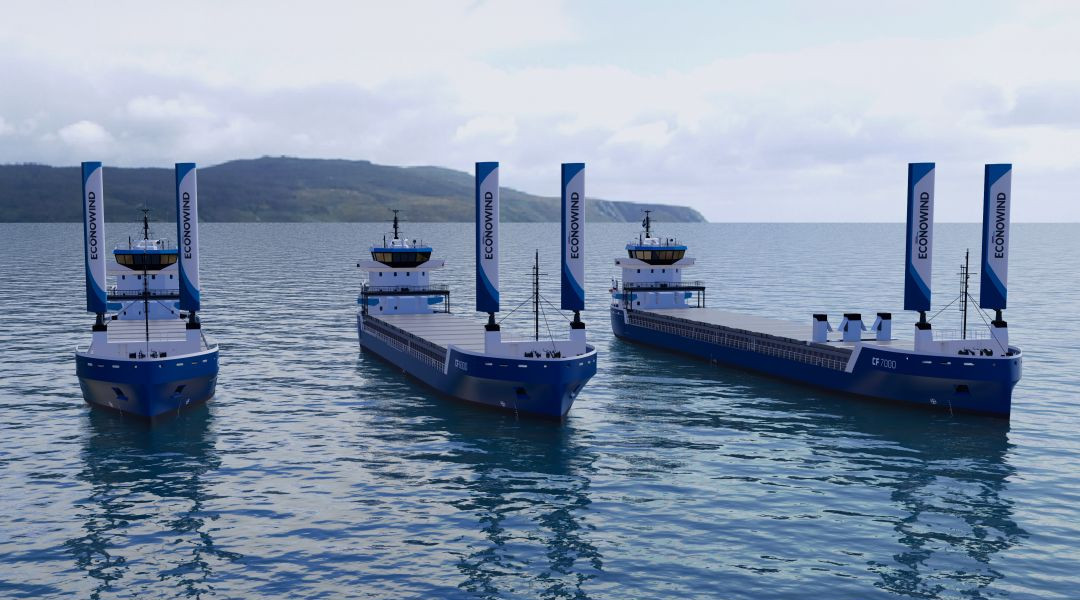
The Damen Shipyards Group is expanding its Combi Freighter (CF) series. The new CF 6000 and CF 7000 vessels, which are based on the CF 5000, feature an extended midship section.Thanks to the extension of their hulls, the CF 6000 and CF 7000 can carry twenty per cent and forty per cent more cargo respectively.
The vessels’ hydrodynamic hull shape ensures low drag in the water and high fuel efficiency. This enables the vessels to offer greater cargo capacity with a comparable installed power output.
The CF series is compatible with B100 biofuel, enabling immediate emission reductions without major technical modifications. The vessels are also equipped to accommodate additional solutions to improve efficiency. These include, amongst other things, a hybrid Power Take-Off (PTO)/Power Take-In (PTI) system for peak load relief and emission-free operation during limited periods, for example when the vessel is in port. There are various configuration options for the batteries, as well as the option to connect to shore power.
Furthermore, the vessels are designed to accommodate the installation of wind-powered VentoFoils for even greater fuel efficiency.
Norsepower
What does it take to install two Norsepower Rotor Sails™ in a single day? Precision engineering, meticulous preparation, close collaboration… and a team ready to perform under challenging conditions.
In the last week of May, Jiangsu Soho Marine Heavy Industry successfully completed the installation of two fixed Norsepower Rotor Sails™, measuring 24 m x 4 m, on board the BRF Froan, Berge Rederi As Future’s new, state-of-the-art general cargo vessel.
“The units have been optimised for snow, ice, sleet and strong winds, which are typical of operations in the North Sea,” said Ingebrigt Andøl, chief engineer at Berge Rederi As. The completion of both sails in a single day was down to contingency planning, technical skill and teamwork; all of which were essential given the challenging weather conditions during the installation, including humidity, heat, occasional rain and strong river winds.
Anemoi
Anemoi Marine Technologies, Hafnia, Guangzhou Shipyard International (GSI) and DNV have obtained Approval in Principle (AiP) for a design of a medium-range tanker with two foldable Rotor Sails, providing tanker owners with a pre-approved basis for evaluating wind-assisted propulsion.
The project focused on one of the more challenging segments for wind propulsion. MR tankers face constraints in terms of deck space, cargo handling and hazardous area requirements, making the integration of energy-saving technologies more complex than for many other ship types.
To address these challenges, the partners developed a design featuring two foldable, EX-classified Rotor Sails measuring 5 m by 35 m. The system complies with the explosion-proof requirements for the decks of product tankers. GSI and Anemoi also developed a lightweight arrangement for the deck mountings, eliminating the need for under-deck reinforcement whilst maintaining access for inspection and maintenance.
DNV assessed the design package, including how the Rotor Sails would be treated in accordance with the IMO requirements for the Energy Efficiency Design Index (EEDI) and the Energy Efficiency Existing Ship Index (EEXI), before issuing the AiP.
Sources: Mariska Buitendijk on SWZ Maritime, LinkedIn and Anel Murga on Vesselperformance.
Image: Damen Shipyards.

Windassist sponsor